B2B Distributor Marketing: How to Win Partner Sign-Ups
B2B distributor marketing differs from advertising a store in one fundamental way: you are not selling a product, you are selling a partnership. Your customer is a contractor, installer, or dealer who needs to sign up in your system and keep ordering for years. In our case study of a window distributor, this logic could be measured directly: after 3 months of working together, 30% of all sign-ups in the dealer system came from Facebook campaigns. Here is the whole structure.
The numbers come from our B2B window distributor case study.
Why is distributor marketing a different game?
Three differences shape everything. Relationship value: a partner who signs up and starts ordering generates revenue for years, so the cost of acquiring one has to be calculated completely differently from the cost of a single sale. A narrow audience: you are not targeting consumers but companies in a specific trade, and there is a finite number of them in any market. A business decision: a contractor switches suppliers when they see better terms, availability, and support, not on impulse.
The campaign structure follows from that: a message about partnership instead of a message about the product, and sign-ups measured instead of clicks.
How was the channel split in the case study?
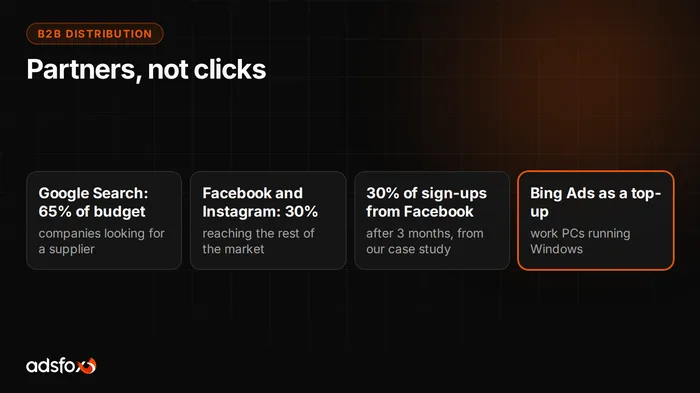
The distributor’s budget was split like this: Google Search Ads 65%, Google Display 5%, Facebook and Instagram 30%, and at a later stage Bing Ads campaigns were added. Each channel had its own job:
- Google Search captured companies actively looking for a supplier: searches about wholesale, dealer programs, and specific products. This is the shortest path to a partner who already wants to change where they buy.
- Facebook and Instagram reached contractors who were not actively searching but fit the profile. And here is the result that surprises B2B skeptics: after 3 months, 30% of all sign-ups in the system came from Facebook. Business owners in the trades are people with phones too.
- Bing Ads came in as a supplement: partners work on company PCs running Windows, where Bing is the default, and ad competition is lower. We covered when this channel makes sense in our post on who uses the Bing search engine.
The takeaway you can reuse: in B2B, search is the core, but social can deliver sign-ups if the message speaks to the customer’s business rather than to the product in general.
What to measure: sign-ups and their quality
The metric in this project was unambiguous: sign-ups in the dealer system, broken down by source. That made it possible to calculate Facebook’s share (30%) and manage the budget on data. One step further, which we recommend to every distributor: measure the activity of the partners who signed up, because a sign-up with no orders is a vanity metric. We described connecting campaigns to a dealer system or CRM in our post on CRM and ad campaigns.
We collected cost benchmarks from other industries in our benchmark of 20 campaigns in 11 industries; campaign management at adsfox starts from $490 a month per channel.
What messaging works on partners?
A contractor does not need poetry about windows; they need answers to business questions. What works: partnership terms, availability and lead times, support (shipping, warranty claims, marketing materials), and the supplier’s stability. Proof works well too: number of partners, years in business, specific projects. What works poorly is a catalog-style product presentation with no partnership context, because at this level a partner compares suppliers, not windows.
A separate note on Facebook creatives in B2B: the message has to signal “this is for businesses” in the first second, or the algorithm will collect consumers. Phrases like “for contractors,” “dealer program,” and “wholesale” are not decoration. They are a filter.
A warning: own your assets
As in every project, a reminder: about 40% of the clients who come to us from other agencies have trouble getting their assets back, and in critical cases it ends with having to change the entire domain. Your dealer system, ad account, and pixel are your business infrastructure. They should belong to you.
Where to start in your own business
- Define a partner sign-up as a measured event, broken down by source.
- Build the core in Google Ads around partnership and wholesale searches.
- Add Facebook campaigns with an openly business-focused message; for us they delivered 30% of sign-ups.
- Once the core is stable, test Bing Ads as a cheaper supplement.
Want to plan a setup like this for your distribution business? Book a free consultation: we will go through your dealer system, margins, and market, and map out channels for sign-ups, not clicks.