Beauty Salon Marketing: What Works and Cost per Lead
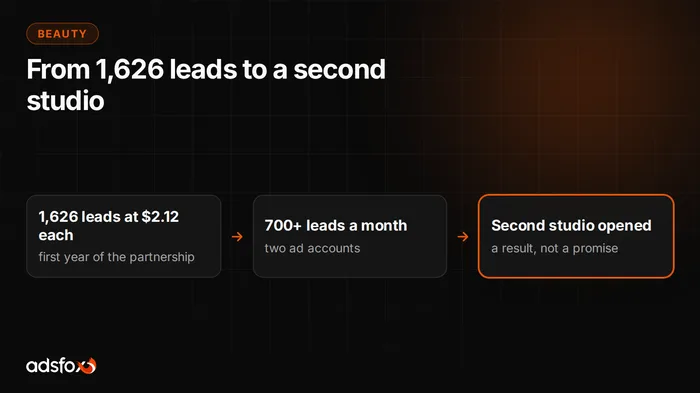
In beauty salon marketing, the best results come from lead campaigns on Facebook and Instagram with a specific treatment promotion, a contact form, and fast handling of inquiries in a CRM. Local targeting decides lead quality, and Instagram acts as the storefront a client checks before booking. At adsfox we have numbers for this, not opinions: in one of our projects, a beauty salon went from 1,626 leads in six months to more than 700 leads a month and opened a second studio. Below we show how it works in practice and what it costs.
What works in beauty salon marketing
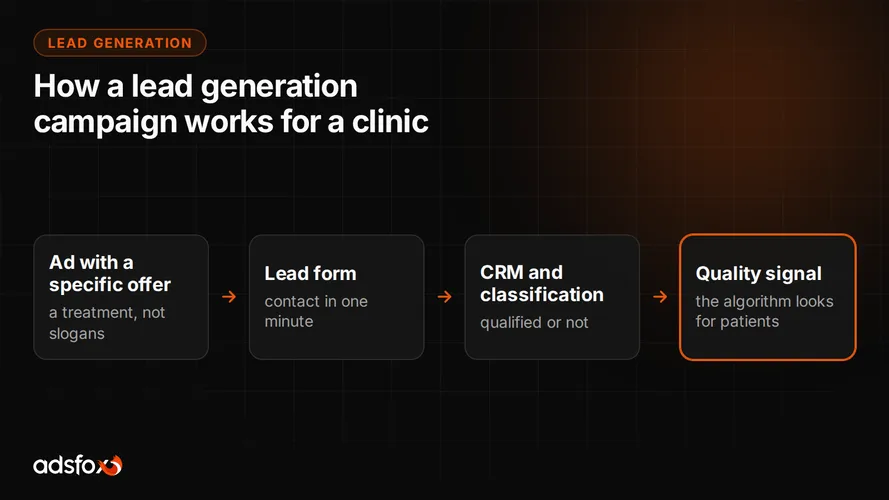
The winning combination has three elements: a specific offer, a campaign optimized for contacts, and a process for handling inquiries. In our project for a beauty salon, one of our European campaigns, the most effective ads were broad lead form campaigns in Meta Ads and promotional messages: a specific treatment, package or new service at an attractive price. Generic ads about self-care gave a weaker signal than a clear reason to book an appointment.
Knowing what to avoid matters just as much. Traffic campaigns can deliver clicks that never turn into bookings. Messenger and phone as the main call to action make it hard to control inquiry volume at scale. That is why in salon campaigns we focus on a measurable contact: the client leaves her details in a form, and the salon handles the inquiry in a defined process.
This pattern repeats across the service businesses we have worked with since 2018: more than 350 clients in over 20 industries so far.
How to keep a steady flow of clients
A steady flow of clients comes from a predictable source of leads, not from one-off promotional pushes. In practice this means always-on lead campaigns, several messages running in parallel, and regular tests of new creatives. In the beauty project described here, the structure included an automated Advantage+ campaign, broad campaigns with no narrowing, narrower interest-based audiences, and remarketing.
The second element is handling. With several hundred forms a month, the salon has to know who calls back, when a contact was handled, and which campaigns produce the best inquiries. That is why we connect campaigns to a CRM and optimize for the new lead event, not for clicks. We describe the technical side in our post on connecting a CRM with ad campaigns, and for service businesses we show our lead generation optimization system.
Only this combination lets you plan the schedule: you know how many inquiries come in each week and how many of them end in an appointment.
How much does a lead and a client cost in the beauty industry
In our beauty salon case study, cost per lead was $2.12 in the first half of 2025 and, after a strong push in scale, $3.48 on one of the accounts in the first half of 2026. A typical starting budget in this industry is about $500 a month. Compared with other industries these are good numbers: in our benchmark of 20 campaigns across 11 industries, cost per lead falls between $2 and $11. Detailed ranges and pricing factors are in a separate post: how much a lead costs in the beauty industry.
Cost per client shows up in the second project, an aesthetic medicine and laser hair removal salon. There, about $1,300 in ad spend in January directly generated about $11,044 in revenue, and after 4 months of working together the salon was serving 60% more clients on a budget of about $1,250 a month. Details are in the beauty salon advertising case study.
Campaign management by adsfox starts from $490/month per channel; the full campaign management pricing is public.
How to handle treatment seasonality
Seasonality in beauty is predictable, and that is good news. Laser hair removal sells before summer, exfoliating and regenerating treatments after summer, and gift packages before the holidays. Instead of advertising the whole price list at once, run a promotion calendar and change the message before demand for a given treatment drops.
In practice we do this at the campaign level. In the aesthetic medicine project, we agreed with the owner on an ongoing basis which treatments to push harder and which to ease off, to keep the schedule optimally booked. This is an important nuance: the goal is not the maximum number of inquiries about one treatment, but an even fill of the whole team’s calendar.
The second way to handle seasonal dips is packages and treatment series. A client who buys a series comes back for months regardless of the season, and her acquisition cost spreads across many visits. A package promotion also works well as ad creative because it shows a specific value at a specific price.
Why location decides lead quality
A beauty salon sells within a radius of a few miles. A lead from outside that area may be cheap, but it will not turn into a visit, so it actually lowers campaign performance. In the project scaled to two studios, this was the biggest challenge: contacts from outside the studio’s service area had to be limited through campaign settings and inquiry verification in the CRM.
That is why you do not judge a local campaign by cost per form alone. What counts is how many contacts come from the right area and how many of them end in a booking. You only see that data when leads go into a system, not into an email inbox.
Location also supports visibility beyond paid campaigns. A complete Google Business Profile with current photos and reviews means that a person who saw the ad finds confirmation of quality before leaving her details. In one of our projects, optimizing the business profile was part of the preparation before the campaign even launched.
Is Instagram enough as the salon’s storefront
Instagram is today’s first storefront for a salon: the client looks at treatment results, the interior and reviews before deciding to reach out. That is why the profile has to be alive: before-and-after photos, faces of the team, current promotions. We describe this part of the work on our social media marketing agency page.
The profile alone, however, is not enough to measure sales. In one of our projects, the owner started without her own website, with a business profile on a business.site domain and bookings through Booksy. The problem is that Booksy’s policy does not allow sending bookings to ad platforms, so you cannot see which campaign brought the client. The first step was therefore her own website with the ability to buy a treatment and conversion tracking.
The takeaway: Instagram attracts and builds credibility, but the contact should end in a place you can measure: a form, a purchase on the website, or an event in the CRM.
How a beauty salon reached 700+ leads a month and a second studio
We started working together in mid-2024. The salon offers body and skin treatments, and we ran campaigns 100% in Meta Ads using the lead form model. In the first half of 2025, one ad account spent about $3,443 and acquired 1,626 leads at $2.12 each.
The campaigns were working, so the goal was not repair but scale. In the first half of 2026, activity ran on two accounts with a combined budget of about $13,900. One of the accounts acquired 1,995 leads at $3.48, and the two accounts together generated more than 700 leads a month. The owner opened a second studio and hired a new team. Cost per lead rose during scaling, and that was a conscious decision: what mattered was the volume of local inquiries the salon was able to handle.
Full data, dashboard screenshots and campaign structure are in the Meta Ads case study for a beauty salon. Projects like this are run by our Facebook Ads team; we are a Meta Business Partner at the Badged level.
Where to start with marketing for your salon
Start with tracking, not budget. You need a website or form where conversions are visible, correctly configured events, and one place where contacts land. Then one specific promotion to start, a lead form campaign in Meta Ads, and a process for handling inquiries: who calls back and how fast. After the first weeks the data will show your cost per lead; compare it with the numbers in this post instead of guessing.
adsfox has run campaigns since 2018, so far for more than 350 clients in over 20 industries. We are a Google Partner and a Meta Business Partner at the Badged level, and beauty is one of the industries where we publish case studies with specific numbers.
If you want to see what such a system would look like in your salon, check out our Facebook Ads agency and book a free consultation: we will analyze your tracking, campaigns and cost per lead.