Brick-and-Mortar Store Marketing: Ads Without E-commerce
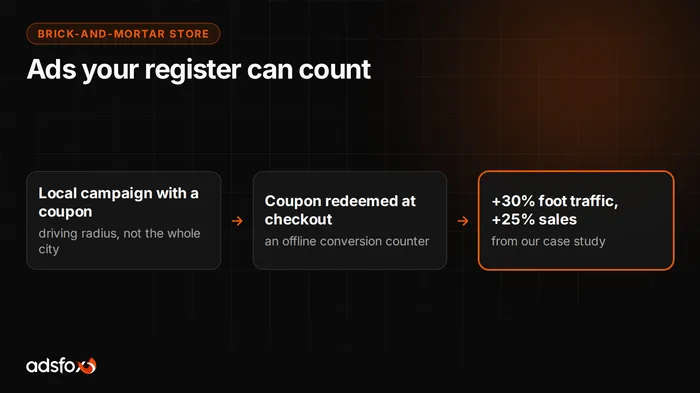
Brick-and-mortar store marketing usually gets stuck on one question: if sales happen at the register, how do you know the advertising works? Our grocery store case study answers it practically: with a mechanism that links online to the register. A store with no e-commerce at all got 30% more visits and a 25% increase in sales from Facebook campaigns, and the proof was discount coupons whose redemptions could be counted. Here is the whole mechanism.
The numbers come from our local grocery store advertising case study.
The measurement problem: online ends before the register
An online store has it easy: a purchase is an event in the browser. A brick-and-mortar store has to build a bridge between the ad and the register, or “effectiveness” stays an impression. There are three bridges, and they can be combined:
- Coupons and codes from the campaign, redeemed at purchase; the simplest offline conversion counter.
- Period comparison: traffic and sales before the campaign and during it, controlling for seasonality.
- Indirect signals: more direction requests, phone calls, local followers.
In our project, the first two worked together: the data showed that store visits rose 30% compared with the period before the campaign, and coupon redemptions directly contributed to a 25% increase in sales.
Why is a coupon a brick-and-mortar store’s best friend?
A coupon does three things at once. It gives the customer a reason to come now, not someday. It gives the store a counter: every redemption is a countable conversion from the campaign. And it gives the campaign feedback: you know which creative and offer bring people to the register, so the budget follows the proof.
The conditions for it to work: the offer has to be specific and honestly attractive, redemption simple (showing your phone is enough), and staff briefed. A coupon the cashier does not know about kills a campaign faster than no coupon at all.
Location: the most important campaign setting
A brick-and-mortar customer lives or works within driving distance. Everything outside that radius is wasted budget, even if the clicks are the cheapest in the world. That is why campaigns for this kind of store are built from geography up: reach around the location, messaging rooted locally (a neighborhood name works better than a city name), ad schedules matched to shopping rhythms.
In Meta campaigns, local reach is cheap and precise, and the offer format naturally carries coupons. For stores in categories people search for (“grocery store [neighborhood],” specialty categories), it is worth adding Google Ads campaigns and a well-kept Google Business Profile with reviews, because the map is often a customer’s first contact with the store.
What to communicate to bring people to the register
This week’s specifics beat brand image: the offer, a new product, hours, parking. Rhythm matters: constant presence with a rotating offer builds the habit of checking “what do they have this week.” Add local proof: the interior, the team, regional products; a brick-and-mortar store also sells neighborhood trust, which big-box chains cannot fake.
What to avoid: generalities about quality and tradition with no offer, and “whole city” reach that flatters vanity and drains the budget.
What does it cost and how to calculate it
The brick-and-mortar math: ad budget (local, so reasonable) plus campaign management, at adsfox from $490 a month per channel. The metric is cost per redeemed coupon and sales growth against the baseline period; for us, those metrics showed +30% visits and +25% sales. We collected benchmarks from other industries in our benchmark of 20 campaigns in 11 industries.
Watch out for the comparison trap: a brick-and-mortar store should not measure itself with e-commerce metrics. There is no ROAS from a cart; there is the register, coupons, and the sales trend. Those are the right numbers for this game.
Where to start in your store
- Design a coupon mechanism that is simple for the customer and for the register.
- Set the campaign up locally: driving radius, not the whole city.
- Establish a baseline period so you have something to compare visits and sales against.
- Rotate the offer on a steady rhythm and move budget toward coupon redemptions.
Want to bring this mechanism to your store? Book a free consultation: we will go through your location, margins, and shopping rhythm, and design a campaign your register can count, not just our report.