Marketing for Buyback Businesses: Leads at $4.25 Each
Marketing for a buyback business works in the reverse world of advertising: you are not persuading anyone to buy, you are looking for people who want to sell you something. That changes the message, the metrics, and the campaign structure. In our printer cartridge buyback case study, this mechanism came down to a $4.25 cost per conversion after optimization, with the budget growing from $500 to $1,000 a month, and a later period showed 115 conversions at $4.37 each. This post breaks down a model that transfers to any buyback business: cash for cars, gold buyers, electronics trade-in, equipment buyback.
The numbers come from our printer cartridge buyback advertising case study.
How does advertising a buyback business differ from advertising a store?
Direction of the transaction. The customer is not spending money but receiving it, so the decision barrier is different: not “can I afford it” but “is it worth it and is it safe.” The message works on trust and convenience: a fair quote, fast payment, a simple process, proof of reliability.
Definition of conversion. The conversion is an inquiry: a quote form, a phone call, a message. The whole system is measured by the cost and quality of inquiries, because between the inquiry and the transaction there is still a quote and logistics.
Competition for search terms. People who want to sell search actively (“sell [item] [city],” “we buy [item] near me”), so search is the natural core, and social adds volume and remarketing.
The road to $4.25 per conversion: what worked
The project followed the classic path of discipline, not tricks:
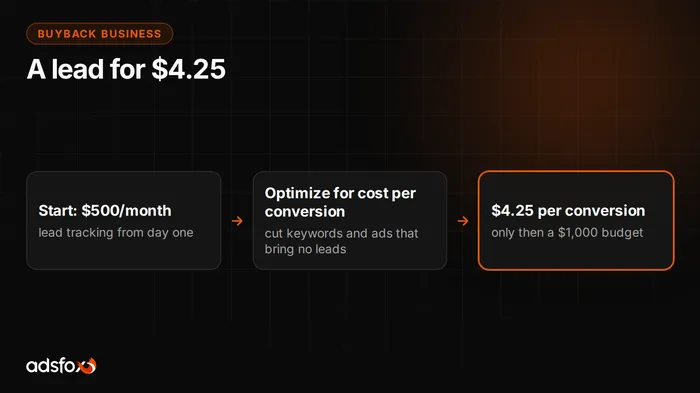
- Start at $500 a month with correct inquiry tracking; the campaigns collected data.
- Optimization for cost per conversion: cutting keywords and creatives that brought clicks without inquiries, strengthening those that delivered.
- Result: cost per conversion down to $4.25, confirmed over a longer window (115 conversions at $4.37 in the period shown).
- Only then scale: budget up to $1,000 a month, because what was growing was a mechanism that already worked.
This order transfers to any buyback business: data before scale, cost per conversion as the north star.
What does a buyback customer cost: how to calculate it
- Cost per inquiry per campaign and keyword. For us, $4.25; your threshold depends on your average margin per transaction, so calculate it before you judge any result.
- Quality of inquiries, not just quantity. Inquiries with no contact details or unrealistic expectations are cost without revenue; it is worth tagging them in a simple CRM and feeding that knowledge back into the campaigns, which we describe in our post on CRM and ad campaigns.
- Benchmarks: our benchmark of 20 campaigns in 11 industries shows the spread of costs between industries; $4.25 per buyback conversion sits in the low, healthy range.
Campaign management at adsfox starts from $490 a month per channel.
What messaging convinces sellers?
A seller is afraid of two things: a lowball quote and complications. Messaging that works disarms both fears with specifics: how the quote is calculated, how long payment takes, who covers shipping or pickup, what happens step by step. Proof of reliability (years in business, number of transactions, reviews) does more here than any slogan.
In creatives, avoid a bidding war on “highest prices paid”: it is a promise everyone makes and nobody verifies. The process wins: simple, fast, predictable.
When and how to scale a buyback business
Our case study gives the pattern: only bringing the cost per conversion down to $4.25 justified expanding further and testing more markets and ad channels, including TikTok, LinkedIn, and international markets. Scale without proof multiplies losses; scale after proof multiplies profit.
Extensions to test, in this order: more keywords and locations in Google Ads, volume and remarketing in Meta Ads, and for a younger group of sellers, a TikTok test.
Where to start in your business
- Define an inquiry as a measured event and calculate your break-even threshold.
- Start at $500 to $750 a month in the intent channel.
- Optimize for cost per inquiry and its quality, not for clicks.
- Scale budget and channels only after the cost is stable, as in our case at $4.25.
Run a buyback business and want to model it out? Book a free consultation: we will go through your margin per transaction and map out campaigns for inquiries that actually end in a pickup.