Campaign Objective Is a Business Decision, Not a Setting
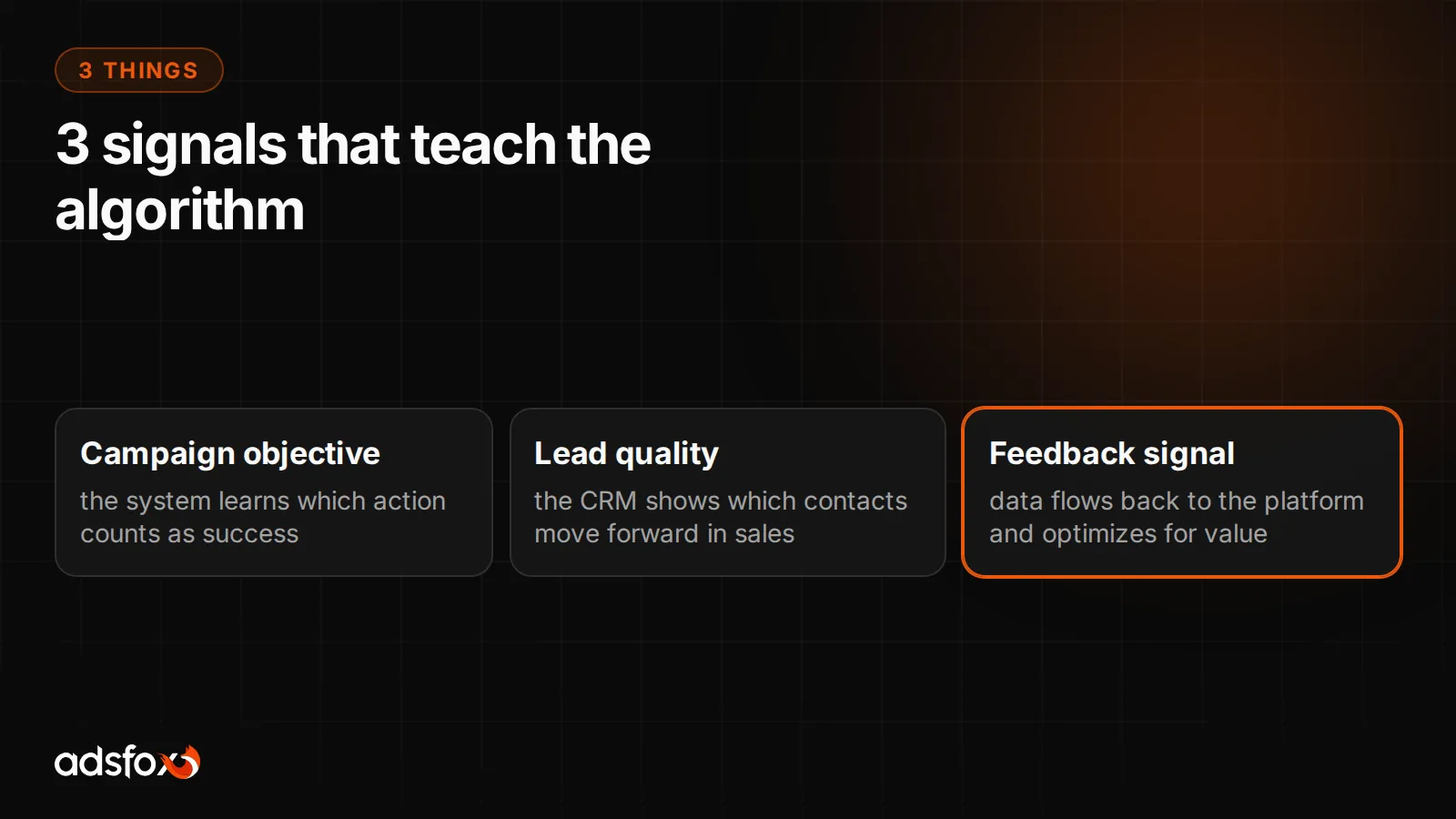
The campaign objective is one of the first settings you pick in the ad dashboard. For the ad algorithm, however, it is something far more important: the signal that tells it what to look for. A poorly chosen objective makes a campaign look good in the report while delivering no real business results.
In this post we explain why the campaign objective should follow from the business objective, how the algorithm interprets it, and how to avoid the most common trap: optimizing for the form instead of for value.
What a campaign objective is and why it is a business decision
A campaign objective is the defined action the ad is supposed to drive on the user’s side. In practice, it can be an ad click, a page view, a form submission, an add to cart or a purchase.
For a service business or an online store, however, the campaign objective should be tied to a real business result. The point is not for the user to take just any action, but to take the action that leads to profit. That is why choosing the campaign objective is a business decision, not just a technical setting.
When the objective is a poor match, the ad algorithm learns the wrong pattern. It can then deliver plenty of activity with low lead quality. The report shows clicks and forms, but sales does not grow.
How the ad algorithm learns from the signal
The ad algorithm does not know on its own who a valuable customer is. It gets a set of data: who clicked, who filled out the form, who bought, who came back. Based on that, it looks for similar people in its user base.
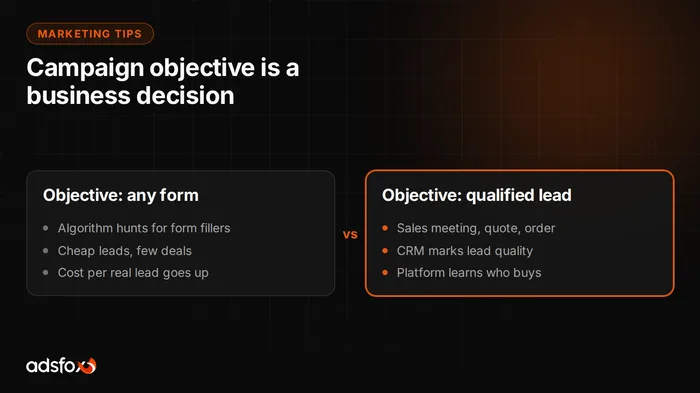
If you set “any form submission” as the campaign objective, the algorithm starts treating that as success. It will look for people who readily leave their contact details, even if they have no intention of buying. The result? A low cost per lead in the dashboard, but a high cost per lead who is actually interested in the offer.
Based on attribution reports and lead analyses, campaigns optimized only for the number of forms often generate contacts with a much lower conversion to sales than campaigns that receive lead value information as their objective (source: adsfox’s own observations from B2B and service campaigns).
The most common mistake: optimizing for the form, not for the business
Many companies treat the form as the main campaign objective. That is understandable, because a form is easy to count. The problem starts when the form is no longer connected to lead quality.
A scenario we see regularly:
- the campaign generates 50 forms a month,
- the sales team marks 5 of them as valuable,
- the algorithm never sees that information and keeps looking for people similar to the other 45,
- cost per lead stays low, but the cost per valuable lead goes up.
As long as the ad platform gets no feedback about lead quality, it optimizes the campaign for the easiest forms, not for customers who buy.
How to set the campaign objective so the algorithm looks for valuable customers
For a campaign to work in the business’s favor, the objective should sit as close to real value as possible. A few examples:
- instead of “form submission”: “sales meeting booked”,
- instead of “price list download”: “quote request with company details”,
- instead of “click on the phone number”: “call lasting longer than 60 seconds”,
- in e-commerce: instead of “add to cart”: “order placed”.
The closer the objective is to the moment of the buying decision, the better the algorithm understands who to look for. Of course, you cannot always set the objective directly in the dashboard. Then it is worth using additional signals: CRM data, lead tags, order values or the Conversions API.
At adsfox we help companies build a data flow in which the ad algorithm receives information not only that someone filled out a form, but also whether that lead was valuable. If you want to see what this looks like in your case, request a free marketing audit.
Connecting the campaign objective with the CRM and sales
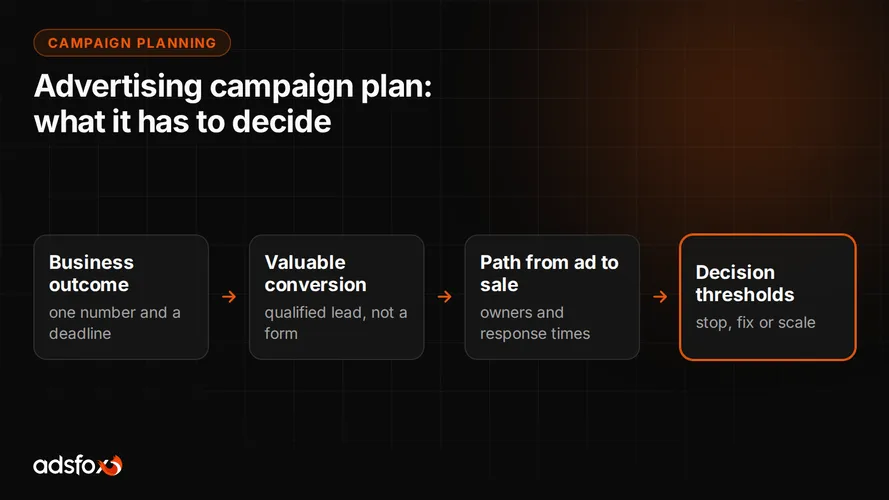
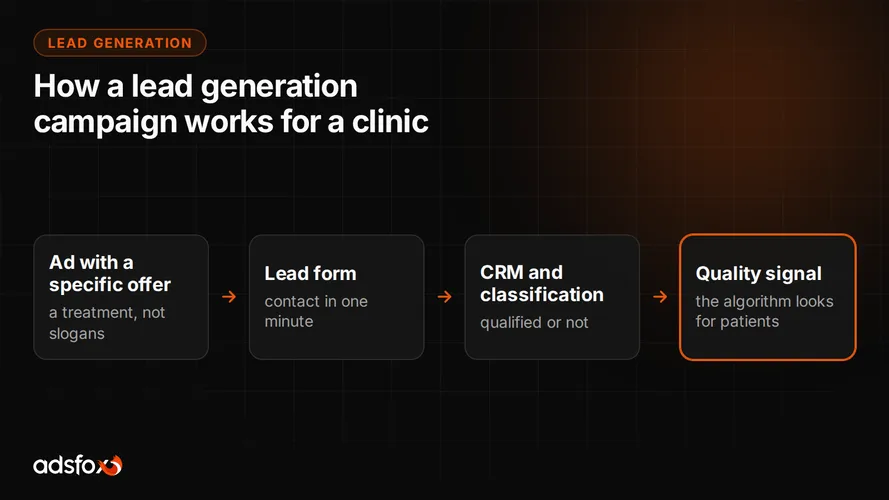
A campaign objective works best when it is part of a bigger system. The campaign attracts traffic, the website or form collects leads, and the CRM shows which leads actually reach sales and turn into customers.
That information should go back to the ad platform. You can do this, for example, through:
- marking lead status in the CRM,
- sending data through the Meta Conversions API or Google’s Measurement Protocol,
- creating custom conversions based on lead value,
- segmenting audiences by quality, not just activity.
This way the ad algorithm starts optimizing the campaign for leads that have a chance to turn into sales. That is what we call optimizing lead generation campaigns for quality, not quantity.
Summary
A campaign objective is not just a technical setting. It is a business decision that teaches the ad algorithm what to look for. If the objective is any form, the campaign will look for forms. If the objective is lead value and the path to a sale, the campaign will start looking for customers.
Key steps:
- pick the objective closest to the buying decision,
- mark lead quality in the CRM,
- send that information back to the ad platform,
- optimize the campaign for value, not just activity.
At adsfox, as a Meta Business Partner and Google Partner, we help companies set up campaign objectives and measurement so that ads work toward a real business result. Book a free consultation and we will review your campaigns and show you whether the campaign objective matches the business objective.