Clothing Store Marketing: From $55 to $15,000 a Month
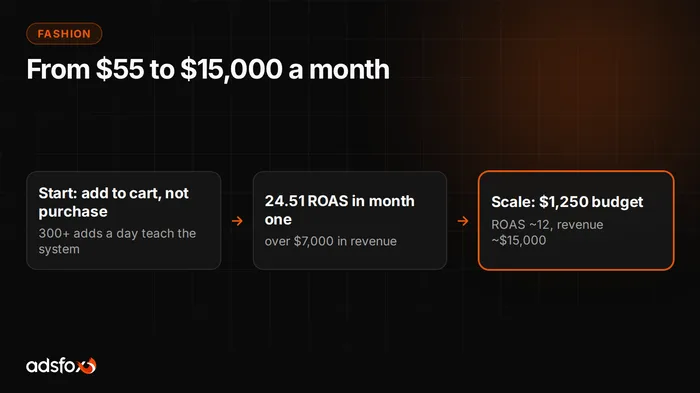
Clothing store marketing is, in practice, teaching the ad system who to show your products to. In our case study that lesson looked like this: a start with sales of $55 a month, a $300 budget optimized for add to carts, over 300 adds a day as fuel for the algorithm, and a result of over $7,000 in revenue at a 24.51 ROAS in the very first month. After raising the budget to $1,250, sales settled at about $15,000 a month. This post takes those mechanics apart.
All the numbers come from our clothing store advertising case study, one of our European campaigns.
Why fashion sells well from ads
Clothing has three traits that favor campaigns. The product is visual: a good photo sells on its own, with no explanation. The decision is fast and emotional, so sometimes only minutes pass between seeing the ad and buying. And there is repeat business: a customer who bought once comes back for the next collections, so remarketing and the customer base work for years.
The same traits have a flip side: competition is enormous and creatives wear out fast. The winner is not whoever has the prettiest photos, but whoever’s ad system knows best who to show them to. And that is where the real work begins.
The mechanics of the case study: why add to cart before purchase?
The most important decision in this project was: with a budget of $300 a month, we optimize the campaigns for add to carts, not for purchases right away. The reason is purely mathematical. Meta’s system learns from events, and on a small budget there are too few purchases to learn anything from. There are many times more add to carts: in our case, over 300 a day.
On that data the algorithm learned the profile of a person who actually goes into checkout, and only then did sales take off: over $7,000 in revenue and a 24.51 ROAS in the first month. From the second month the budget rose to $1,250. ROAS then dropped from 24.51 to about 12, which is the normal physics of scaling, and at that level the store generates stable revenue of about $15,000 a month, meeting the owner’s business targets.
The lesson to remember: a drop in ROAS when the budget grows is not a failure, it is the price of scale. The question is whether the whole calculation still adds up.
How much does a clothing store customer cost: how to calculate it
In e-commerce everything can be counted, provided you track events: add to cart, checkout started, purchase with a value. Three rules from practice:
- ROAS on purchase value, per campaign. You see which ad set sells and which only collects clicks. Reference points from different industries are in our benchmark of 20 campaigns across 11 industries.
- Judge the phase, not the day. The learning phase looks weak by definition; judge after the system has received data.
- Count returns and margin. ROAS calculated on gross revenue can be misleading in fashion, where returns are part of the model.
On top of the budget comes campaign management: at adsfox from $490/month per channel.
What else worked for the result
Tracking from day one. Without correct events in the store, the whole add-to-cart strategy does not exist. At larger scale you add server-side tracking so browser blocking does not cut out the data the system learns from.
Product creatives in rotation. Fashion wears out creatives faster than other industries: what sold last month has gone stale this month. A steady supply of new variants is a line item in the budget, not an option.
Remarketing as the closer. People with a cart but no purchase are the cheapest sale in the whole system; a campaign that ignores them leaves money on the table.
Where to start in your store
- Set up events: add to cart, checkout, purchase with a value.
- Start with a campaign for add to carts on a small budget; in our case it was $300 a month.
- Let the system collect data before you judge the result.
- Scale the budget only after the first returns, and accept a lower ROAS as the price of scale.
We have run campaigns like this as part of our Facebook and Instagram advertising since 2018. If you want to walk this path without learning on your own budget, book a free consultation: we will run the numbers for your store on your margins.