CRM and Ad Campaigns: How to Stop Losing Leads
CRM and ad campaigns should work as one system. If marketing generates leads but the CRM does not show their quality, a company can scale campaigns that look good in the ad dashboard but do not actually make money. The problem is not the number of leads. The problem is not knowing which campaigns generate qualified inquiries, customers and revenue.
A CRM is the system that organizes information about leads, customers and the sales process. Ad campaigns are the source of traffic and inquiries. Only when these two areas are connected can you judge whether the marketing budget is really working for the growth of the business.
Why the CRM and ad campaigns have to work together
In many companies, marketing and sales work side by side. The agency or the marketing team reports the number of leads, cost per click and cost per form. Sales works in the CRM, talks to customers and knows which inquiries were worth anything.
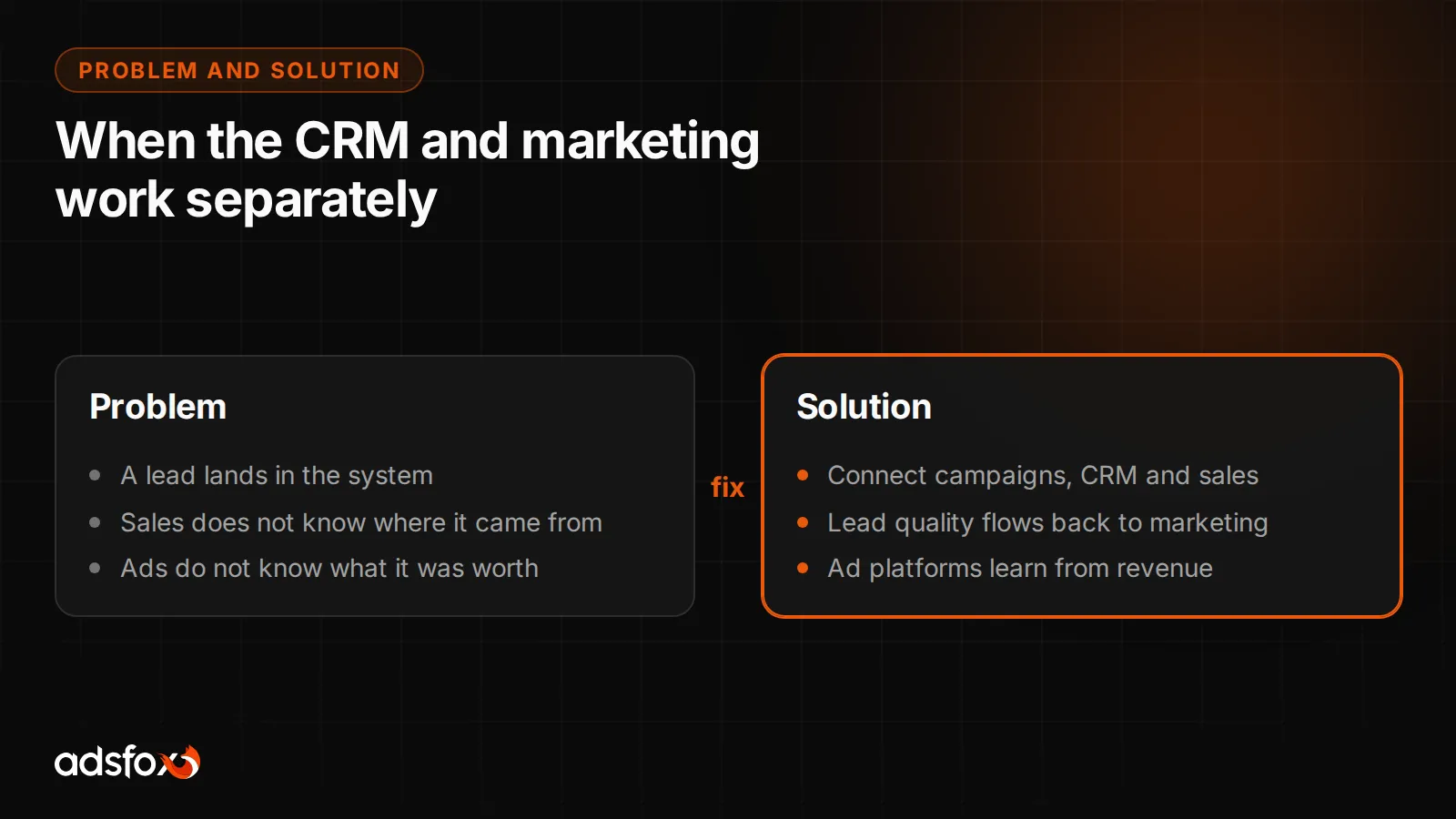
The problem starts when these two worlds are not connected.
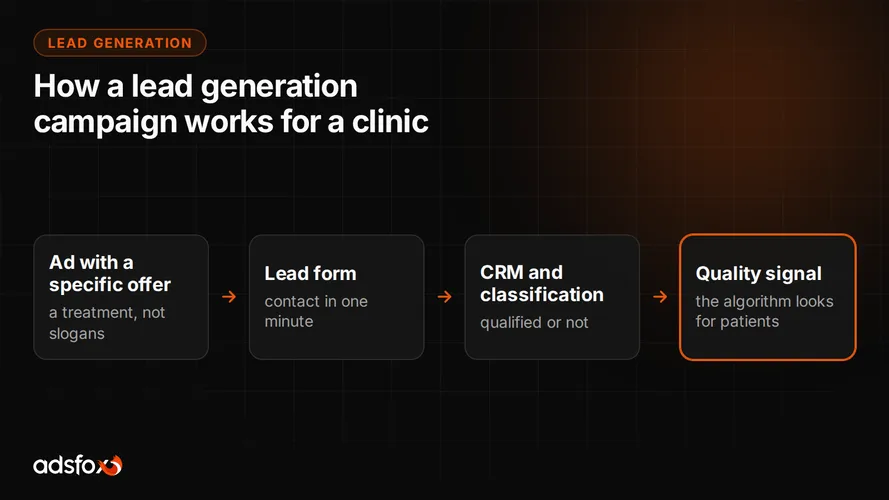
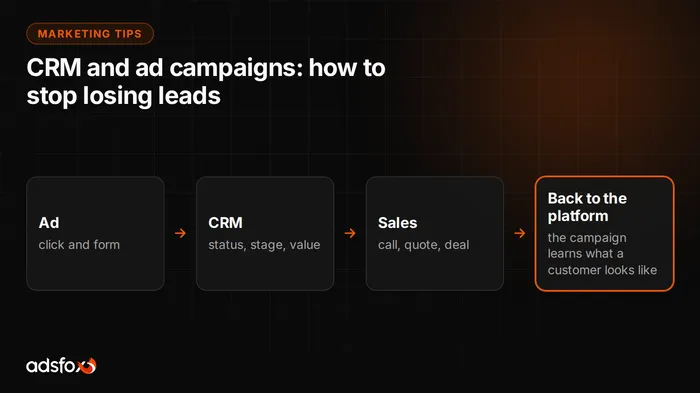
The ad platform sees a conversion but not the whole story. It does not know whether the lead picked up the phone. It does not know whether the lead was qualified. It does not know whether a quote was sent. It does not know whether the lead became a customer.
As a result, the campaign may optimize for a simple signal: a form submission. That is not enough if the company wants to win customers, not just collect contacts in a spreadsheet.
What does a red flag look like in this process?
A red flag appears when the company cannot answer simple questions:
- which campaign generated a qualified lead,
- whether the lead picked up the phone,
- whether the lead moved forward in the sales process,
- whether a quote was sent,
- whether the lead became a customer,
- what the acquired leads were worth.
If the answers are scattered across the ad dashboard, the CRM, a spreadsheet and conversations with sales reps, marketing decisions start to rest on an incomplete picture.
The ad dashboard may look fine. Cost per lead is low, there are plenty of forms, the chart goes up. But sales may see something different: weak inquiries, no responses, poorly matched prospects and a lot of wasted time.
This is exactly the moment when marketing starts looking good in a report but working poorly for the business.
Why the number of leads is not enough
The number of leads only says that someone left their contact details. It does not say whether that contact had any sales potential.
Two leads can look identical in the ad system and have completely different value. One may be ready to talk and a good fit for the offer. The other may not pick up the phone, may have no budget, or may be looking for something completely different.
If the ad platform sees both as the same conversion, the algorithm has no reason to tell a valuable contact from a random inquiry. It may find more similar leads, but not necessarily better customers.
That is why, in lead generation campaigns, the key question is not only cost per lead but also lead quality and what happens next in the CRM.
Which CRM data should flow back to campaigns?
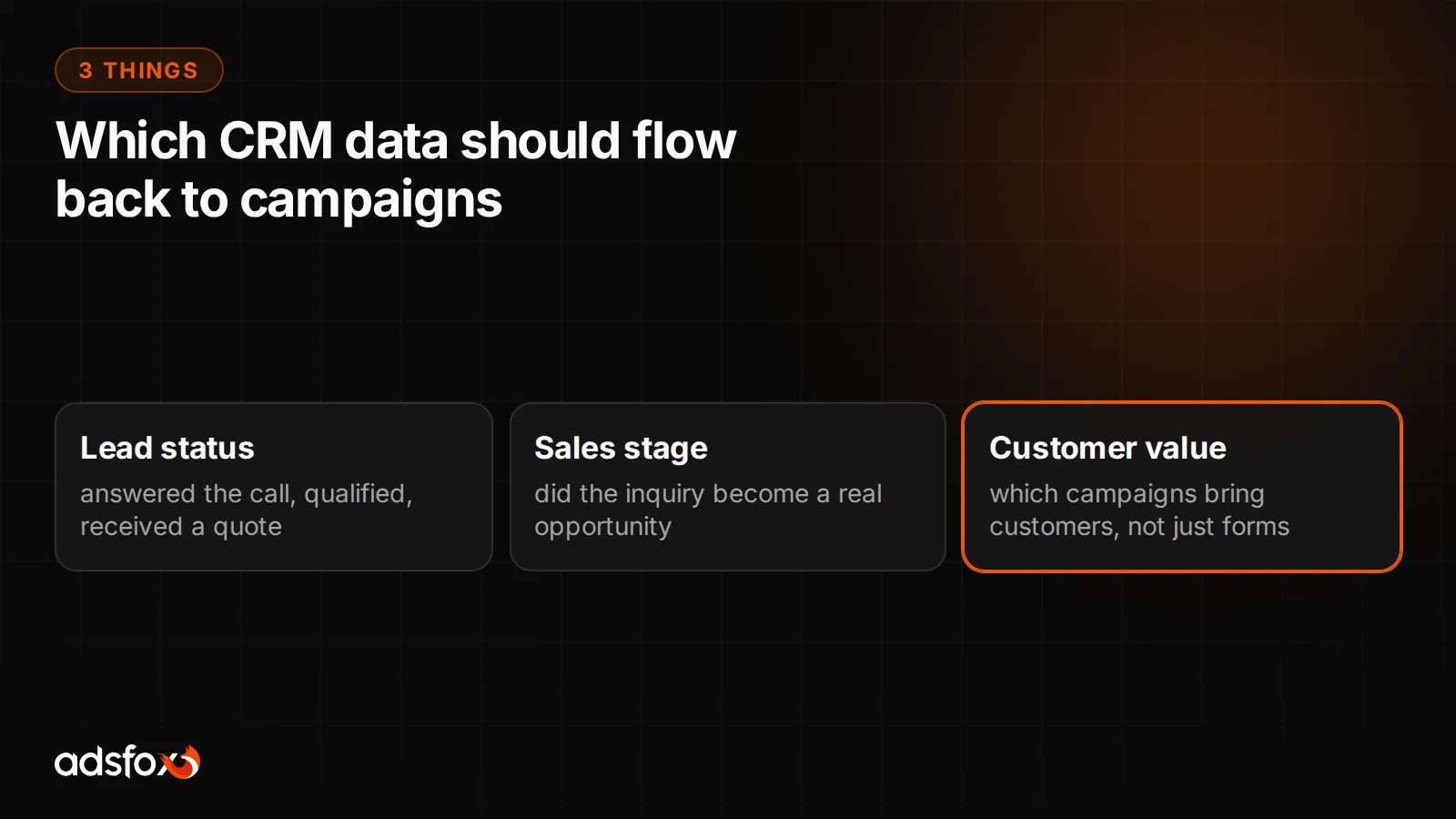
The most important data shows what happened after the contact details were submitted. In practice, this can be:
- lead status in the CRM,
- whether the lead was contacted,
- the qualification result,
- the stage of the sales process,
- whether a quote was sent,
- whether the opportunity was won or lost,
- customer or deal value,
- the campaign and ad source.
This kind of data lets you evaluate campaigns differently. Not only through the number of inquiries, but through which sources deliver real value.
This is exactly why adsfox builds an approach in which campaigns, CRM and sales data are connected. If you want to check whether your campaigns are optimized for the right signals, a marketing audit is a good place to start.
What does lead response time have to do with campaign quality?
Connecting the CRM and campaigns is not just for reporting. It also helps you see where the company is losing sales opportunities.
Harvard Business Review described a study in which companies that tried to contact a prospect within an hour of the inquiry were nearly 7 times more likely to qualify the lead than companies that tried an hour later, and more than 60 times more likely than companies that waited 24 hours or longer.
This points to something important: marketing and sales are not separate stages. They are one system.
If a campaign generates leads but the CRM does not help handle them quickly, part of the budget may already be lost on the sales side. Then the problem is not just the ads. The problem is the whole flow from the click to the sales conversation.
How does a CRM help the ad algorithms?
Ad platforms rely more and more on automation. Google Ads, Meta Ads and other systems learn from the data they receive.
If they get a simple signal, they optimize campaigns for a simple signal. If they get information about lead quality, sales stages and customer value, they can learn something closer to the real business result.
This matters most in service businesses, where the customer’s decision often does not end with an immediate purchase. The lead goes through a conversation, qualification, a quote and a decision. Without CRM data, the ad platform sees only the beginning of that path.
In some cases it is also worth cleaning up server-side tracking to reduce data loss and improve the quality of signals sent to the ad systems.
How adsfox connects campaigns, CRM and sales
adsfox treats ad campaigns not as a separate dashboard but as part of the customer acquisition system. Ads, CRM, analytics and sales should together answer one question: which activities actually help the company make money?
In practice, this means working so that the company can see:
- where the most valuable leads come from,
- which campaigns generate customers,
- where budget is being wasted,
- which sources are worth scaling,
- what to fix in the sales process,
- which data should flow back to the ad platforms.
If you run lead generation campaigns, take a look at our lead generation optimization system. Its purpose is to shift optimization from the number of leads to their real value.
How to start cleaning up your CRM and campaigns
You do not have to rebuild your entire marketing at once. First, answer a few questions:
- Does every lead from a campaign land in the CRM?
- Can you see the campaign and ad source in the CRM?
- Do sales reps mark lead statuses?
- Does marketing see which leads are valuable?
- Does sales data flow back to the ad platforms?
- Does the report cover customers and revenue, not just cost per form?
If the answer to most of these is “no,” the campaign itself may not be the problem. The problem may be the missing connection between marketing, the CRM and sales.
Summary: campaigns should learn from value, not just volume
CRM and ad campaigns have to work together if a company wants to make decisions based on real data. The number of leads alone is not enough, because it does not show which contacts have business value.
A good campaign should not just generate inquiries. It should help the company win customers who fit the offer and have real value.
That is why connecting ads, CRM, sales data and the lead handling process matters more and more.
Book a free consultation and we will review your campaigns and show you where you are losing qualified leads.
Background sources: Pipedrive, Harvard Business Review.