Driver Recruitment Ads: 1,880 Applicants at $5.36 Each
Recruiting drivers with ad campaigns is a way of finding candidates where the application is submitted in a form on Facebook or Instagram, without going to a website. In our project for a fleet partner in the Lublin area (Poland), it produced 1,880 form leads at an average cost of $5.36, starting from about $11 per application. Below we break down what cut that cost in half and why the raw number of forms is a bad metric.
Why is driver recruitment not a sales campaign?
Because the company is not selling anything. On the fleet’s side there is a car, paperwork, and payouts. On the candidate’s side there is a decision whether to sign up and start driving for apps like Uber, Bolt, or Lyft.
That changes two things. The decision cycle is shorter, because the candidate is not spending money, just leaving contact details, and the first applications can show up within days. But the marketing result only ends after the phone call, so the campaign has to be evaluated together with the follow-up process, not separately.
The three problems we find most often
In this project, campaigns were already running, managed in-house. The channel was delivering applications, but with three flaws that repeat at most fleets:
- High cost per lead. About $11 at the start, on a budget that cannot sustain that in the long run.
- Uneven quality of some applications. The form is easy to fill out, so it also attracts people who did not read the terms.
- Leads from outside the right location. The costliest of these problems, because such a lead looks identical to a good one in the dashboard.
What cut the cost per application in half?
Three things, in this order:
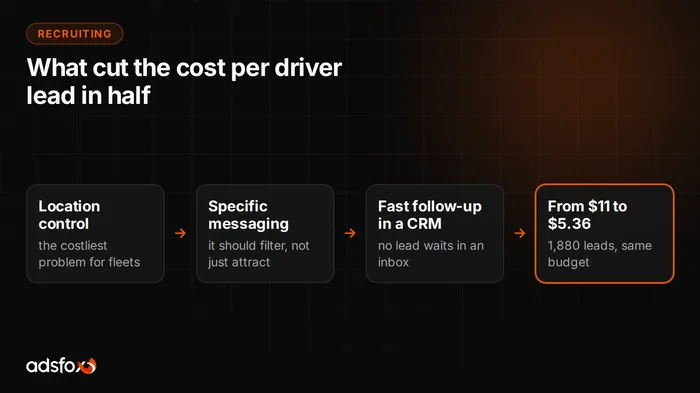
- Location control. Not just narrowing settings in the dashboard, but checking on the follow-up side where the leads really come from, and correcting the campaigns based on that.
- Better forms and messaging. The candidate should know what they are applying for before they click. That filters out accidental applications before they start costing the recruiter’s time.
- Fast follow-up in a CRM. Every application went straight into an organized process, so it did not get lost after the form was submitted.
The result: an average cost per lead of $5.36 across the entire period, with the main campaign delivering 1,659 applications at $5.37 each. In total, the campaigns reached 321,294 people for $10,070 in ad spend.
What messaging works in an ad for drivers?
A specific, verifiable benefit. In this campaign, one of the best-performing promises was a $375 sign-on bonus. On the settings side, local Lead Ads campaigns, broad Advantage+ audiences, and interest targeting worked best.
The rule we apply: the message should filter, not just attract. An ad that promises everything and says nothing about the terms generates cheap forms and expensive phone calls.
What budget is enough for a fleet?
In this project, about $500 a month, all on Meta Ads, and that amount did not change during the engagement. The entire volume of applications came from that budget, so scaling was not needed to improve the result. The improvement came from quality, not money.
That matters for planning: if a recruitment campaign is not working, adding budget usually multiplies the problem instead of solving it.
Where to start in your own business
- Calculate cost per application and cost per phone call separately. If you only know the first number, you do not know whether the campaign works.
- Check how many applications come from outside your region. This is the most common and most expensive source of wasted budget at fleets.
- State the terms plainly in the ad. Filtering a candidate out before the form costs nothing; after the form, it costs the recruiter’s time.
- Connect a CRM from day one, so no application sits waiting in an inbox.
We described the full numbers and dashboard screenshots in our case study: Meta Lead Ads for rideshare driver recruiting.
adsfox is a full-service digital marketing agency for service businesses: content, SEO and GEO, paid campaigns, and your website. More than 350 clients since 2018, Badged Meta Business Partner and Google Partner.
Related adsfox services
We run recruitment campaigns as part of our Facebook and Instagram advertising. Organizing applications, statuses, and quality ratings is handled by lead generation optimization. If your recruitment campaign is already running but brings leads from outside your region, start with a marketing audit.
Book a free consultation: we will check how many of your applications come from the right region and where candidates drop out of the process.