E-commerce Marketing: ROAS From 10 to 29 in Our Campaigns
E-commerce marketing is work on one metric: how much revenue comes back from every dollar you put into advertising. In our campaigns for five online stores, Meta Ads Manager showed a ROAS of 29.66 for a home textiles brand and 24.51 in the first month of a clothing store, a pet supply store reached 10x on Meta and 16x in Google Ads, and a store selling original illustrations cut its cost per add to cart from $41 to $2.65. Below we break down what these results had in common.
What decides a store’s result: budget or optimization signal?
The signal. This is the most common mistake we find when taking over an account.
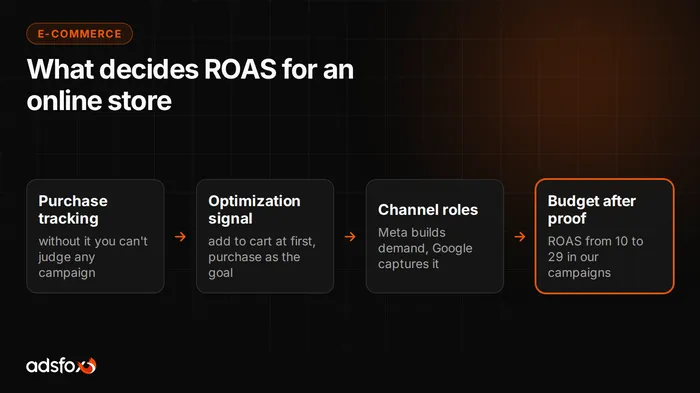
A campaign learns from what you show it. If you measure clicks, you get cheap clicks. If you measure adds to cart, you get carts, including ones nobody will ever pay for. Only a purchase has business value, and ultimately that is what the campaign should be optimizing for.
There is one exception, and it concerns the start: with a very small number of transactions, the system has nothing to learn from, so a micro-conversion like add to cart is often the only sensible first step. It is a stage, not the end state.
How much budget does an online store need?
Less than industry legend suggests, but spent with focus.
- Store selling original illustrations: start at $150, then about $190 a month, which is about $6 a day and three parallel campaigns. Result: cost per add to cart from $41 to $2.65.
- Clothing store: $300 for the first month and more than $7,000 in revenue at a ROAS of 24.51.
- Jewelry store: start at $75, growing to $450 a month after results were confirmed.
- Home textiles manufacturer: $500 a month, all on Meta Ads, 80 purchases and $55,100 in conversion value in the dashboard.
The common denominator: budget increases came after results were confirmed, not before. The reverse order is the most expensive way to test a hypothesis.
Meta or Google: which channel for a store?
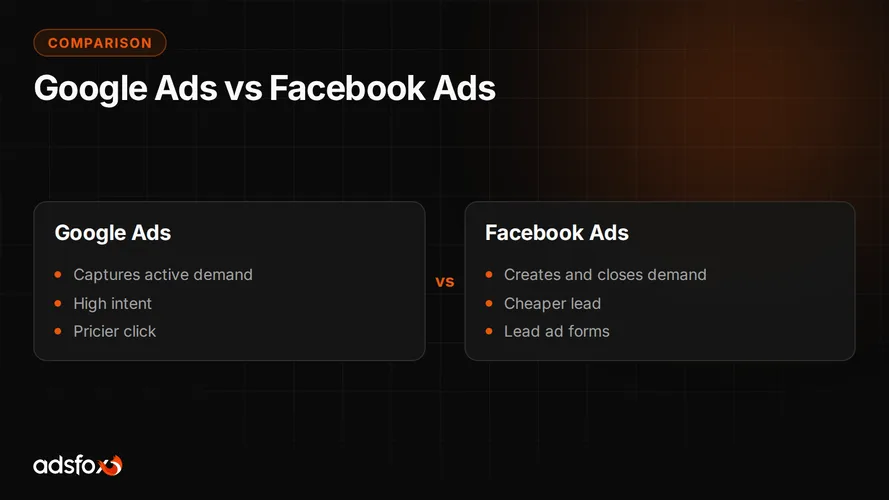
The two channels do not compete; they do different jobs.
| Channel | Job | What it brings |
|---|---|---|
| Meta Ads | builds demand and returns to people who visited the store | reach among people who are not searching yet |
| Google Ads | captures existing purchase intent | a customer who already knows what they want |
For a dog food store, a 50/50 split produced about 30 purchases a month from Meta and about 55 from Google, at a cost per purchase of about $9 and combined revenue of about $8,800 a month.
If you sell a product nobody types into a search engine because they do not know it exists, Meta is your first channel. If the product has established demand, Google is usually cheaper.
Why is tracking a prerequisite, not an add-on?
In the pet supply store, before the pixel was installed, there was no data on cost per purchase. That means no campaign could be evaluated: not the good one, and not the one burning the budget.
The minimum we start every e-commerce project with:
- Meta Pixel with correct purchase events and transaction value.
- GA4 and Google Tag Manager, so data can be compared across channels.
- Server-side events wherever browser blocking eats part of the conversions.
What works in online store creatives?
Authenticity beats the catalog, especially for original products. In the illustration store, the best performers were materials showing the artist’s real work and products, not styled shots that looked like a big retail chain. The most effective placement turned out to be Facebook Feed, and the best-responding group was women aged 35 to 44.
The second lesson is about seasons. Holiday collections, fall collections, and gift products require regular creative rotation. The same graphic running for a quarter loses effectiveness faster than the budget grows.
Where to start in your own store
- Check whether you track purchases and their value. Without that, everything else is guessing.
- Calculate your break-even point from your margin instead of comparing yourself with someone else’s ROAS screenshot.
- Limit the number of campaigns if the budget is small. Three campaigns at $6 a day learn faster than ten.
- Separate the channel roles: Meta builds demand, Google captures it.
We described the full numbers and dashboard screenshots in our case studies: home textiles manufacturer with a 29.66 ROAS, art print store, raw dog food store, and kids’ clothing store.
adsfox is a full-service digital marketing agency for service businesses and online stores: content, SEO and GEO, paid campaigns, and your website. More than 350 clients since 2018, Badged Meta Business Partner and Google Partner.
Related adsfox services
We run sales campaigns for online stores as part of our Facebook and Instagram advertising and Google Ads campaigns. Search traffic is built separately, through e-commerce SEO. Recovering conversions lost to browser blocking is handled by server-side tracking and the Conversions API, and if you want to first check where your budget is leaking, start with a marketing audit.
Book a free consultation: we will check which signal your campaigns are optimizing for and whether purchase tracking works at all.