Effective Online Advertising Starts With Your Website
Effective online advertising does not end at the click. If the ad leads to a slow, unclear, or poorly tracked page, a bigger budget usually does not solve the problem. It only exposes the same weakness faster: the user arrives, does not understand the offer, does not leave their contact info, or leaves a lead that sales cannot do anything useful with.
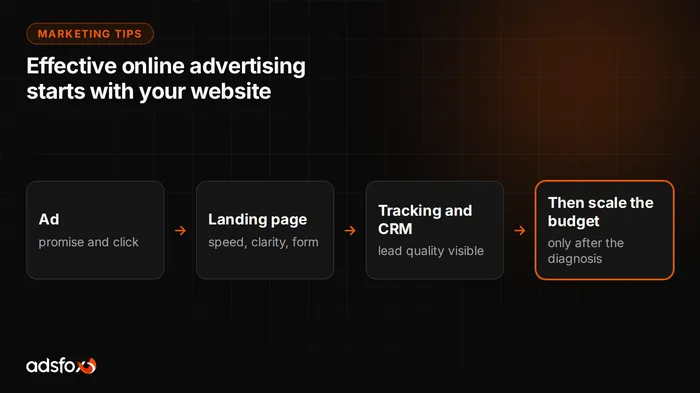
An ad campaign is a system for acquiring traffic that should lead the right user to the right decision. But the campaign alone is not the whole sales system. After the click, the second stage begins: the page, the form, tracking, the CRM, and the sales follow-up.
So before increasing the budget, ask a simple question: does the campaign really need more scale, or should you first fix the place you are sending people to?
Why does effective online advertising depend on your website?
Effective online advertising depends on your website because the user makes the decision after the click, not in the ad platform. The platform will show you cost per click, CTR, cost per form, and the number of conversions. It will not immediately show you whether the customer understood the offer, whether the form was easy to use, or whether the lead had real sales value.
This matters most for service businesses and B2B. There, the user often does not buy right away. First they compare options, check credibility, look for specifics, and decide whether it is worth leaving their contact info. If the landing page does not answer their questions, the ad can look fine on paper and still fail to deliver business results.
In practice, a weak website works like a leaky funnel. You can pour in more traffic, but part of the budget will keep leaking out in the same places: slow loading, an unclear message, a form that is too long, no proof of trust, no measurement of lead quality.
What does Google say about landing pages in campaigns?
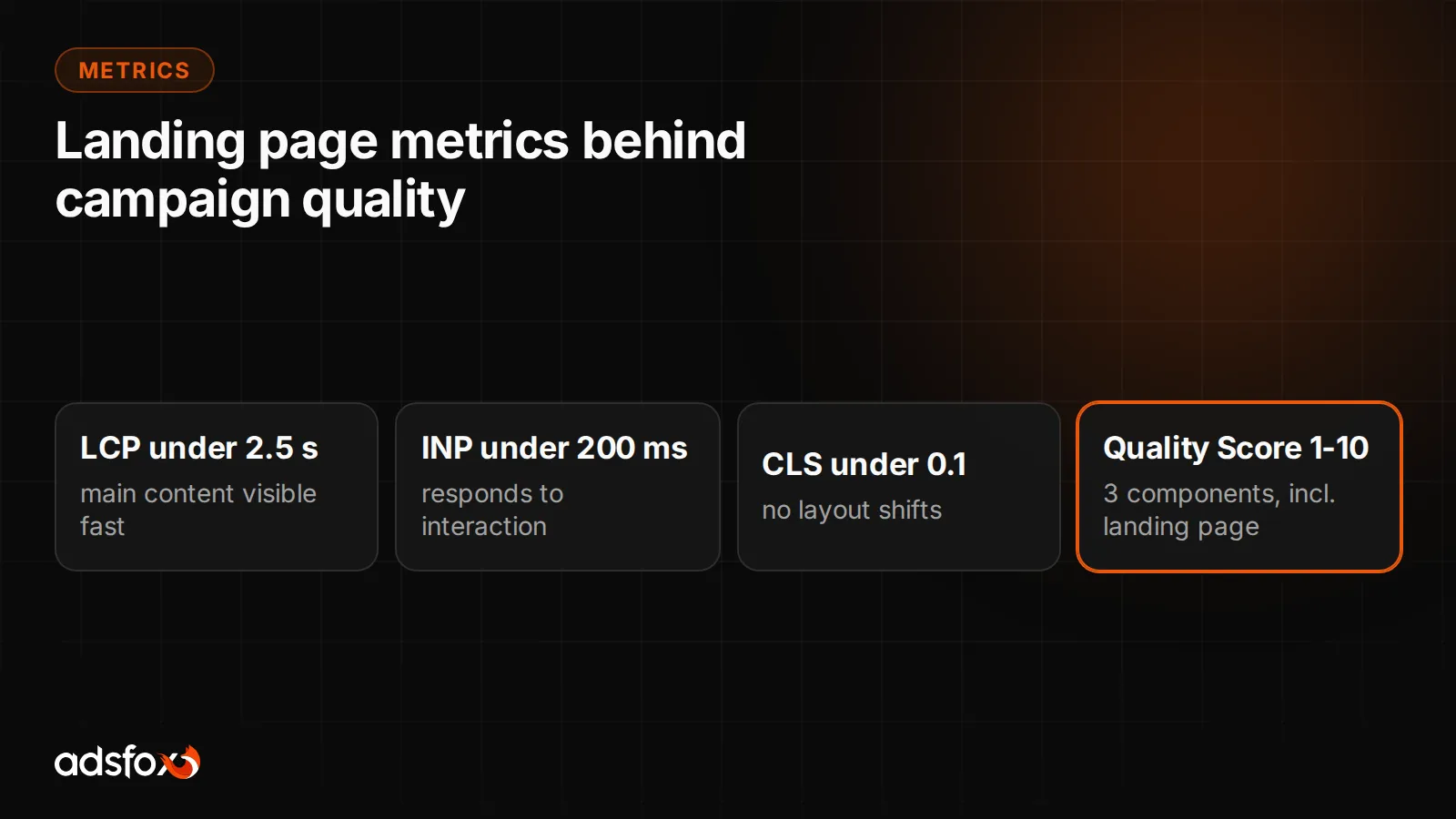
Google’s Quality Score documentation states that Quality Score is measured on a scale of 1 to 10 and takes into account three components: expected clickthrough rate, ad relevance, and landing page experience (source: Google Ads Help, “About Quality Score”). That is an important signal for a business owner: the ad platform itself treats the landing page as part of campaign quality, not a separate topic for the IT department.
The second dimension is user experience. Core Web Vitals, as defined on web.dev, set good thresholds: LCP up to 2.5 seconds, INP up to 200 ms, and CLS up to 0.1, measured at the 75th percentile of page loads. These values are not just technical trivia. For a business, they mean the page should show its most important content quickly, respond to the user’s actions, and not shift elements around while the page is in use.
If the ad promises a specific benefit and the page loads slowly or hides the offer behind generalities, the algorithm will not fix that gap. It can bring more users, but it will not change their experience after the click.
When does raising the budget only make the problem bigger?
Raising the budget makes sense when the basic path works. If the current traffic produces repeatable inquiries, leads move on to sales, and the CRM shows contact quality, more scale can be a logical step. The problem starts when the budget decision rests on a single metric, for example “cost per form is acceptable.”
A cheap form does not always mean a cheap sale. A campaign can generate lots of contacts that do not match the customer profile, have no budget, do not pick up the phone, or are too early in their decision. Then adding budget increases the workload for sales but does not necessarily increase revenue.
A slow or inconsistent page works the same way. If 1,000 clicks do not turn into quality contacts, 3,000 clicks usually will not solve the problem. It will just make the test more expensive. That is why at adsfox we look at the campaign, the landing page, tracking, and the CRM as one system, not as separate silos.
What to check before increasing your ad budget
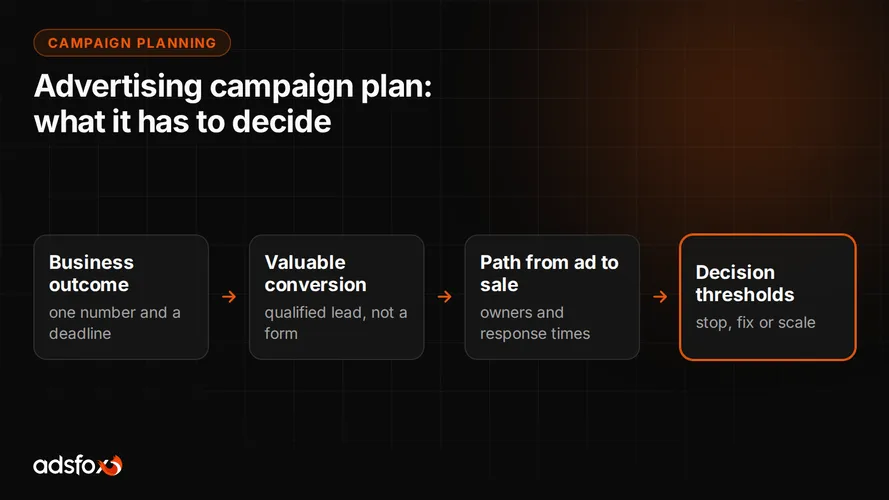
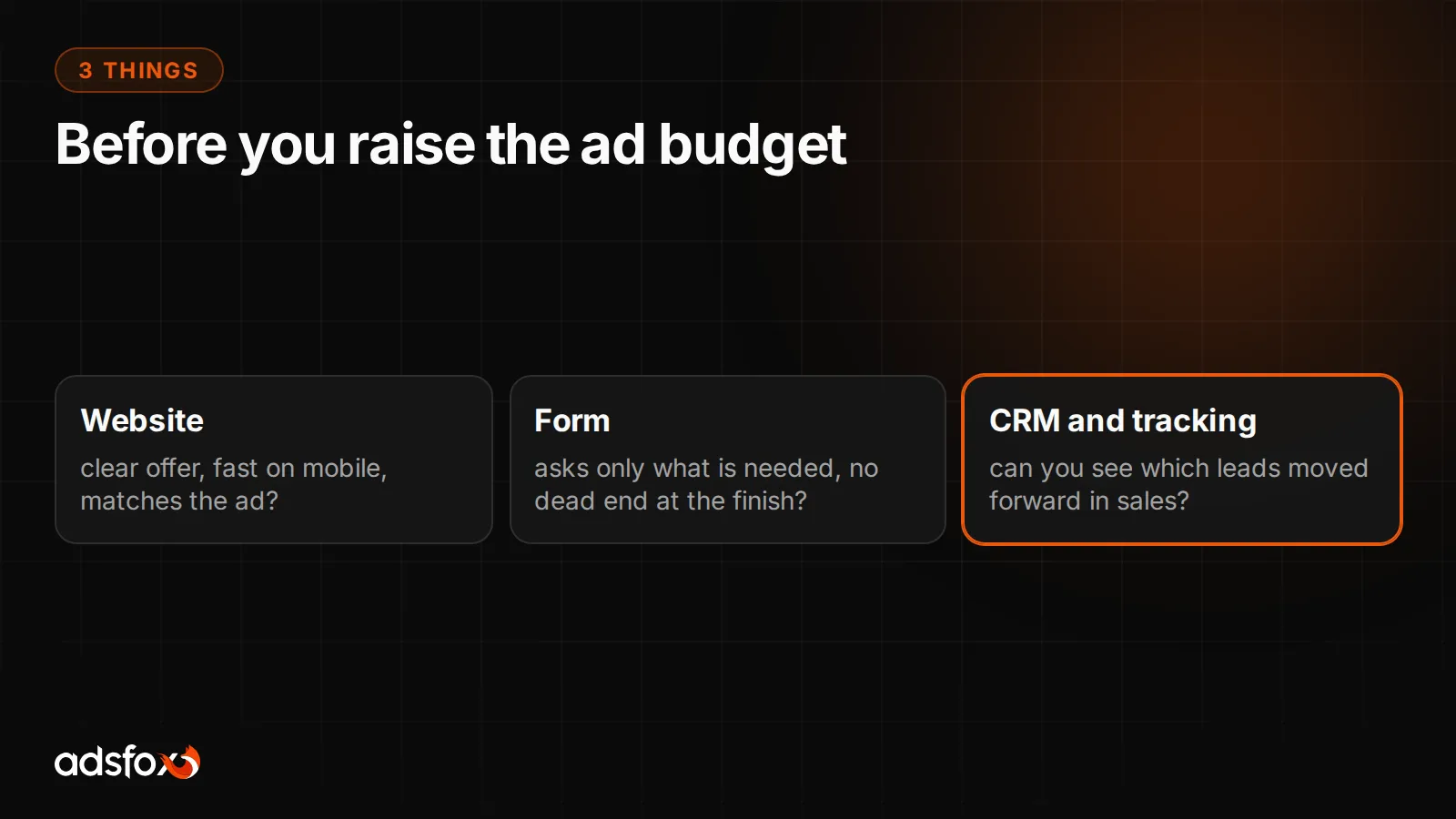
Before increasing your ad budget, run a short audit of the path after the click. This is not a months-long project, just a check of the places that most often block results.
- Do the ad and the page headline promise the same benefit?
- Does the user understand within a few seconds what the company offers and for whom?
- Does the page load fast on mobile?
- Does the form ask only for information needed at this stage?
- Is there proof of trust: case studies, reviews, numbers, partnerships, past work?
- Does tracking measure real conversions, not accidental clicks?
- Does the CRM show which leads were valuable and which campaign they came from?
- Does sales respond quickly and record the outcome of each contact?
This is the point where a marketing audit often delivers more value than another 20% of budget. If the company does not know exactly where it loses users, adding money to the campaign is more of a bet than a data-driven decision.
How to tell a campaign problem from a website problem
A campaign problem usually shows up before the click or at the start of the path. It looks like low CTR, poor search term matching, traffic from keywords with no buying intent, targeting that is too broad, or a message that attracts the wrong people. In that case you need to fix campaign structure, keywords, negatives, creative, and messaging.
A website problem shows up after the click. Users arrive but leave quickly. They click the ad but do not go further. They fill out the form but are not a fit for the offer. Sales says the leads are weak while the ad platform still shows “conversions.” That is a signal that campaign optimization alone will not be enough.
The riskiest situation is when a company looks only at the ad platform data. The platform can show that the campaign is delivering forms. Only the CRM shows whether those forms turn into conversations, proposals, and sales. Without it, it is easy to optimize for quantity instead of value.
How adsfox treats the campaign and the website as one system
At adsfox, the campaign is not detached from the page, the form, and sales. On Google Ads, Meta Ads, and lead generation projects, we analyze whether the ad system is getting the right signal: not just that someone submitted a form, but whether that contact had business quality.
That is why in our Google Ads management we look beyond cost per click and cost per conversion. Keywords, user intent, the landing page, lead quality in the CRM, and whether data flows back to the ad systems all matter. adsfox is a Google Partner, so we understand the platform’s tools, but we tie campaign decisions to the real sales process.
This approach helps avoid the typical mistake: “the campaign isn’t working, let’s raise the budget.” Sometimes the right decision sounds different: fix the landing page, shorten the form, clean up tracking, and only then scale traffic.
Summary: a bigger budget only after a diagnosis
Effective online advertising requires not only a well-built campaign but also a website that can turn a user’s attention into a valuable contact. If the landing page is slow, the offer unclear, the form too heavy, or the CRM does not show lead quality, a bigger budget may only burn money faster.
The starting point should be a diagnosis of the whole path: ad, page, tracking, CRM, and sales. Only then can you tell whether it is worth increasing the budget or whether you should first fix the elements that are blocking results.
Book a free consultation and we will check whether your campaigns are losing results in the ad, on the page, or only in the lead handling process.