Hotel Marketing: How to Fill Rooms Without OTAs
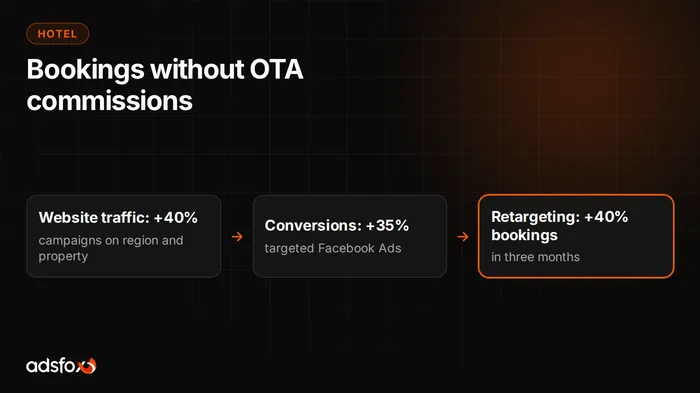
Hotel marketing has one overriding goal: direct bookings on the hotel’s own website, instead of paying a commission for every guest. In our case study, that work produced measurable results in three months: a 40% increase in website traffic, a 35% increase in conversions from targeted Facebook campaigns, and a 40% increase in bookings from retargeting campaigns. Below we break down how that result came about and in what order it is worth repeating.
All numbers come from our hotel advertising case study. They are not a market average or a promise: they are the record of a specific project that yields repeatable rules.
Why direct bookings are worth fighting for
Online travel agencies deliver guests, but for a commission on every booking and on their own terms: they own the relationship with the guest, their data, and the decision about the property’s visibility. Your own channel reverses that arrangement. Every booking from the website means full margin, the guest’s contact details, and the ability to come back with an offer next season.
We do not suggest cutting ties with OTAs overnight: they are a channel like any other. We suggest building an alternative that takes over a larger share of bookings with every month.
What the sequence of actions looked like in our project
The sequence turned out to be more important than it seems, and it produced part of the result. First, reach and traffic campaigns brought people interested in the region and the type of getaway to the website, building a base of visitors. Only on that base did we launch retargeting to people who visited the website but did not get in touch through the form or the clickable phone number.
The results of that sequence from the case study:
- 40% increase in website traffic for the hotel compared with the previous period,
- 35% increase in conversions from targeted Facebook Ads campaigns,
- 40% increase in bookings within three months from retargeting campaigns,
- cost per click 25% lower precisely because of the right campaign sequence.
Retargeting without a built-up base has no one to talk to; traffic without retargeting leaks away for good. Separately these campaigns are average; together they make the result.
What a hotel that knows what it is doing measures
Events on the website: entries into the booking engine, submitted forms, phone number clicks. Without them, “ad effectiveness” is an opinion. With them it becomes a number: you know which campaign and which creative bring inquiries, and which only bring visits.
Hospitality adds seasonality: campaigns are judged in the rhythm of the season, and data from one period is used for a cheaper start in the next. The visitor base and the guest list are assets that work for years, as long as they are collected from the start.
What creatives work in hotel advertising
A property sells through images. What works is showing what the guest is actually buying: the room, the view, breakfast, the pool, the surroundings. Add a specific offer: dates, the benefit of booking direct, terms. Generic claims about a “unique atmosphere” with nothing to back them up in the frame work poorly.
In retargeting the message changes: the person already knows the property, so the creative reminds and closes, for example with a benefit available only when booking on the website. That is a different conversation than with someone who sees the hotel for the first time, which is why these campaigns run separately.
How much does it cost
A hotel’s bill consists of the ad budget (paid to the platforms) and campaign management. At adsfox, management starts from $490/month per channel, and with several channels the unit price goes down. Reference points for acquisition costs in different industries are in our benchmark of 20 campaigns across 11 industries.
The right measure for a hotel, however, is not cost per click but the cost of a direct booking compared with the commission you pay OTAs for the same booking. That comparison is won more often than the industry assumes.
Where to start at your property
- Set up event tracking on the website: booking engine, form, phone.
- Build traffic with campaigns on the region and the type of getaway (Meta Ads do the heaviest lifting here).
- Add retargeting to visitors who did not get in touch; in our project it delivered +40% bookings in three months.
- Compare the cost of a direct booking with OTA commissions and shift budget to where the math wins.
If you want to travel this road faster and without learning on your own budget, see how we run campaigns for businesses and book a free consultation. We will go through your property, your season and your OTAs, and calculate where your direct bookings are.