How to Choose a Marketing Agency for a Service Business
How do you choose a marketing agency that actually supports sales? Look for a partner that does not end the conversation at campaigns, clicks and lead counts. A good agency should understand your CRM, the quality of inquiries, your sales process and which marketing activities actually turn into revenue.
A marketing agency is a partner responsible for planning, running and optimizing the marketing activities that are supposed to help a company win customers. In performance marketing, the difference is that “running ads” is not enough. You also have to know whether the ads deliver the right business signals.
How to choose a marketing agency: campaigns or revenue?
Many conversations with marketing agencies start the same way: budget, ad channels, cost per click, cost per lead, number of forms. Those are important, but they should not be the end of the conversation.
For a company with 10, 50 or 150 employees, the question is different: which marketing activities actually support sales?
If an agency only reports clicks and leads, you may see activity but not necessarily results. A campaign can have a low cost per lead and at the same time deliver contacts that do not pick up the phone, do not match your offer, or never make it to a sales conversation.
That is why a good marketing agency should ask not only about the ads but also about what happens after someone leaves their contact details.
Why the number of leads can be misleading
A lead is only the beginning of the process. Not every contact has the same value for your company. One lead may be ready to buy, another may be a random inquiry, and a third may not fit your service at all.
The problem starts when the ad system only sees the fact that a form was submitted. If the algorithm gets the information “lead acquired” but not whether that lead was valuable, it starts optimizing campaigns for an incomplete signal.
In practice, this means you can scale campaigns that look good in the ad dashboard but do not deliver a proportional increase in sales.
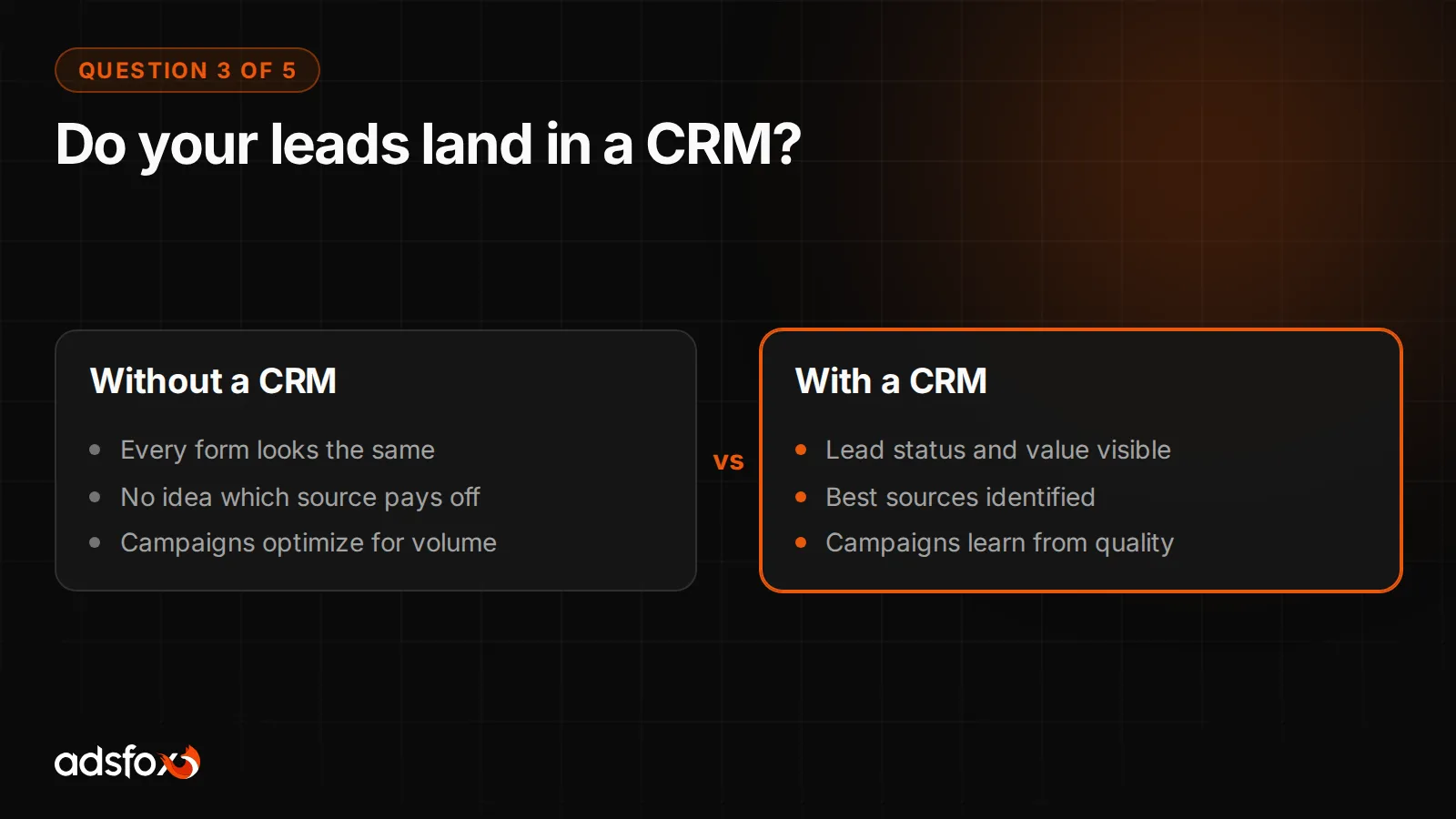
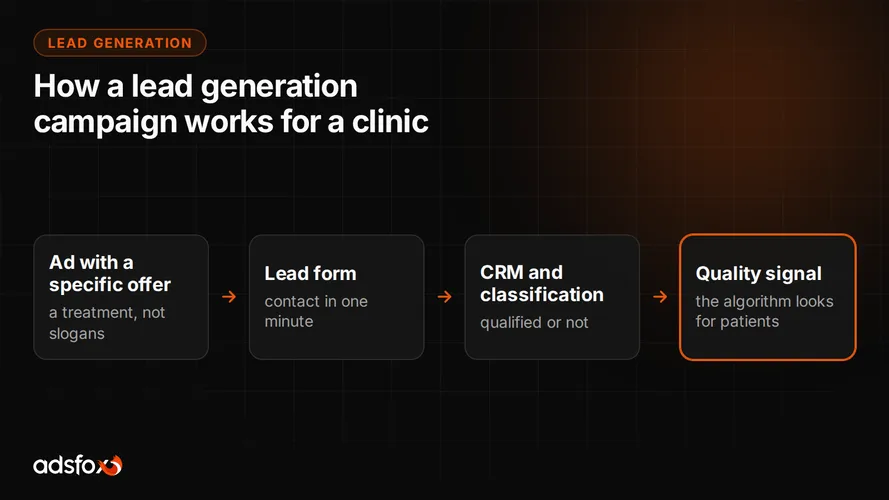
CRM data is the key here. That is where you can see whether a lead:
- responded to your outreach,
- moved forward in the sales process,
- received a quote,
- became a customer,
- had real value for the company.
Without that connection, marketing often operates at the level of claims. With it, marketing starts operating at the level of business decisions.
If you want to check whether your campaigns measure the right things, a marketing audit is a good starting point. It shows where reporting on activity ends and where evaluating the impact on sales begins.
Which questions should you ask an agency before working together?
When choosing a marketing agency, ask a few simple questions. Not technical for technology’s sake, but questions that show whether the agency understands the whole customer acquisition process.
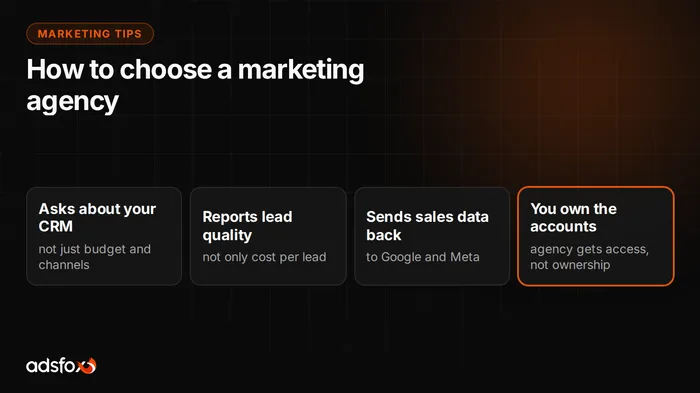
First question: do leads go into a CRM, and can you track their status afterwards?
Second question: does the agency analyze which campaigns generate customers, orders, bookings or revenue, and not just forms?
Third question: does sales data flow back into the ad platforms so the algorithms can learn from a better signal?
Fourth question: does the report cover lead quality and the impact on sales, or only cost per click and cost per lead?
If an agency cannot answer these questions, it may mean it will only manage a fragment of the process. And in a business, customer acquisition does not end in the ad dashboard.
What does connecting ads, CRM and sales mean?
Connecting ads, CRM and sales means marketing is not judged only through the lens of activity. It is judged through the lens of results.
In this model, the company sees a fuller path:
- Which campaign the lead came from.
- Whether the lead was valuable.
- Whether sales contacted the lead.
- Whether the lead moved forward in the process.
- Whether a customer or revenue came out of it.
- Whether the quality data went back to the ad platforms.
This allows you to make decisions differently. Not just “this campaign has a low cost per lead,” but “this campaign generates leads that convert into sales more often.”
The importance of speed and quality in lead handling is well illustrated by a study described in Harvard Business Review. Companies that tried to contact a potential customer within an hour of the inquiry were nearly 7 times more likely to qualify the lead than companies that tried an hour later, and more than 60 times more likely than companies that waited 24 hours or longer. This shows that the ad campaign and the sales process are one system, not two separate worlds.
When does an agency become a business partner?
An agency becomes a business partner when it helps you make better decisions, not just when it manages campaigns.
That means it cares not only about:
- how much budget was spent,
- how many clicks there were,
- how many leads came in.
It also cares about:
- which leads had real value,
- which sources deliver the best customers,
- where the sales process loses opportunities,
- whether tracking is losing data,
- whether the ad platforms are learning from the right conversions.
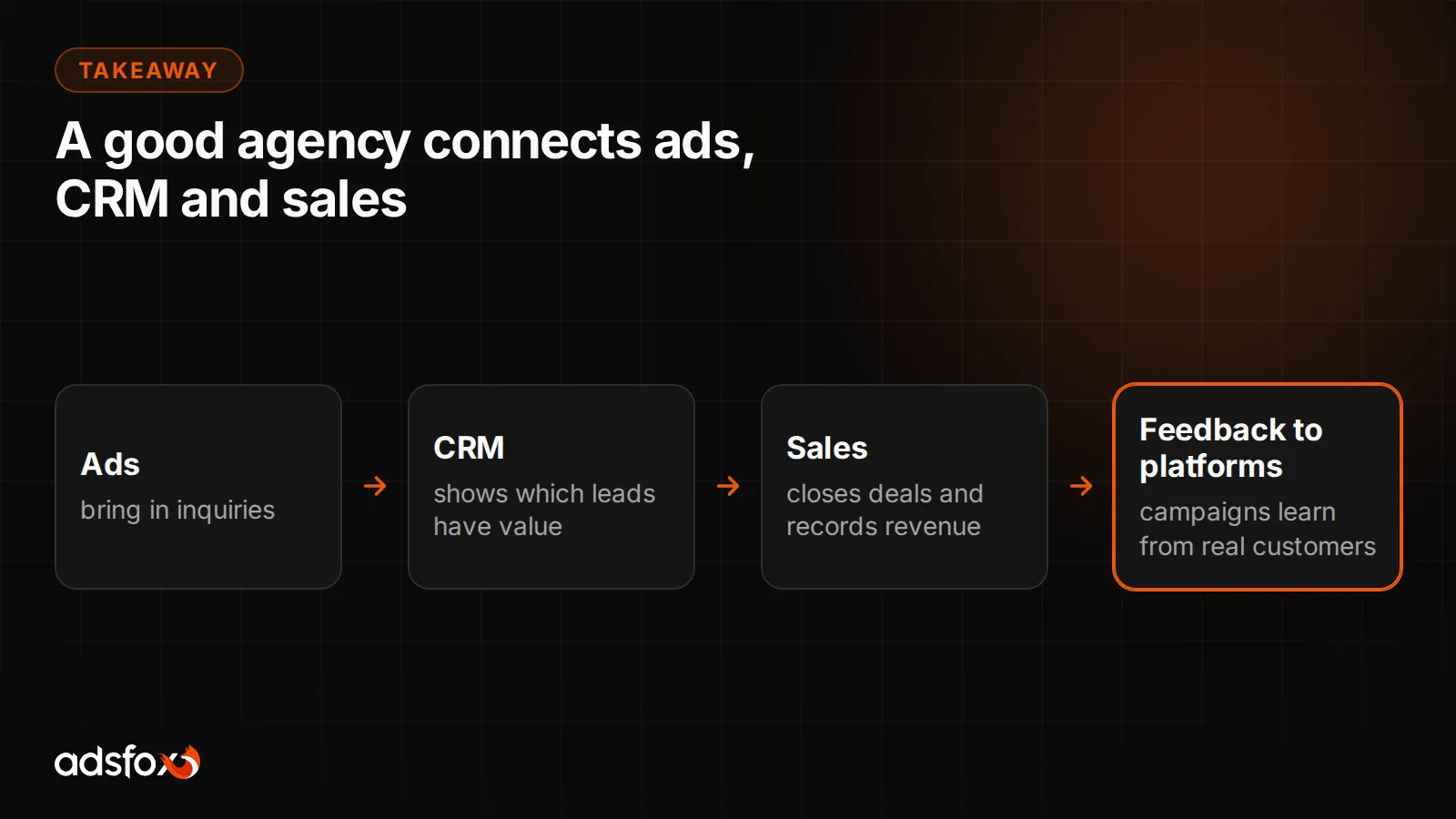
This matters most with bigger budgets and longer sales cycles. Then campaign decisions should not rest only on what the ad dashboard shows. They should include the real quality of inquiries and data from the sales process.
That is why, with lead generation campaigns, you should look not only at cost per form but at the whole optimization system. adsfox builds a lead generation optimization system that helps connect lead data with advertising decisions.
Marketing agency, freelancer or an in-house marketer?
This question comes up in every conversation, because a freelancer clearly costs less and, at first comparison, an agency simply looks expensive. The difference, however, is not in the rate. It is in how many areas one person can realistically handle.
Paid campaigns, conversion tracking, CRM integration, content and the website are separate skills. One person is usually strong in one or two of them and works by feel in the rest. In an agency, each of these areas is run by someone who does only that, and that is the whole advantage: not the headcount, but the absence of places where nobody knows what is going on.
The second difference is continuity. A freelancer gets sick, takes a vacation or ends the engagement, and the campaign is left unattended exactly when it is spending budget. An agency has backup built into the way it works.
The third is verifiability. Statuses such as Meta Business Partner or Google Partner are granted by the platforms themselves and can be checked independently of what an agency writes on its website. A solo specialist rarely has anything beyond their own portfolio to back up their skills.
To be fair: with a small budget and one channel, a good freelancer is often the better choice, because you do not pay for coordination you do not need. An agency starts to make sense when there are several channels and the data from them has to be tied together.
How to verify an agency before you sign
Three things you can check yourself, without technical knowledge.
References with a face. Case studies are easy to write, so ask for clients you can talk to, or for video testimonials where you can see real people and company names. At adsfox we publish more than 20 client video testimonials and our case studies with numbers, precisely because an anonymous chart proves nothing.
Partner statuses you can verify yourself. Check whether the agency is listed in the official platform directories. adsfox is a Meta Business Partner at the Badged level and a Google Partner, and both can be confirmed at the source.
Who ends up owning the accounts. This is the question that separates a partner from a trap. The ad account, the Pixel, the conversion data and the analytics account should belong to you, and the agency should have access, not ownership. If you cannot take your campaign history and data with you when the engagement ends, you start from zero at the next agency.
How adsfox approaches choosing the right signals
adsfox looks at performance marketing more broadly than cost per click, cost per lead or the number of form submissions. Our goal is to connect marketing, CRM, analytics and sales data into one system that helps a company grow sales.
In practice, this means working so that the company can answer these questions:
- which campaigns generate qualified inquiries,
- which leads turn into customers,
- whether the ad algorithms are getting the right data,
- whether tracking shows a fuller picture of performance,
- whether marketing decisions come from data, not guesswork.
adsfox is a Meta Business Partner and a Google Partner. That matters, but the partnership itself is not the point. The point is the way of thinking: campaigns should work toward a real business result, not just toward metrics that look good in a report.
If you want to check whether your marketing campaigns are optimized for the right signals, let’s talk about your customer acquisition process.
Book a free consultation and we will review your campaigns and show you where you are losing leads.
Summary: how to choose a marketing agency without the red flags
The red flag appears when an agency talks only about campaigns, clicks, budget and lead counts. Those numbers matter, but they are not enough to judge marketing’s impact on the business.
A good agency should understand what happens after the click and after the form. It should care about the CRM, lead quality, the sales process, tracking and the data that goes back to the ad platforms.
Because marketing that cannot see sales may be optimizing for an incomplete truth.