How to Improve Online Ad Performance After the Click
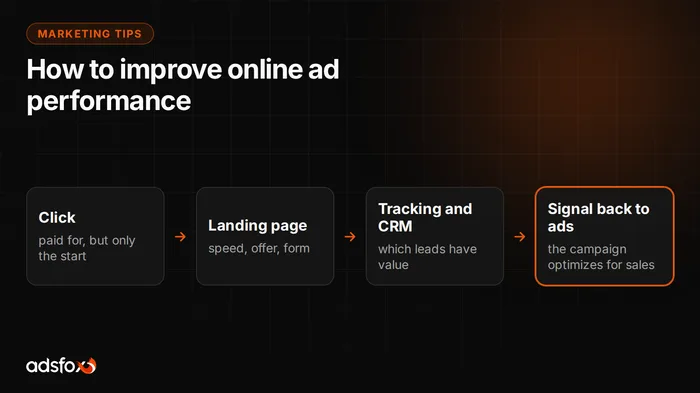
How do you improve online ad performance? The starting point should be an evaluation of the entire path after the click, not just the number of clicks and leads. Check whether the website works correctly, whether the form collects the right data, whether tracking is losing conversions, and whether the CRM shows which leads actually move into sales.
Online ad performance is a measure of whether the ad budget leads to real business actions, not just to traffic in the ad dashboard. For a service business, it is not enough to know how many people clicked the ad. What matters more is how many qualified sales conversations, inquiries and customers came out of those clicks.
Why the campaign report does not show the whole truth
A campaign report shows only part of the process. You can usually see cost per click, the number of forms, cost per lead and basic conversions. The problem starts when the company does not know what happens after the user lands on the site or submits the form.
In practice, budget can disappear in several places. The page loads too slowly. A redirect loses part of the traffic. The form generates spam submissions. The conversion tag does not fire correctly. The CRM does not separate leads with sales potential from those that should never have been used for optimization.
That is why the question “how much did a lead cost?” is too short. A better question is: “what were the leads worth, and did the ad system get that information?”
How to improve online ad performance after the click
To improve online ad performance after the click, you have to analyze the whole process from the ad to the sale. That means checking not only the campaign settings but also the landing page, the form, the tags, the CRM and the response time to inquiries.
The most common places where you lose results:
- the page loads too slowly,
- the form is too long or attracts low-quality submissions,
- redirects make it hard to record data correctly,
- tracking does not measure all the important events,
- the CRM does not send lead quality information back to the campaign,
- sales responds too late to new inquiries.
Start with the data: 53% of mobile users leave a page that takes longer than 3 seconds to load (source: PPC Hero, “5 Post-Click Leaks Draining Your PPC Budget”). This means the click may be paid for, but the user has no real chance to move forward and become a lead or a customer.
Are cost per click and cost per lead enough to make decisions?
Cost per click and cost per lead are useful, but they are not enough to judge campaign performance. CPC tells you how much you pay for a visit to the site. CPL tells you how much you pay for a submission. Neither metric on its own tells you whether the contact had business value.
Example: a campaign can generate a lot of cheap leads, but if half of them are spam, wrong phone numbers or people with no intent to buy, the algorithm gets a bad signal. The platform sees “conversions” and looks for more similar people. As a result, the campaign may scale the problem, not the sales.
That is why, in lead generation campaigns, connecting marketing data with the CRM matters. Only then can you see which traffic sources generate qualified conversations, quotes and customers.
If you want to check whether your campaigns are judged by the right metrics, see what a marketing audit at adsfox looks like.
How do tracking and the CRM affect the algorithm’s decisions?
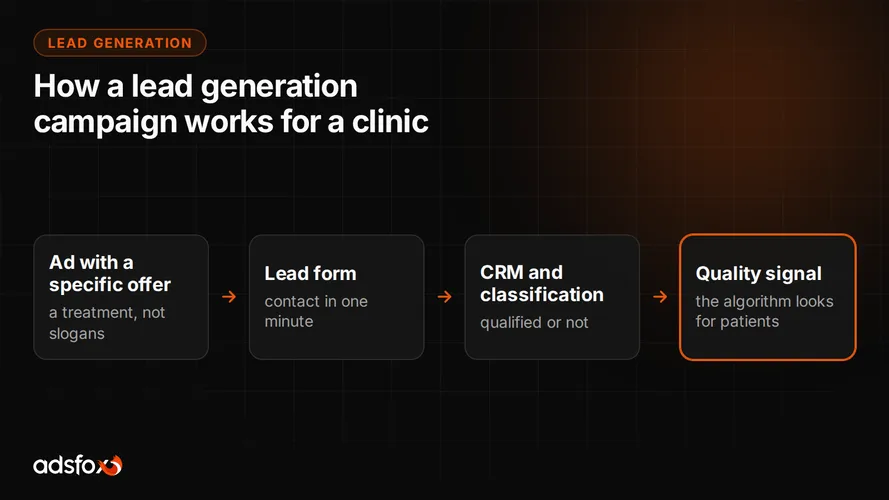
Tracking and the CRM affect the algorithm’s decisions because ad platforms learn from the signals they receive. If the system only sees a form submission, it will optimize the campaign for more form submissions. If it sees which leads were qualified by sales, it can learn from better data.
This matters most in campaigns where the buying decision does not end right away on the page. In many companies the lead goes first to a sales rep, then into the CRM, and only after a conversation do you know whether it was valuable. If that information does not go back to the ad systems, campaigns work from an incomplete picture.
That is why solutions such as server-side tracking, the Conversions API and CRM CAPI matter more and more. Their purpose is not technical novelty, but a better signal for the campaign and a better business decision.
What to check before you increase the ad budget
Before you increase the ad budget, check whether the current system is burning money after the click. Scaling a campaign without checking the data may increase the number of leads, but it does not have to increase sales.
Before raising the budget, check:
- whether the landing page loads fast on mobile,
- whether the form collects data that helps assess lead quality,
- whether tracking measures the events that matter for sales,
- whether the CRM shows the status and value of the acquired leads,
- whether CRM data flows back to the ad systems,
- whether the report shows only the number of leads or also their quality.
If the answer to several questions is “I don’t know,” that is a sign the problem may not be the creative or the budget. It may be the measurement system.
How adsfox looks at ad performance
At adsfox we look at campaigns as part of the customer acquisition system, not as a separate dashboard full of metrics. A campaign makes sense when it is connected to the website, the form, tracking, the CRM and the sales process.
That is why we analyze not only the number of leads but also their quality and their impact on sales. We check whether the ad platforms get the right signals, whether data is lost to technical errors, and whether the company knows which traffic sources really generate customers.
This approach matters most for companies that want to grow sales predictably. The point is not to get more clicks. The point is to have the budget work for leads that have a real chance of becoming customers.
Summary
If you want to improve online ad performance, start by checking what happens after the click. The campaign report may look good, and yet the budget may leak through a slow page, broken tracking, spam forms or missing CRM data.
The biggest difference appears when campaigns are optimized for the right signals: lead quality, CRM status and real impact on sales. Only then does it make sense to increase the budget and make decisions based on a fuller picture.
Book a free consultation and we will review your campaigns and show you where you are losing leads.