How to Sell Handmade Products Online: Cart Cost $41 to $2.65
Selling handmade products online differs from regular e-commerce in one way: the customer buys style and an idea, not an item from a catalog. In our project for a store selling original illustrations, that meant cutting the cost per add to cart from $41 to $2.65 on a budget of about $6 a day. Below we break down what produced that change and what not to do on a small budget.
Why does a small budget need fewer campaigns, not more?
Because the ad system learns from data, and data split across ten ad sets never forms a sufficient sample anywhere.
At about $190 a month, we worked with three parallel campaigns. That is uncomfortable, because it is tempting to test many products at once. But at this spend level, every additional split of the budget delays the moment when the campaign starts reaching the right people.
The practical rule: the smaller the budget, the fewer things you test at the same time.
What actually changed the result?
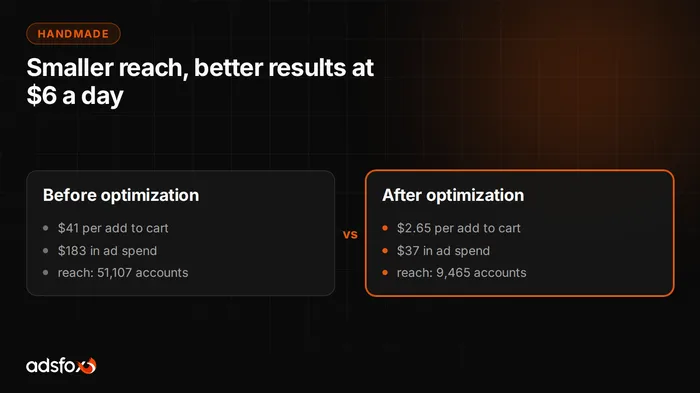
The starting point and the state after optimization, both from Meta Ads Manager:
| first period | later period | |
|---|---|---|
| Adds to cart | 2 | 14 |
| Cost per add to cart | $41 | $2.65 |
| Ad spend | $183 | $37 |
| Reach | 51,107 accounts | 9,465 accounts |
Look at the last row. Reach dropped more than fivefold, and the result improved more than tenfold. That is the essence of working on a small budget: the goal is not for more people to see you, but for the right people to.
What creatives work for original products?
The maker’s real work. This store sold art prints, framed graphics, posters, originals, calendars, and gift sets, with botanical, animal, and architectural motifs. A creative that tried to look like a chain-store catalog lost to material that simply showed what the artist had made.
Three observations from this project:
- The most effective placement turned out to be Facebook Feed, not Instagram, even though the product is visual.
- The best-responding group was women aged 35 to 44. That does not mean you should speak only to them. It means that on a limited budget, it is worth checking which segment responds to a specific collection.
- Remarketing to people who already knew the brand worked better than expanding reach.
Seasonal and local collections: when do they make sense?
When you have enough to rotate. In this project, collections tied to specific cities worked, as did holiday and gift products. They are a natural reason to swap creatives, and handmade goods wear out creatives faster than typical e-commerce, because the buyer responds to novelty, not price.
A difficulty you have to resolve consciously: some products have nationwide potential, and some are strongly tied to a local identity. Putting both into one campaign on a small budget ends with neither group getting enough data.
Why is add to cart not the store’s result?
Because a cart is not revenue. In this project, the average result after optimization was $2.65 per add to cart at about 65 adds a month, and that was a real improvement. But it is still an indirect signal.
Add to cart is a good goal at the start, when there are too few transactions for the system to learn from purchases. A campaign that permanently optimizes for carts can produce carts nobody pays for. That is why the natural next step in a store like this is switching to purchase optimization.
Where to start in your own store
- Limit the number of campaigns to two or three if you spend less than $250 a month.
- Show your work, not styled shots. Authenticity is your advantage here, not a limitation.
- Plan creative rotation in advance, ideally around seasons and collections, instead of swapping them when results drop.
- Decide when you switch to purchase optimization, so the cart does not become a goal in itself.
We described the full numbers and dashboard screenshots in our case study: Meta Ads campaign for an art print store. We collected broader lessons from five stores in our guide to e-commerce marketing.
adsfox is a full-service digital marketing agency for service businesses and online stores: content, SEO and GEO, paid campaigns, and your website. More than 350 clients since 2018, Badged Meta Business Partner and Google Partner.
Related adsfox services
We run campaigns for small stores as part of our Facebook and Instagram advertising. Search traffic is built separately, through e-commerce SEO. If you want to first check whether your budget is hitting the right signal, start with a marketing audit.
Book a free consultation: we will check whether your campaigns have a chance to learn on your budget and what they should be optimizing for.