Jewelry Store Marketing: Cost per Action from $20 to $3.26
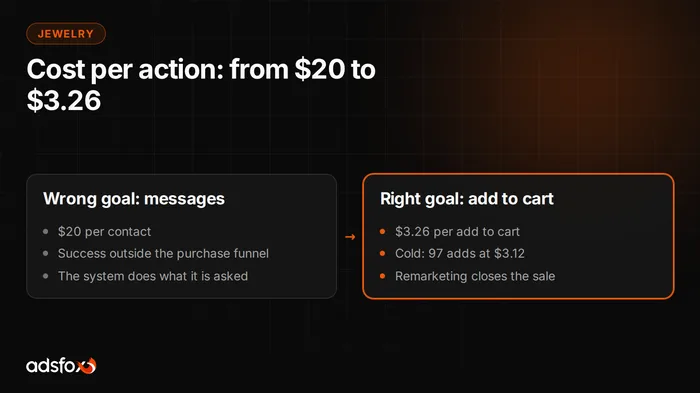
Jewelry store marketing most often breaks on one thing: the campaign measures the wrong kind of success. Our case study shows it in textbook numbers: as long as the campaign was optimized for messages, the cost was $20 per contact. After fixing the tracking and switching the objective to add to carts, the cost per key action fell to $3.26. Same platform, same product, a six-fold difference in cost. Below are the full mechanics.
The numbers come from our jewelry advertising case study, one of our European campaigns.
Why jewelry is a rewarding and difficult product at the same time
Rewarding because it is visual: a good photo of a ring can stop a thumb better than any copy, and purchases tend to be emotional and gift-driven, so impulse works. Difficult because competition is enormous, from handmade makers to national chains, and the customer often browses for a long time, compares and comes back before buying. That shifts the weight to two things: the right events in tracking, and remarketing that closes the browsers.
Anatomy of a $20 mistake: the wrong campaign objective
The starting point in this project was typical for small stores: a campaign set up for messages, because “let people write to us.” The result: $20 per contact, often more than the margin on the product. The system did exactly what it was asked to do, the request was just wrong: a message is not a natural step in buying jewelry online.
The change looked like this: clean up the store’s event tracking, then switch the campaign objective to add to carts, the event that actually precedes a purchase in this business. The cost per key action fell from $20 to $3.26. Broken down by campaign: cold delivered 97 add to carts at $3.12, remarketing 22 adds at $7.13. The more expensive remarketing is not a mistake: it closes people closer to the decision, with a different value for the store.
Budget: from a $75 test to $450 of real work
This case study is also an honest lesson about small budgets. Starting at $75 a month allowed us to test the first assumptions, but at that amount it is hard to quickly collect stable data for optimization: conclusions come slowly, and every decision rests on a small sample. The current budget is $450 a month, and that is the level at which the system has something to learn from.
Practical advice: treat a small budget as a hypothesis test, not as a miniature of the target campaign. And do not judge a channel by a phase in which it had no chance of working yet.
How much does a jewelry store customer cost: how to calculate it
Three rules we carry over from this project to every similar store:
- Track purchase events: add to cart, checkout, purchase with a value. Without them you are optimizing blind. At larger scale you add server-side tracking so data does not get lost to browser blocking.
- Separate cold and remarketing. Each of these campaigns has a different cost per action and a different role; mixing them in one evaluation blurs the picture.
- Compare cost per action with your margin, not with other people’s results. Reference points from other industries are in our benchmark of 20 campaigns across 11 industries, but your margin on the product decides.
On top of the budget comes management: at adsfox from $490/month per channel, on transparent terms.
What else makes a difference in this industry
Photos in context. Jewelry on a model in a lifestyle shot sells differently than a packshot on a white background; both types have their roles in the funnel and are worth testing as separate creatives.
Gift seasons. December, Valentine’s Day, Mother’s Day: demand and bid prices rise together. Campaigns are planned before the season, because during it the system will not have time to learn.
Dynamic remarketing. Showing the exact product someone viewed but did not buy is one of the cheapest sales in jewelry; it requires a product catalog and events, meaning the foundation from the start of this post.
Where to start in your store
- Clean up your purchase event tracking.
- Switch the campaign objective to events from the purchase funnel, not messages.
- Accept that a small budget is a test: for us $75 verified the assumptions, and $450 a month does the work.
- Separate cold and remarketing and judge each by its role.
We run campaigns like this as part of our Facebook and Instagram advertising. If your jewelry ads cost as much today as our “before,” book a free consultation: we will show you, in your own account, where the difference between $20 and $3.26 is leaking.