Language School Marketing: How to Sell Courses Online
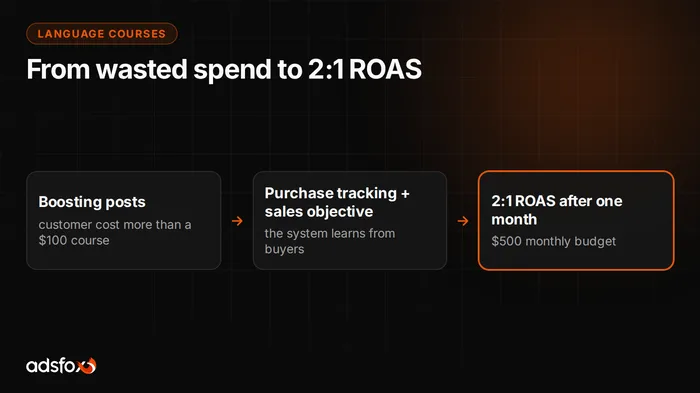
Language school marketing usually breaks in the same place: the owner boosts posts, pays for reach, and discovers that the cost of acquiring a customer is higher than the price of the course. That is exactly where the subject of our case study started, with an online school and a $100 course. After the rebuild: a budget of $500 a month and a 2:1 ROAS after the very first month, with further growth in the months that followed. This post shows exactly what we changed and what you can repeat.
The numbers come from our language course advertising case study, one of our European campaigns, and from our benchmark of 20 campaigns across 11 industries, where language courses reached a ROAS of about 6:1 after six months.
Why “boost post” kills course sales
The boost button optimizes for engagement: likes, comments, reach. The algorithm gets the task “find people who click” and does it brilliantly, except that clickers do not buy. With a $100 course, that mechanic very quickly produces a calculation in which the customer costs more than they pay.
Our client also went through the second classic stage: an agency that charged $500 in fees on a $750 ad budget and brought no sales at all for an entire month. The problem was not the budget, it was the missing foundation: purchase tracking and campaigns optimized for purchases rather than traffic.
What we rebuilt: three changes that made the result
Purchase tracking before the campaign. A pixel with a purchase event and a value, correctly placed on the checkout path. From that moment the system learns from buyers, not browsers, and every dollar of budget has a return attached to it.
Campaigns with a sales objective. Instead of boosting posts: a structure with campaigns optimized for purchases, creatives that speak to a specific motivation (a job, a move abroad, an exam), and remarketing to people who looked at the course but did not buy. A course sale rarely closes on first contact.
Budget behind results, not ahead of them. Together we set a starting budget of $500 a month, smaller than the one being burned before. After the first month, the result: a 2:1 ROAS. Only on that foundation does the budget grow, because you scale a working mechanism, not hope.
How much does a language school customer cost: how to calculate it
In online education the math is rewarding, because everything can be counted: the course price, the acquisition cost, the return on spend. Three rules for the calculation:
- ROAS calculated on purchase value, not on leads. With a $100 course, you see in the dashboard exactly how much each ad set sold.
- Think in months, not days. For us: 2:1 after the first month, about 6:1 after six. The system learns, creatives get refined, remarketing matures.
- Customer value beyond the first purchase. A student who comes back for the next level changes the math of the whole; it is worth measuring from the start.
On top of the budget comes campaign management: at adsfox from $490/month per channel, on terms spelled out in the open.
A warning from this industry: ownership of your assets
This case study also left a cautionary lesson. About 40% of clients who come to us from other agencies have trouble getting back their assets: the ad account, the pixel, access. In the worst cases it ends with a change of the entire domain, meaning the loss of everything the account had managed to learn.
The rule is simple and not up for negotiation: the ad account, the pixel and the domain belong to you, and the contractor works on access you grant. If an agency proposes otherwise, that tells you something about the agency.
Which channels work for language courses
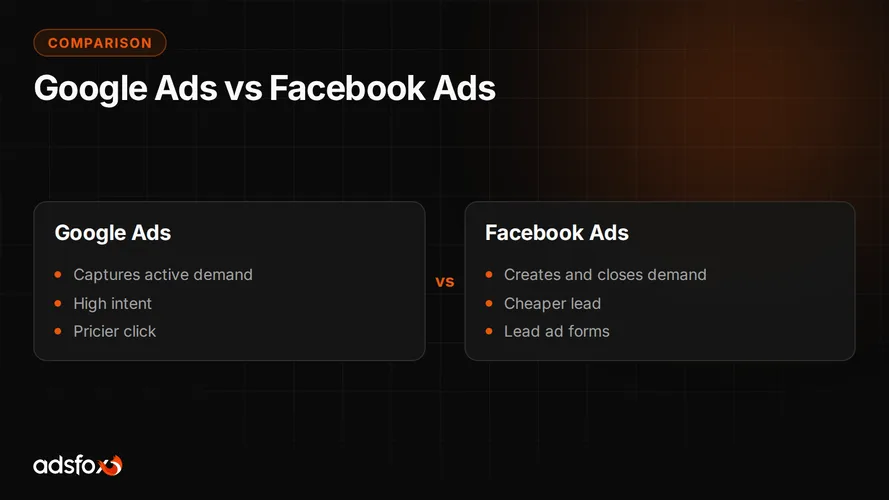
The core is Facebook and Instagram advertising: that is where the target audience lives and where video remarketing works. Search adds intent (“online English course”, “Spanish for work”), and Google Ads campaigns catch people already decided on learning and comparing offers. With a younger audience it is worth adding TikTok as a test, where the video format lets you show the method and the teacher before anyone clicks.
The common denominator: everything measured with one tracking setup, so the budget goes where it actually sells.
Where to start
- Set up a purchase event with a value before you spend a dollar.
- Stop boosting posts; set up campaigns with a sales objective and remarketing.
- Start with a budget that collects data (for us $500 a month was enough) and scale behind results.
- Keep ownership of the account, the pixel and the domain.
If you would rather skip the stage of learning on your own budget, see how we run campaigns for businesses, and book a free consultation. We will run the numbers for your course, your margin and your real break-even point.