Med Spa Marketing: How to Get More Patients
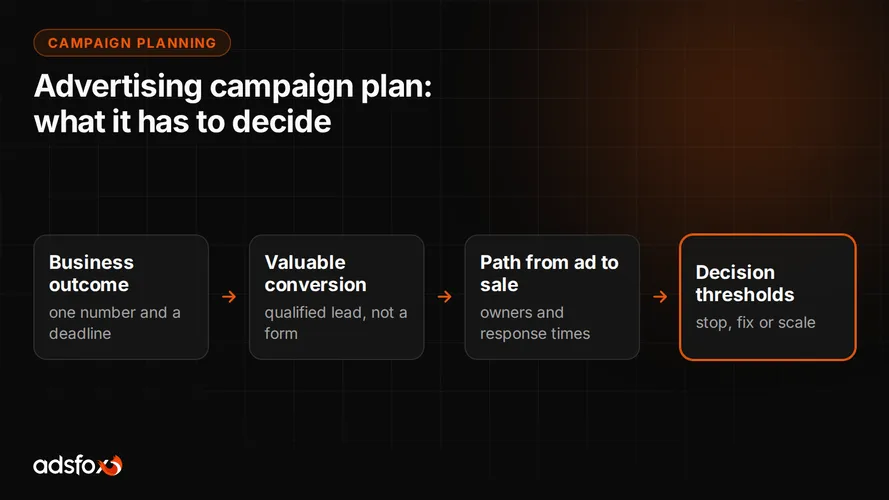
Med spa marketing works when three elements come together: lead campaigns in Meta Ads and Google Ads, lead quality classification in a CRM, and remarketing to people who already visited your website. The raw number of form fills says nothing about whether the clinic is gaining patients. At adsfox we have run campaigns since 2018 for more than 350 clients in over 20 industries, including aesthetic medicine businesses. In one of our projects, lead classification and a quality signal back to Meta increased qualified leads from 80 to 195. In another, a newly opened clinic saw a 70% increase in clients within 3 months at a cost per lead of about $5. This guide shows how we got there and what to watch out for in medical categories.
Why lead quality matters more than the number of forms
A cheap form fill in aesthetic medicine can be misleading. A campaign can look great in the ad dashboard because it generates a lot of submissions, but part of those contacts have no sales potential. The person lives outside the treatment area, does not pick up the phone, or leaves their details out of curiosity. Every such submission costs the front desk and the sales team time, and open treatment slots are limited.
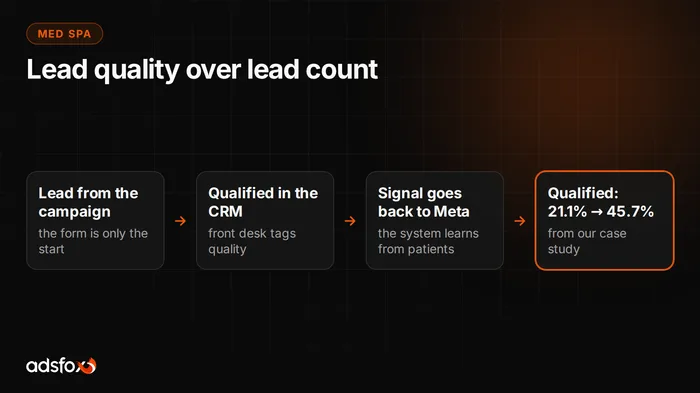
In our project for a beauty and aesthetic medicine brand, Meta Lead Ads campaigns generated 379 classified leads in the first analyzed period, of which only 80 were qualified. The share of valuable contacts was 21.1%. The ad dashboard showed stable costs, but almost 4 out of 5 submissions could not be turned into a booked appointment.
The conclusion is simple: if the clinic does not know which leads are valuable, the ad algorithm learns the wrong signal and scales cheap volume instead of patients. The first step is measuring quality, not increasing the budget.
How lead classification in a CRM improves campaigns
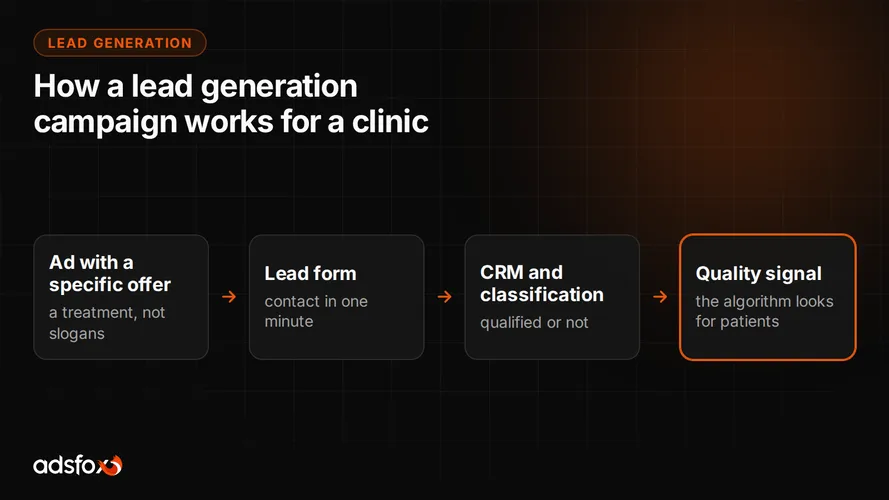
Classification means the team tags every contact in the system: qualified, unqualified, appointment booked. Those tags go back to the ad platform through the Pixel and the Conversions API as a quality signal. Meta stops looking for people who will merely submit a form and starts looking for people similar to those who actually book treatments.
In the project described above, this funnel raised the share of qualified leads from 21.1% to 45.7%, a gain of 24.6 percentage points, between two two-month periods. The number of unqualified leads dropped from 299 to 232, so the front desk handled fewer random submissions and more conversations ended with a date in the calendar.
For classification we use the adsfox tool, described on the lead generation optimization page. We explain how to connect a CRM with your campaigns step by step in the guide on CRM and ad campaigns.
What advertising restrictions apply in medical categories
Aesthetic medicine faces restrictions that other industries do not. Meta does not allow ads to imply personal attributes of the viewer, so messages like “get rid of your wrinkles” can be rejected. Before-and-after photos and promises of treatment results require caution. Google, in turn, limits ad personalization in health topics, which narrows your options for building audience lists.
In practice this means two things. First, creatives must talk about the treatment and the offer, not about how the viewer looks. Second, overly aggressive sales messaging attracts random submissions. A message that filters interest and helps the user judge whether the offer is for them works better. This conclusion comes directly from our Meta Ads case study for aesthetic medicine.
An effective campaign in this category requires knowledge of ad policies and regular creative tests that pass platform review without account blocks.
How remarketing works for med spas
The decision to book a treatment rarely happens after the first contact with an ad. The user compares clinics, reads about the procedure, checks reviews and comes back to the topic a few days later. Remarketing reminds people who visited the website about the offer, and it is often what closes the booking.
In the campaign for a newly opened aesthetic medicine clinic, we combined Google Search campaigns with remarketing to website visitors, plus video ads and carousels on Facebook and Instagram that built brand awareness. Because of personalization limits in health categories, we base remarketing on website visits and treatment content, not on audience attributes.
The prerequisite is correct tracking. In this project we configured GA4 and the Meta Pixel with custom events: treatment booking and phone number click. With growing browser restrictions, server-side tracking further improves data quality.
How much does a lead and a client cost in aesthetic medicine
In our projects in this industry, cost per lead ranged from about $5 to $8.50. In the campaign for the new clinic (Google Ads 70% and Facebook Ads 30%, average budget $750 a month), the cost of acquiring one lead was about $5. In the Meta Lead Ads campaign for the beauty brand, the average CPL dropped from $8.50 to $7.08 after we implemented quality classification.
These values line up with our benchmark of 20 campaigns across 11 industries, where cost per lead ranged from $2 to $11 depending on the industry and region. Full ranges, the math for cost per qualified lead and pricing factors are in a separate post: how much a lead costs in aesthetic medicine.
On top of the ad budget you need campaign management. At adsfox it starts from $490/month per ad channel. With a media budget of about $750 a month, the clinic from our case study had enough data for the campaigns to be optimized.
How we increased qualified leads by 143.8%
This is a project for a beauty and aesthetic medicine brand that books treatments in many cities in an event-based model, in one of our European campaigns. We compared two two-month periods: December 2025 to January 2026 and February 2026 to March 2026. Meta Ads spend was about $3,220 and $3,031 respectively, so the improvement did not come from a bigger budget.
Results after implementing lead classification and the quality signal to Meta:
- qualified leads: from 80 to 195, up 143.8%,
- unqualified leads: from 299 to 232, down 22.4%,
- share of qualified leads: from 21.1% to 45.7%,
- all classified leads: from 379 to 427, up 12.7%,
- average CPL: from $8.50 to $7.08, about 16.7% lower.
The full implementation is described in the Meta Ads case study for aesthetic medicine. We run campaigns like this as part of our Facebook Ads agency service.
How a new clinic grew its client base by 70% in 3 months
The second project is a newly opened aesthetic medicine clinic that, despite investing in the space, equipment and team, was not attracting clients. We started with the basics: a website audit (navigation, load time, broken redirects), an SEO audit, Google Business Profile improvements, and setup of Google Search Console, GA4 and the Meta Pixel with custom events.
Only then did we launch campaigns: Google Search Ads with remarketing (70% of the budget) and Facebook and Instagram Ads with video and carousels (30% of the budget), promoting treatments such as needle mesotherapy and microdermabrasion. The total ad budget averaged $750 a month.
The result: a 70% increase in clients within 3 months at a cost per lead of about $5. Details are in the aesthetic medicine clinic case study. We run search campaigns as part of our Google Ads agency service.
Where to start with med spa marketing
Start with tracking, not budget. The order that worked in the projects above: website and analytics audit, event setup (bookings, calls), launch of lead campaigns, classification of every contact in the CRM, quality signal back to the ad platforms, and remarketing to website visitors.
adsfox has run campaigns since 2018 for more than 350 clients in over 20 industries. We are a Google Partner and a Meta Business Partner at the Badged level, and we show results in public case studies with numbers, not generalities.
If you run a med spa or an aesthetic medicine clinic, we will analyze your campaigns, forms and contact classification. See how we work as a Facebook Ads agency and book a free consultation.