Medical Supply Store Marketing: 3.58 ROAS and a B2B Channel
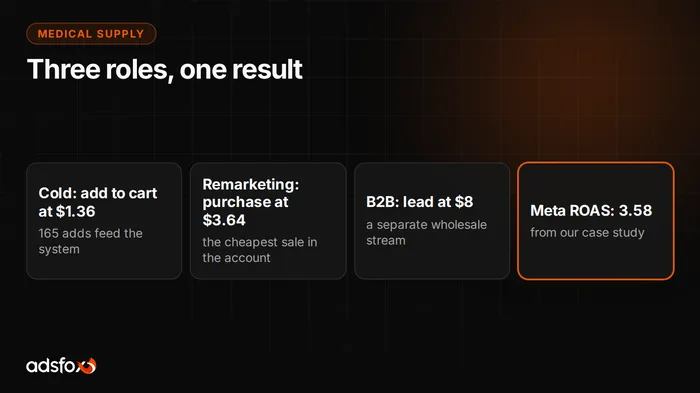
Medical supply store marketing differs from regular e-commerce in two ways: the rules on advertising health-related products, and the frequent two-track sales model, where wholesale exists alongside retail. Our medical footwear case study shows how to tie both into one structure: 3.58 ROAS from Meta Ads, remarketing delivering purchases at $3.64, a cold campaign collecting add to carts at $1.36, and a separate B2B channel with leads at $8.01. Below is the whole puzzle.
The numbers come from our medical footwear advertising case study, one of our European campaigns.
What the “medical” label changes in advertising
Ad platforms treat health topics with caution, and so should the advertiser. In practice that means: no treatment claims, no suggesting the viewer has a condition, no language that sounds like a diagnosis. The message shifts to where it converts best anyway: wearing comfort, professional use, certifications, user reviews.
The second consequence is budgetary: some classic e-commerce tricks are off the table, so the result has to be built with campaign structure and tracking quality, not aggressive messaging. That is exactly what the numbers in this project show.
The structure that made the result: three campaign roles
The key in this case study was dividing the work between campaigns, each with a different objective and a different acceptable cost:
- Cold campaign for add to carts: 165 adds at $1.36. This campaign feeds the system with data and builds a base of people engaged with buying.
- Remarketing for purchases: 21 purchases at $3.64. It closes people who already know the product; this is the cheapest sale in the account.
- B2B lead forms: 19 leads at $8.01. A separate stream for wholesale buyers, judged on cost per lead, not on retail ROAS.
The sum of that structure: 3.58 ROAS from Meta Ads, on $453 spent in the period shown. Each role judged separately; throwing everything into one pot would blur the picture and lead to switching off campaigns that do their part of the job.
Budget: from $375 to $750
The start in this project was $375 a month, the current budget is $750, and as a typical starting point for this industry we suggest about $500 a month. The logic for raising it is always the same: first the system collects data in every role, then the budget grows where the return is proven.
A warning from the same industry: campaigns judged on page views can look impressive (in our case: 2,611 results at $0.05 with a reach of 50,068) and sell nothing. A cheap event is not the goal; the goal is an event that leads to money.
How much does a customer cost: how to calculate it for a medical supply store
- ROAS on purchase value for retail, cost per lead for B2B; two metrics, two calculations.
- Margin over revenue. Medical products are often high-margin, so a 3.58 ROAS can mean an excellent business; your margin decides, not comparisons with fashion.
- Reference points: our benchmark of 20 campaigns across 11 industries shows the spread between industries; medical footwear at 3.58 ROAS sits next to pet food at 10-16 ROAS, and both results are good in their own context.
Campaign management: at adsfox from $490/month per channel.
Retail and wholesale in one account: the rules
Medical supply stores often sell on two tracks: to end customers and to clinics, stores or practices. In advertising these worlds have to be separated, otherwise the system optimizes for one audience at the expense of the other:
- Separate campaigns with separate objectives: purchase events for retail, a form for wholesale.
- Separate creatives: consumer benefit language versus trade partnership language.
- Separate accounting: $8.01 per B2B lead is a different currency than $3.64 per retail purchase; comparing them head to head makes no sense.
Where to start in your store
- Set up purchase events and a B2B form as separately tracked goals.
- Build three campaign roles: cold for add to carts, remarketing for purchases, B2B for leads.
- Start with a budget around $500 a month and scale the roles that prove their return.
- Keep the messaging compliant with the rules for health products.
We build structures like this as part of our Facebook and Instagram advertising, and for purchase intent we add Google Ads campaigns. Book a free consultation: we will go through your product range and map out campaign roles for your numbers.