Online Course Marketing: How to Sell Education Online
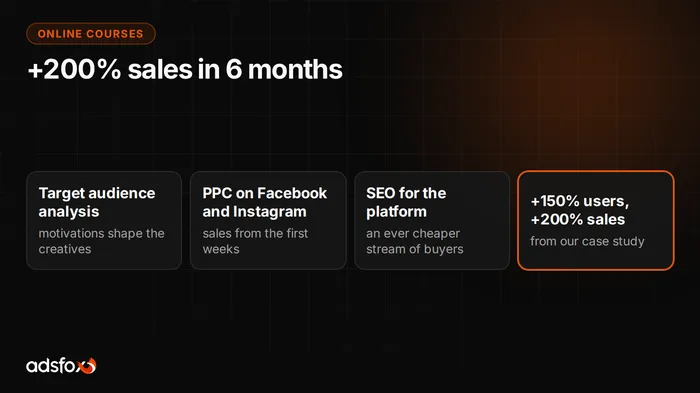
Online course marketing works best as a system, not as a single channel. In our case study, combining audience research, SEO for the platform, and PPC campaigns on Facebook and Instagram brought 150% more new users to the platform and 200% more course sales in six months. This post breaks that result down into parts: what drove traffic, what drove sales, and why the order mattered.
The numbers come from our online course advertising case study, one of our European campaigns. It is a record of one specific project, not a market average, but the principles behind it are repeatable.
Why online courses need more than ads
Online education has two traits that shape all of its marketing. First, the decision rarely happens on first contact: the buyer compares, reads, and comes back. Second, the market is crowded, so simply showing up in an ad does not set you apart; what does is hitting a specific motivation (a promotion, an exam, a career change) and proving quality.
That leads to the architecture that worked for us: paid campaigns make the first contact and close the sale with remarketing, content and SEO build trust and a second, cheaper stream of visits, and shared tracking shows what actually sells.
What exactly made up the 200% increase in sales?
Three layers worked in parallel for six months:
- Precise market and audience research. Before the first campaign launched: who buys, why, what the platform competes against, and which motivations the market leaves underserved. That sets the creatives and keywords for months.
- SEO for the platform. Visibility for the phrases people type when they look for a course, built systematically. SEO in education takes time to pay back, but it compounds: every month adds traffic you do not pay for per click. We describe how to organize that work in our guide to SEO step by step.
- PPC campaigns on Facebook and Instagram. Sales objectives, creatives built around motivations, remarketing to people who looked but did not buy. These delivered results from the first weeks, before SEO gained momentum.
The result after six months: new users on the platform up 150%, course sales up 200%. Sales grew faster than traffic, which is a healthy sign: the system did not just bring more people, it brought better-fit people.
How to measure marketing for a course platform
The rule is the same as for any e-commerce business: a purchase event with a value, tracked from day one and tied together across channels. Only then can you see that campaign X sells while campaign Y only brings browsers, and that SEO traffic converts differently than paid traffic.
Two metrics we watch in education:
- ROAS per channel and per campaign, calculated on purchase value. Reference points from different industries are in our benchmark of 20 campaigns across 11 industries.
- Sales growth relative to traffic growth. If traffic grows and sales do not, the problem is in the offer or the course page, not in the ads.
Our campaign management pricing is public: from $490/month per channel, with the rules spelled out.
What not to copy blindly from this case study
Honesty requires a caveat: six months was the horizon of this project, not a universal promise. The platform had a product that held up and an owner willing to work on content. If a course has no proof of quality, or the website loses buyers before checkout, campaigns will only expose the problem faster. That is also the value of tracking: it tells you what to fix first.
The second warning, shared across the whole education industry: ownership of your assets. About 40% of clients who come to us from other agencies have trouble getting back their ad account, pixel or access, and in the worst cases it ends with a change of the entire domain. Everything your marketing runs on has to belong to you.
Where to start promoting your courses
- Define your buyers’ motivations and check how they search: that sets your keywords and creatives.
- Set up the purchase with a value as a tracked event before you spend a dollar.
- Launch Facebook and Instagram campaigns with a sales objective and remarketing.
- Build SEO in parallel: over time, it is what brings the average acquisition cost down.
- Judge the whole over months; in our case the full effect showed after six.
Want to see what such a system would look like for your platform? Book a free consultation. We will go through your product, pricing and current results, and tell you straight where the shortest path to growth is.