Pet Store Marketing: 10-16x ROAS on Repeat Pet Food Orders
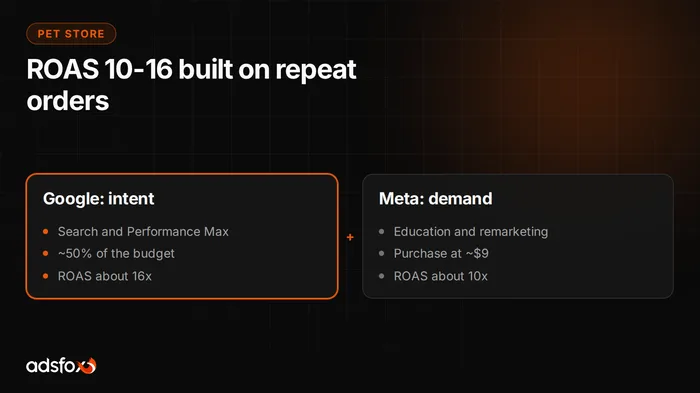
Pet store marketing has a built-in advantage other industries can only dream of: purchases repeat. Pet food runs out every month, so a customer who is convinced once comes back regularly, and that changes the entire math of advertising. In our case study of a raw dog food store, that math looked like this: ROAS of 10-16x (about 10x from Meta, about 16x from Google), campaign revenue of about $8,800 a month, and a cost per purchase of about $9 with correct tracking. Below is the full structure.
The numbers come from our dog food store advertising case study, one of our European campaigns.
Why the pet industry handles advertising so well
Three mechanisms work together here. Repeat business: the customer acquisition cost is spread over many purchases, so even a moderate first ROAS becomes a great deal over a year. Emotion: owners treat their pets like family, so food quality is not a category they save on. Searchability: some customers actively search for specific diets and brands, giving search campaigns ready-made intent to capture.
From these mechanisms comes the two-channel architecture that made the result in this project.
Division of labor: Google captures intent, Meta builds demand
In this case study, about 50% of the budget went to Google Ads, including Search and Performance Max, to capture purchase intent: people already searching for pet food, raw diets, specific needs. The return on that part: about 16x, and a screenshot from the account showed the scale of that machine: 17,020 clicks, a conversion value of about $64,850 on spend of about $2,840.
The other half worked in Meta: building demand among dog owners, education around the diet, and remarketing. The return: about 10x, and at a later stage of optimization the dashboard showed 335 purchases at $8.15 per purchase and a conversion value of about $36,400 (13.36 ROAS).
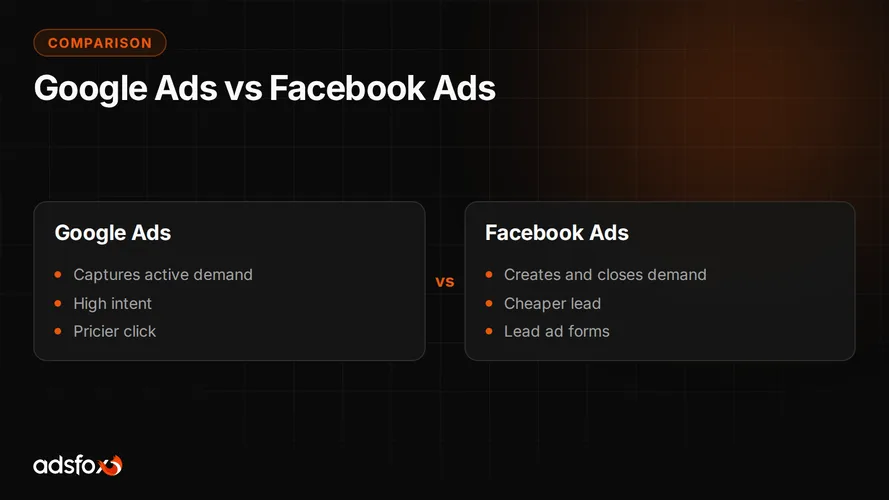
The conclusion that carries over to other stores: the channels do not compete, they do different parts of the funnel. Cutting either one “because the other has better ROAS” breaks the whole, because Meta also feeds the searches that Google later collects.
How much does a pet store customer cost: how to calculate it
- Cost per purchase, not per click. In our case, with correct conversion tracking, the cost per purchase from Meta and Google campaigns was about $9. That number only makes sense against customer value over time.
- Customer value over time. With food bought every month, a customer acquired for $9 pays back many times over; that is the right metric for this industry.
- ROAS per channel and per role. Reference points from other industries are in our benchmark of 20 campaigns across 11 industries; pet food at 10-16 ROAS sits at the top precisely because of repeat business and margin.
The starting budget in this project: about $500 a month. Campaign management: at adsfox from $490/month per channel.
What else worked for the result
Conversion tracking with values. The whole puzzle stands on purchase events with amounts; without them there is no ROAS and no decision on how to split the budget. At scale it is worth closing the data gaps with server-side tracking.
Performance Max with a product catalog. For a store with a wide product range it is the natural engine: products land in Google Shopping results automatically. We explain how this campaign type works and when it makes sense in our post on Performance Max.
Returning customers. Remarketing to buyers and recurring communication turn a single purchase into a subscription; in the pet industry that is not an add-on, it is the core of the model.
Where to start in your store
- Set up purchase events with values; without them nothing else exists.
- Build two engines: Google Ads for intent, Meta Ads for demand and remarketing.
- Start with a budget around $500 a month and split it by cost per purchase, not by preference.
- Count customer value over time, because in this industry that is the real result.
Want this setup for your store? Book a free consultation: we will go through your product range, margins and purchase frequency, and calculate what acquisition cost you can really accept.