Real Estate Developer Marketing: 742 Leads on a $250 Budget
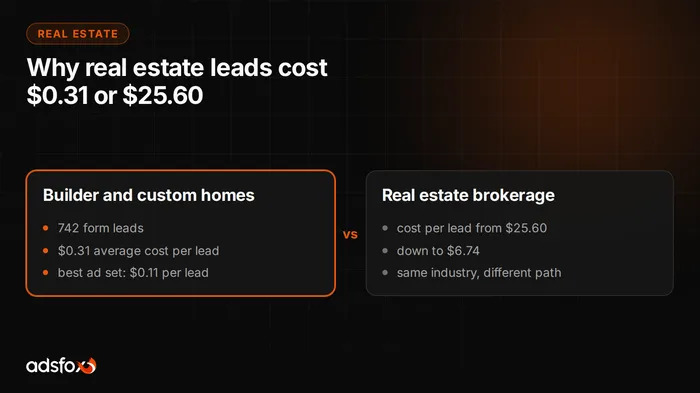
Real estate developer marketing is a set of activities that turns an ad budget into countable quote requests, not reach and comments. In our real estate campaigns, that meant 742 form leads at an average cost of $0.31 for a home builder, and a cost per lead cut from $25.60 to $6.74 for a real estate brokerage. Below we break down where that difference comes from and in what order to repeat it.
Why does cost per lead in real estate differ by a factor of dozens?
Because “real estate” is not one industry but at least two different advertising tasks.
A developer or home builder looks for an interested prospect. The customer is at the beginning of the journey and wants to understand the construction method, cost, and timeline. There are many such people, the form is cheap, and the work only starts with follow-up.
A brokerage looks for an owner ready to list a property. That is a narrow group, the decision is serious, and the process runs through a phone call and a meeting to a signed listing agreement. That is why a lead costs dozens of times more, and why the raw number of forms says nothing here.
The practical conclusion: before you compare your cost per lead with someone else’s, check whether you are talking about the same task. We collected benchmarks from eleven industries in our CPL and ROAS benchmark.
Where to start: tracking, not ads
In the project for the company that designs and builds homes, two things were missing at the start: the Meta Pixel and form conversion tracking. The consequence is always the same. The ad account does not know what a valuable action is, so it learns to optimize for what it can see: clicks, reactions, traffic.
The order that worked for us:
- Meta Pixel and form tracking before any budget increase.
- A CRM connected to the campaigns, so you can see not only the number of leads but what happens to them.
- Only then scaling, because scaling a campaign without tracking just increases the speed at which you spend money on the unknown.
What budget does a developer really need?
Less than most companies assume. The campaign that produced 742 leads started at about $125 a month and grew to about $250. In the main results view, $232 in spend produced the full set of those leads, and the best ad set got down to $0.11 per lead, the second to $0.25.
The real estate brokerage was different: a start around $375 to $500 a month, and about $750 after results were confirmed. There, the budget has to carry a more expensive lead and a tight geographic focus.
What messaging works in developer ads?
Specifics beat brand image. In our creatives, the best performers were promises the customer can verify: building a home in four months, well-planned interiors, downloading a detailed quote. Generic slogans about design and space performed worse when they did not lead to specific information.
On the audience side, interest-based groups tied to real estate worked: home, starter home, real estate investing, mortgage calculator, new home, single-family home.
For a brokerage there is one more condition: geography. A lead from the wrong location looks good in the dashboard and solves no sales problem.
Why is lead count the wrong metric for a brokerage?
Because the form is only the beginning of the process. The business result appears when a phone call turns into a meeting, and the meeting into a signed agreement.
That is why, in the brokerage project, the campaign ran together with the adsfox CRM, which let the sales team set lead statuses and rate lead quality. Without that layer, lowering the cost per lead can worsen the company’s result: more contacts, the same number of meetings.
Where to start in your own business
- Check whether you track forms at all. If not, every discussion about cost per lead is a discussion about a number you do not know.
- Separate the two tasks: acquiring people interested in building, and acquiring owners who want to sell. Those are two different campaigns and two different budgets.
- Start with a small budget and calculate the cost per lead before you add money. Our 742 leads came from a budget that, at many companies, fits within the cost of a single trade show banner.
- Connect a CRM from day one, because without it you cannot tell a cheap lead from a valuable one.
We described the full numbers, dashboard screenshots, and the course of both projects in our case studies: Meta Lead Ads for a custom home builder and Meta Lead Ads for a real estate brokerage.
adsfox is a full-service digital marketing agency for service businesses: content, SEO and GEO, paid campaigns, and your website. More than 350 clients since 2018, Badged Meta Business Partner and Google Partner.
Related adsfox services
We run campaigns for developers and real estate brokerages as part of our Facebook and Instagram advertising. Rating lead quality on the sales side is handled by lead generation optimization. Inquiries from search are built separately, through local SEO. If your campaigns are already running but you do not know where the budget is leaking, start with a marketing audit.
Book a free consultation: we will check whether your campaigns track forms and whether your budget is working toward real quote requests.