Server-Side Tracking: How to Measure Marketing Without Cookies
Server-side tracking is a way of measuring conversions on the server, which helps a company keep control of its data despite the limits of cookies, iOS, ad blockers and user consent. If you run Google Ads or Meta Ads campaigns, the question is no longer “can you measure marketing without cookies?” The question is: “does your data system show the ad platforms which leads actually turn into sales?”
Our verdict at adsfox: measurement without cookies is possible, but it does not work well if it relies only on a standard pixel, basic GA4 and the number of form submissions. You need your own data system: server-side tracking, the Conversions API, first-party data and a CRM connected to your campaigns.
What is server-side tracking?
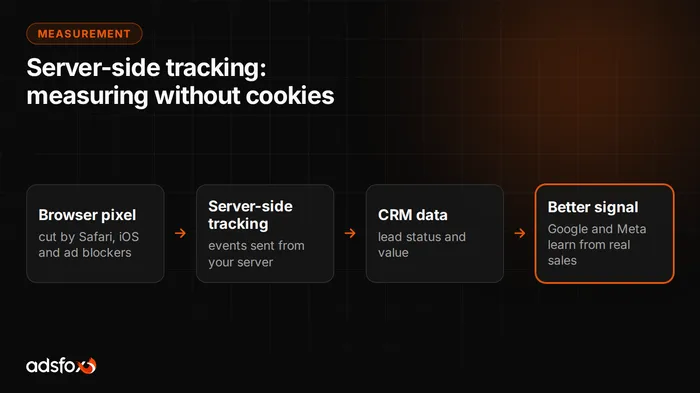
Server-side tracking is a method of collecting and sending data about marketing events through a server, not only through the user’s browser. In practice, part of the information about conversions, leads and sales is passed to the ad systems through a more stable path than the classic browser pixel.
This is not about “getting around privacy.” It is about organizing first-party data, handling consent correctly and connecting marketing with sales more tightly. Standard tracking increasingly loses part of its signals to browser restrictions, ad blockers, privacy settings and cookie limits.
Apple WebKit described full third-party cookie blocking in Safari as the default privacy approach back in 2020. StatCounter Global Stats describes its browser market share data as based on more than 3 billion page views a month, so changes in browsers are not a technical detail. They are real context for every company that spends money on ads.
Sources: WebKit: Full Third-Party Cookie Blocking and More and StatCounter Global Stats.
Why “you can’t measure marketing without cookies” is a myth
It is a myth because cookies are only one element of measurement, not the whole data system. A company can measure marketing effectively if it knows what it wants to measure, where a lead is created, how it gets into the CRM, and which data then goes back to Google Ads and Meta Ads.
The problem starts when campaigns optimize for the easiest signal: a form submission. Such a lead may be cheap, but not necessarily valuable. If the ad platform does not know whether the lead was qualified, whether it picked up the phone and whether it finally bought, the algorithm learns from an incomplete truth.
That is why at adsfox we do not treat tracking as a technical add-on. It is the foundation of media decisions. Well-implemented measurement shows not only where an inquiry came from but also whether that inquiry made business sense.
How server-side tracking helps Google Ads and Meta Ads
Server-side tracking helps Google Ads and Meta Ads receive fuller conversion data, even when part of the browser signals is limited. In lead generation campaigns, this means above all better quality feedback data.
Example: a service business gets 100 leads a month. In a classic report it sees the cost per form. That is not enough. After connecting the CRM, it can see which leads were valuable, which did not fit the offer, which never picked up the phone and which moved forward in the sales process.
That signal can be used in campaigns. Google Ads and Meta Ads should not learn only from the number of forms. They should get information about the value of the leads they generated. This is where server-side tracking stops being a technical topic and becomes a tool for improving ROI.
What should a good cookieless measurement system include?
A good measurement system without cookies is not one tool. It is a set of connected elements that together show a fuller picture of marketing and sales.
| Element | Why you need it |
|---|---|
| First-party data | So that measurement rests on your own data, not only on browser data. |
| Server-side tracking | To pass events more reliably and limit signal loss. |
| Conversions API | So that Meta Ads can receive events from the server, not only from the pixel. |
| Enhanced conversions | So that Google Ads recognizes conversions better while respecting privacy rules. |
| CRM | So that campaigns see the status and value of leads, not just the submission. |
| User consent | So that measurement complies with privacy requirements and regulations. |
The biggest mistake is implementing one element without a process. CAPI alone will not solve the problem if the CRM is empty, lead statuses are random and sales does not update the data.
Is the Conversions API enough?
The Conversions API matters, but on its own it is not enough. CAPI is a channel for passing data to Meta, not a measurement strategy for your whole marketing. If a company sends Meta only the information “lead,” without quality, status or sales context, it is still optimizing campaigns for a limited signal.
In practice, the best results come from combining several layers: the browser pixel, server signals, event deduplication, Consent Mode, the CRM and regular data quality checks. Only then does the ad system see something more than the fact that a form was sent.
This matters most in Meta Ads. adsfox is a Meta Business Partner and a Google Partner, so we treat this not as a trendy technical buzzword but as part of a system that should help you make better advertising decisions.
When should a company implement server-side tracking?
A company should consider server-side tracking when it spends a meaningful budget on campaigns and wants to know which sources really deliver sales. Most often this applies to companies with 10 to 200 employees that generate leads through forms, phone calls or a booking calendar and handle them in a CRM.
Signs that it is time to act:
- Cost per lead looks good, but sales is not growing proportionally.
- GA4, Meta Ads and Google Ads show different conversion numbers.
- The sales team rates leads differently than the ad dashboard does.
- Campaigns are optimized for the number of leads, not their value.
- The company does not know which campaigns generate customers and which only generate forms.
If you recognize these symptoms, the campaign itself may not be the problem. The problem may be the quality of the signals the campaign is learning from.
Want to check whether your campaigns are optimized for the right signals? Book a free consultation and we will review your tracking, CRM and campaign feedback data.
How to implement cookieless measurement step by step
The safest way to start is with an audit, not with installing another tool. At adsfox we first check which events are measured, where the discrepancies come from and whether sales data can flow back to the ad systems.
The practical order looks like this:
- Map the path from the ad click to the sale.
- Check which events really matter for the business.
- Clean up consent, GA4, tags and UTM parameters.
- Connect forms, the CRM and lead statuses.
- Implement server-side tracking and the Conversions API where it makes sense.
- Set up event deduplication and data quality tests.
- Send lead value and status information to your campaigns.
This is not a project “for the analyst.” It is a project for management, marketing and sales, because it affects where the ad budget goes.
Summary: server-side tracking gives you control of your data
Server-side tracking is not a magic fix for the end of cookies. It is part of a bigger system that helps a company measure marketing based on better data. The biggest benefit is not that more conversions show up in the dashboard. The biggest benefit is that campaigns can learn from signals closer to sales.
If your company only measures the number of form submissions, you may be scaling leads that have no value. If you connect campaigns with the CRM and first-party data, you can optimize budget for leads that have a real chance of becoming customers.
Book a free consultation and we will check whether your tracking, CRM and Google Ads or Meta Ads campaigns send the right signals for optimization.