Social Media Management Contract: What It Must Include
A social media management contract has one job: to make sure both sides know exactly what they are buying and what happens when they part ways. A good contract spells out the scope, content approval, rights to materials, and, most importantly, ownership of the accounts. A bad one consists of generalities that work until the first dispute. This article is a checklist of points to review before you sign, written from experience on both sides of the table.
A disclaimer up front: this is not legal advice, just a practical marketing checklist. It is worth showing any specific contract, especially an unusual one, to an attorney.
Scope: measurable, not poetic
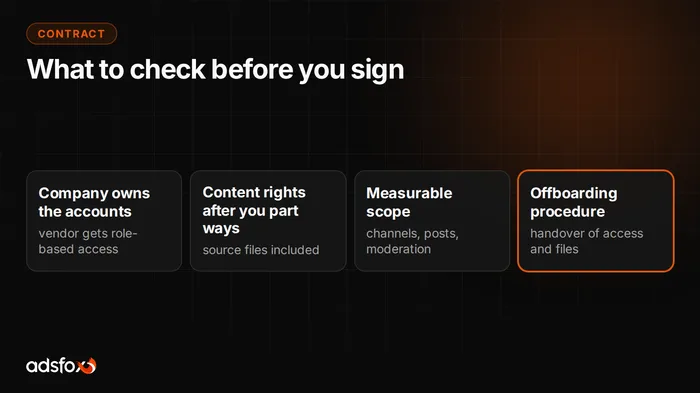
“Full-service social media management” means everything and nothing. A scope that protects both sides is measurable:
- which channels (Facebook, Instagram, TikTok, LinkedIn…),
- how many posts per month and of what kind (static graphic, carousel, Reel),
- who creates the materials: graphics, photos, video editing; what the company supplies,
- community management: does it cover comments and messages, with what response time, during which hours,
- reporting: what, how often, in what form.
We broke down what goes into the cost of such a service and how to compare proposals in our article on social media management pricing. The rule is the same: anything not counted in the contract will one day be “out of scope.”
Account ownership: where companies lose the most
We will say it plainly, because we have cleaned up after these situations: company accounts must belong to the company. The Facebook Page, the Instagram account, the TikTok profile, the Business Manager: set up under the company, with the company as the owner, and the vendor gets role-based access that can be revoked at any time.
The reverse setup, where the account is “run” on the agency’s side or on an employee’s personal profile, creates a hostage. While the relationship is good, nobody notices; at the breakup, the company discovers that its community, its publishing history, and its ad results are in someone else’s hands. The contract should state that the company owns the accounts and that the vendor must hand over full access at the end of the engagement, with no additional conditions.
Content rights: what stays after you part ways
The copy, graphics, photos, and video created as part of the service are copyrighted works, and under US copyright law, work created by an outside vendor is not automatically “work made for hire.” Rights do not transfer on their own. The contract has to settle:
- whether rights are assigned to the company or a license is granted, and for what uses,
- whether the company can use the materials after the engagement ends (this is the critical point),
- what happens to source files: design files, raw video,
- what happens to materials featuring the vendor’s employees or music licensed through the platforms.
Without these clauses, the engagement ends and, formally, so does your right to your own archive of posts. Few vendors enforce this out of spite, but contracts are written for bad scenarios, not good ones.
Content approval: rhythm instead of chaos
Disputes over content almost always come from a missing procedure, not from bad faith. The contract should define the rhythm: how far in advance the company receives posts for approval, how long it has to respond, what happens when there is no response, and how many rounds of revisions are included in the price. Add a clause on sensitive content: what the vendor may publish without asking and what always requires sign-off.
It also pays to cover crisis situations: a wave of negative comments, a mistake in a post, an account outage. Who responds, how quickly, and who speaks on behalf of the company.
Personal data and access
When moderating messages and comments, the vendor processes personal data of the company’s customers, so a data processing agreement is the standard. If you have customers in the EU, GDPR requires one; US state privacy laws such as CCPA also expect a written contract with service providers that handle consumer data. Alongside it, keep access in order: named accounts instead of shared passwords, a list of people with access, and an obligation to revoke access for the vendor’s departing employees.
Termination and the offboarding procedure
Nothing says more about a contract than how it describes the end. Reasonable clauses: a notice period that allows scheduled posts to be completed and accounts handed over, plus a specific handover procedure: access, materials with rights, source files, reports. We work without contracts that lock clients in by force, because we would rather results keep a client than paragraphs, and we recommend checking every vendor for the same philosophy: how easy it is to leave a contract is a good test of intentions when signing it.
Red flags in social media management contracts
- accounts created or “maintained” on the vendor’s side,
- no mention of content rights after the engagement ends,
- a scope described in generalities with no numbers,
- early termination penalties out of proportion to the actual harm,
- no data processing agreement when the vendor moderates your inboxes.
Any one of these can be an oversight; several at once is a pattern.
Summary: the contract as a test of the vendor
How a vendor reacts when you ask for these clauses says more about them than their portfolio. A professional has them as standard, because they protect the vendor too. Pushback on account ownership or content rights is information you would rather get before you sign.
If you are looking for a service where these rules are the starting point rather than a negotiation, see our social media marketing agency page and book a free consultation. We will show you a sample scope that makes it clear what you get and what is yours. Because it should be: everything.