Social Media Management Pricing: What Drives the Cost
Social media management pricing does not exist as a single number, because the cost depends on the scope of work, not on a rate floating around the internet. Two proposals with the identical price can mean completely different work: a different number of posts, different formats, different community management, different rights to the content. So instead of looking for an “average market price,” it is better to learn how to read scopes. This article shows what makes up the bill and what to ask before you sign.
We will not give you numbers pulled out of thin air. We have run marketing for businesses since 2018, served more than 350 clients across more than 20 industries, and we know that every “average price” without a scope is misleading. Instead, you get a list of the components that actually create the cost.
Social media management pricing: what makes up the price?
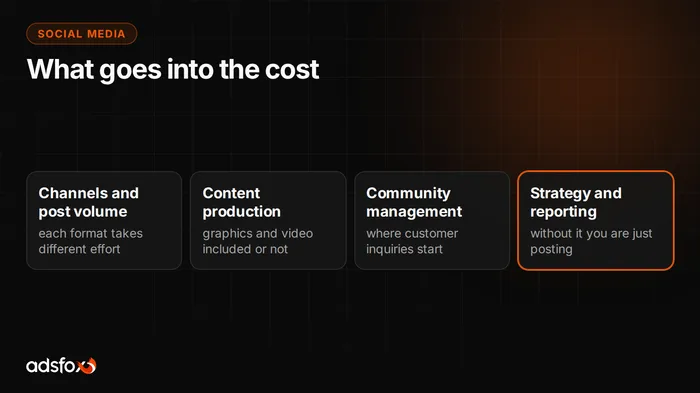
Five elements build the bill, and each one can be priced separately.
- Number of channels. Facebook and Instagram often go together, because you publish through one system. TikTok, LinkedIn, or Pinterest are separate work: a different format, a different voice, different materials.
- Number and type of posts. A static graphic, a carousel, a Reel, and an article on a company profile are four different amounts of work. Video is the most expensive to produce and usually the most effective for reach.
- Content production. Are graphics and editing included, or do you supply the materials yourself? Does someone come to shoot on location, or do they work with what you send?
- Community management. Replying to comments and messages is often out of scope, and that is exactly where customer inquiries start. Check who does it and what the response time is.
- Strategy and reporting. A topic plan, a publishing calendar, a results report, and a conversation about what to do next. Without these you are buying “posting,” not marketing.
Why comparing prices alone leads to bad decisions
Because a number without a scope says nothing. A proposal that is half the price can contain a quarter of the work: fewer posts, no community management, template graphics, no report. On paper you save money; in practice you pay for a presence that changes nothing in your sales.
There is a second trap: scope written in generalities. “Full-service profile management” can mean anything. A good proposal lists numbers and specifics: how many posts, which formats, who makes the graphics, what about video, how content approval works, what is in the report. If that is missing, ask before you sign, not after the first invoice. We put together a list of things to check in the contract itself in our article on the social media management contract.
Profile management vs. paid campaigns: two different costs
This is the most common misunderstanding in pricing conversations. Social media management is organic work: content, publishing, community management. Paid campaigns are a separate mechanism with a separate budget that goes to the ad platform, not to the vendor.
In practice, the two work best together: content builds trust and provides material, campaigns add reach and conversions. But in your budget they need to be separated, otherwise you do not know what you are paying for. If the paid side interests you, we collected reference points for customer acquisition costs in our CPL and ROAS benchmark from 20 campaigns in 11 industries, and you can find the full overview of channels on our PPC agency page.
When does doing it yourself make sense, and when does it stop?
Honestly: a very small business just starting out should often run its own profiles. The owner knows the offer and the customers best, and authenticity beats polish. The cost is real, just hidden: it is your time and consistency, which is the first thing to slip when things get busy.
Outsourcing starts to pay off at three points:
- The time math. An hour of your work is worth more than an hour of the vendor’s, and social media eats a dozen or more of them every month.
- The consistency math. The profile “lives” in bursts, with silence in between. Algorithms and customers both notice.
- The skills math. Video formats, planning content for sales, and community management are a separate craft that the vendor already has and you would have to build.
How much does social media management cost at adsfox?
At adsfox we combine social media management with the rest of your marketing, because content does not live in a vacuum: the same materials work in campaigns, and campaign data suggests topics. The repetitive part of the work is done by our tools and AI agents, which analyze data and prepare drafts for review, and every post is approved by a person. As a result, the scope is broader than the rate alone would suggest, and you know up front exactly what you are getting.
We put together the scope and quote after a conversation about your goals, not from a rate card, because a restaurant profile with three posts a week is a different job than a clinic profile with moderation of treatment inquiries. Service details are on our social media marketing agency page.
Where to start?
With a decision about what these profiles are for: sales, recruiting, or customer service. Then with a scope that can carry that. Only at the end with the price, because it follows from the first two.
If you want to run the numbers on your case, book a free consultation. We will go through your channels and tell you plainly which scope makes sense and what is not worth paying for.
Related adsfox services
Profile management and paid campaigns on the same channels are described on our social media marketing agency page. If, alongside posts, you also need copy for your website and blog, that is handled by our content marketing agency. We run ad campaigns measured by cost per lead as part of our PPC agency services, and you can see the results of our projects in our client case studies.