Social Media Marketing: What Actually Drives Results
Social media marketing is everything a business does on social platforms, and it combines two different jobs: organic posts that build credibility and paid campaigns that reach people outside your follower base. In our projects that combination produced concrete numbers: 1,880 leads at an average of $5.36 each in a recruiting campaign, a ROAS of 29.66 for a home textiles manufacturer, and a cost per purchase that dropped from $41.32 to $2.65 in a small art print store. Below we break down what those results had in common and what they did not.
Why is a profile alone not enough, and an ad alone not enough either?
Because they do different things and have different limits.
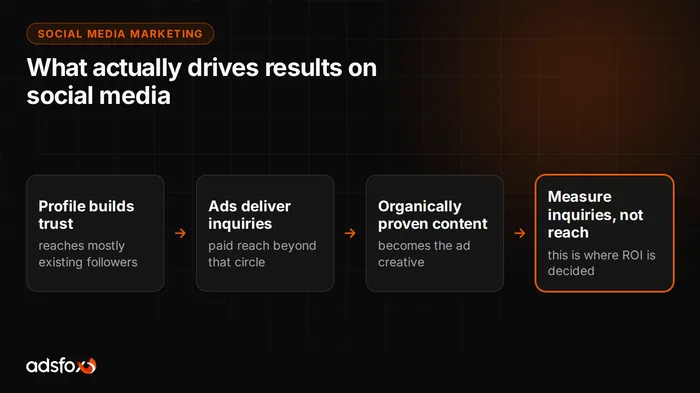
A profile reaches mostly people who already know you. It builds credibility and closes doubts before a decision, but it grows slowly, and organic reach on Facebook and Instagram has been falling for years. A business that relies on posting alone spends its first months talking to itself.
An ad reaches further, but it lands on the profile. A person who clicks an interesting ad will often check the profile before leaving their contact details. If the last post is six months old, some of those people drop off right there, and no campaign report will show it.
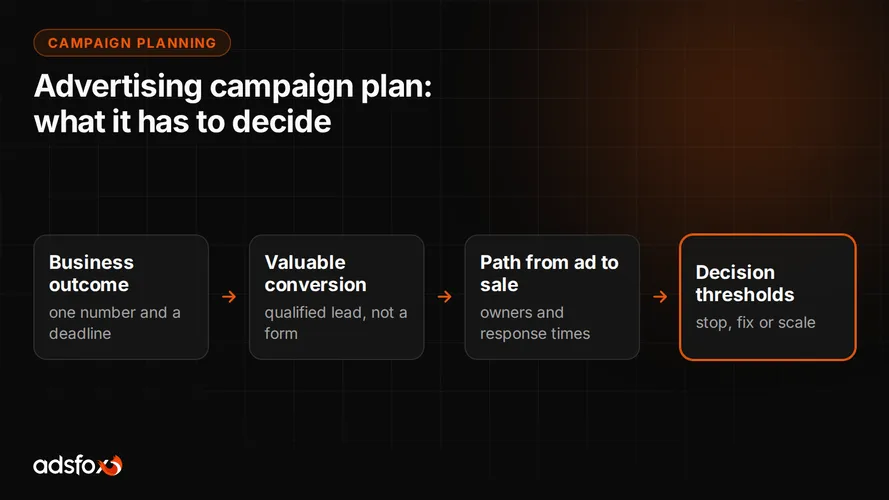
The practical takeaway: this is not a choice between content and ads, it is a question of order and proportions.
What actually determines the result of a social media campaign?
Three things, in this order, and none of them is the creative.
1. Measurement. In a project for a pet supply store, there was no data on cost per purchase before the Pixel was installed. That means no campaign could be evaluated: not the good one, not the one burning budget. Tracking is not something you add later, it is the entry ticket.
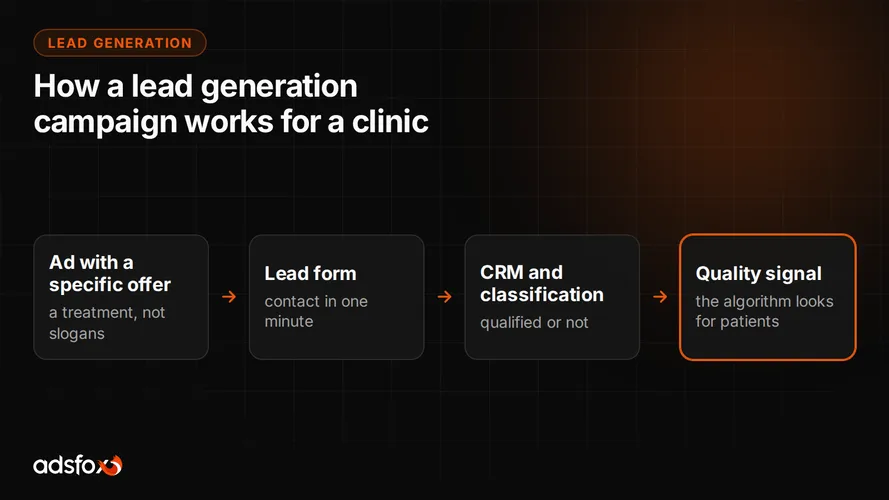
2. The optimization signal. A campaign learns from what you show it. Measure clicks and you get cheap clicks. Measure add-to-carts and you get carts, including ones nobody pays for. The business value sits in a purchase or a lead, and that is what the goal has to be.
3. Follow-up on the other side. In a recruiting campaign for a fleet partner, cost per lead dropped from about $11 to $5.36 on the same budget. The improvement came from controlling where applicants were located, the quality of the form and fast follow-up in the CRM, not from adding money.
How much does it cost and what budget makes sense?
Less than most businesses assume, but it has to be spent with focus.
| Project | Monthly budget | Result |
|---|---|---|
| Art print store | $150 to $193 | cost per purchase from $41.32 to $2.65 |
| Lead generation for a custom home builder | $125 to $250 | 742 leads at an average of $0.31 |
| Home textiles manufacturer | $500 | 80 purchases, ROAS of 29.66 |
| Driver recruiting | $500 | 1,880 leads at $5.36 |
The common thread: budget grew after the result was confirmed, not before. The reverse order is the most expensive way to test a hypothesis. How to read agency proposals and what goes into the price of profile management is covered in our post on how much social media management costs.
Which channels should you choose for your business?
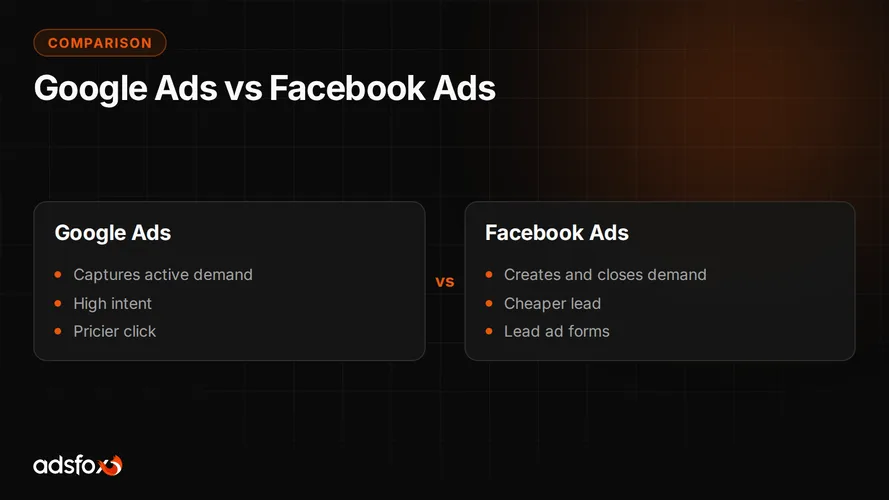
Not all of them at once, because with one budget split across six platforms none of them gets enough data to learn.
- Local service business: Instagram, Facebook and your Google Business Profile. Video of real jobs works better than studio material.
- B2B sales: LinkedIn, with a longer decision cycle and a pricier click, but a higher value per lead.
- A service with a visible result: TikTok and YouTube, because there the result can be shown instead of described.
- A visual product: Pinterest, where purchase intent builds up ahead of time.
What not to measure, so you do not fool yourself
Reach, impressions and follower counts are vanity metrics unless they are tied to inquiries. The art print store shows it best: between two periods reach dropped more than fivefold while the result improved more than tenfold. Anyone judging that campaign by reach would have called it a decline.
A sensible set of metrics is cost per lead or per purchase, number of inquiries, the quality of those inquiries on the sales side, and ROAS where there are online sales.
The same goes for organic posts. Reach grows most easily on content that has nothing to do with what the business earns money on. In August 2026 we talked with a hair salon owner whose how-to content pulled in traffic, while the treatments the salon actually makes money on were not properly described or tied to the salon’s city. The material performed in the stats and did nothing in the appointment calendar. That is why, when planning content, we first ask which service a piece is supposed to lead to, and only then what format it should have. We cover this in more depth under content marketing.
Where to start in your own business
- Check whether you track conversions and their value. Without that, everything else is guesswork.
- Pick at most two or three channels and give them enough budget to learn.
- Decide what the campaign goal is: a lead or a purchase. Not a click.
- Connect posting with campaigns, so content proven organically goes into ads as ready-made creative.
adsfox is a marketing agency for service businesses that runs the whole marketing stack: content, SEO and generative engine optimization, paid campaigns and the website. Over 350 clients since 2018, Badged Meta Business Partner and Google Partner.
Related adsfox services
Profile management and paid campaigns on the same channels are described under social media marketing agency. Campaigns billed on cost per lead are what we run as a Facebook and Instagram ads agency, a TikTok ads agency and a LinkedIn ads agency. Copy for your website, blog and campaign materials is handled by our content marketing agency. The full numbers from the projects described here are in our client case studies.
Book a free consultation and we will check whether your campaigns measure the right things and whether your profile is losing the people who clicked your ad.