What Is Bing Ads (Microsoft Ads) and How Does It Work
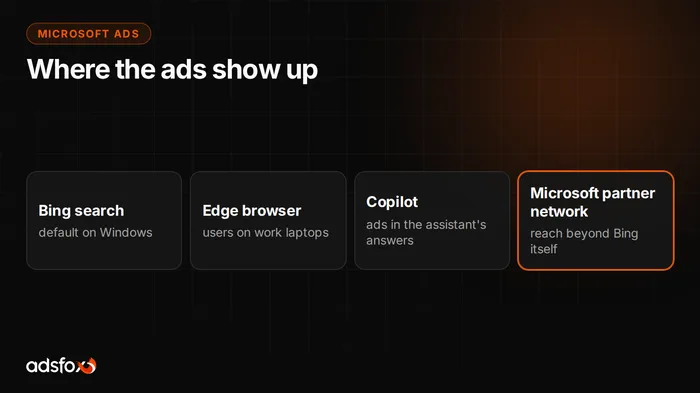
Microsoft Ads is Microsoft’s advertising platform that serves ads in Bing search, in the Edge browser, in the Copilot assistant and across the search partner network. Until 2019 it was called Bing Ads, and that name stuck, so both terms refer to the same panel. It works on the same principle as Google Ads: you pick keywords, set a budget and pay per click from a person who is searching for something right now. The difference is in scale and competition, because fewer advertisers bid on the same queries.
Below we break it down: where exactly these ads appear, how the channel differs from Google Ads, what drives its cost and when it is not worth opening.
Where do Microsoft Ads show up?
The name “Bing Ads” is misleading, because it suggests a single search engine. One account covers several placements at once:
- Bing search. Text ads above and below the results, exactly as in Google.
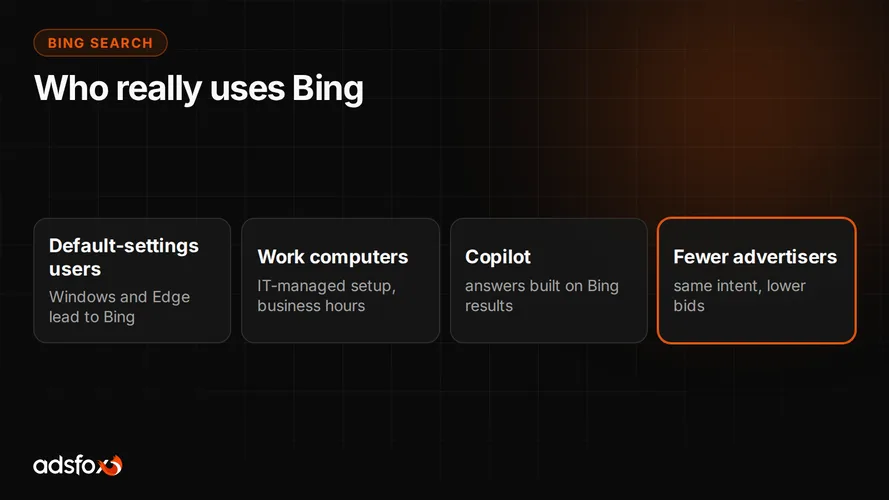
- Edge browser. The default in Windows, with Bing as its default search engine. That matters, because a large share of users never change the settings they found on a company laptop.
- Copilot. Microsoft’s assistant shows ads next to its answers, so the channel also covers traffic that stopped reaching a classic results list.
- Search partner network. Sites that use Bing results and show the same ads next to them, including Yahoo and DuckDuckGo.
- Microsoft Audience Network. Ad placements on Microsoft properties, working more like display than search.
The practical takeaway: when you buy Microsoft Ads, you are not buying “ads on Bing,” you are buying access to users of the Windows ecosystem. In the workplace that group is larger than the private habits of people who use Chrome after hours would suggest.
How is Microsoft Ads different from Google Ads?
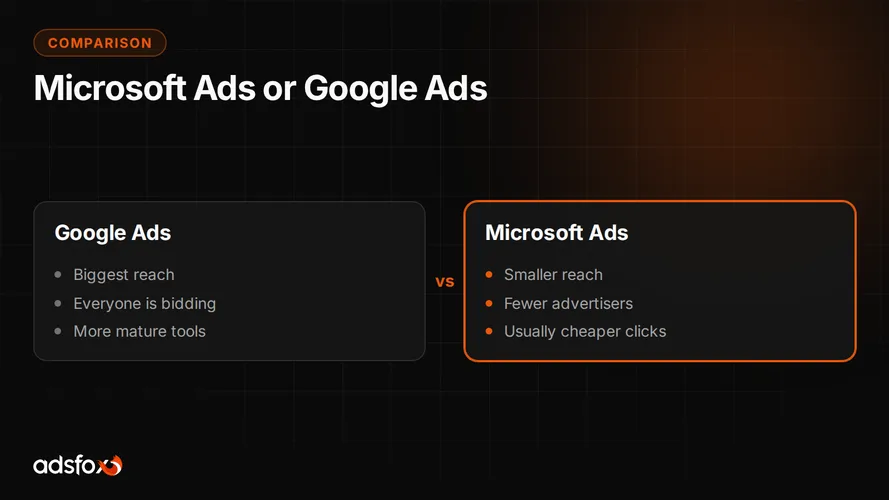
The mechanics are almost identical: an auction for every query, cost per click, a quality score for the ad and landing page, search and shopping campaigns. The differences show up only in the day-to-day of running an account.
| Area | Google Ads | Microsoft Ads |
|---|---|---|
| Search volume | Much larger | Clearly smaller |
| Auction competition | High in most industries | Usually lower |
| User profile | The whole market | Stronger share of work computers |
| Campaign import | Source channel | Built-in import from Google Ads |
| Professional targeting | No data on the user’s company | Targeting by industry, company and job function from LinkedIn data |
The last row is a real differentiator that rarely gets mentioned: Microsoft owns LinkedIn, so campaigns can be narrowed to specific industries, companies and job functions. In B2B sales that is often worth more than the lower cost per click alone. Details of how we run campaigns on this platform are on our Bing Ads agency page.
What campaign types can you run in Microsoft Ads?
The set of campaign types matches what you know from Google Ads, so there is no learning the system from scratch:
- Search campaigns. Text ads on queries, the basic format and the most common reason companies open this account at all.
- Shopping campaigns. Based on a product feed, with results in Bing’s shopping tab. You can bring over your Google Merchant Center feed, so e-commerce gets started fast.
- Audience campaigns. Image and native formats on Microsoft properties, closer to display than search.
- Video and app campaigns. A supplement for companies that already have video creative or an app to promote.
- Performance Max. Microsoft’s equivalent of Google’s automated campaign type: you set the spending limit, the platform decides which placements to show the message in. Convenient, but it requires correctly configured conversions, otherwise the platform optimizes on random events.
For most companies the sensible start is one search campaign on the best-converting queries from Google. The rest can wait until you see the first data.
How much does Bing Ads cost?
There is no rate card. You pay whatever you set as the daily budget, and the cost per click is set by an auction where what counts is not just the bid but also how well the ad matches the query and the quality of the landing page. The principle is the same as on the Google side, so if you want to understand the mechanism itself, our article on how much Google Ads costs will help.
Advertisers usually pay less per click in Microsoft Ads than in Google, simply because fewer companies bid on the same query. That is not a guarantee, though: in narrow niches bids can be comparable, and search volume is smaller either way.
One honest note: we do not have our own cost-per-lead data from Microsoft Ads, so we will not give you a number here or pretend to have one. Reference points from our Google and Meta campaigns across eleven industries are in our CPL and ROAS benchmark. Treat them as a measure of what a lead is worth in a given industry, not as a promise of results on Bing.
Can you move campaigns over from Google Ads?
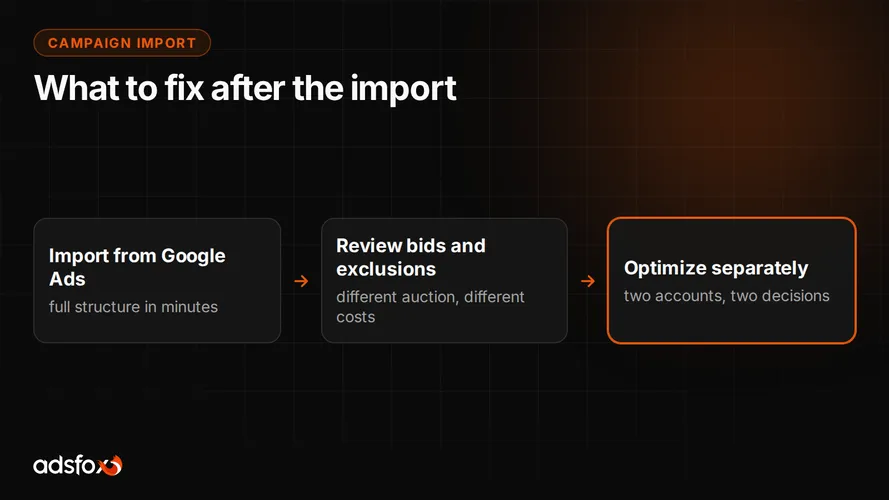
Yes, and it is usually the fastest way to start. Microsoft Ads has a built-in import that carries over your Google Ads account structure: campaigns, ad groups, keywords, ad copy and some settings. Work that would take days shrinks to a few minutes.
The problem starts in the next step. An imported campaign carries bids, negatives and a schedule tuned to a different auction, different volume and different traffic. Launched without a review, it can burn budget from day one, because it is bidding in conditions it does not know.
So after importing, go through keywords, the negative list, bids and landing pages, then run the two accounts separately. They are two different channels with different audiences, so copying decisions from one to the other usually makes both worse, and the difference is easiest to miss on keywords that have volume in Google and practically none on Bing.
Which businesses is Microsoft Ads right for, and which is it not?
The channel performs best where the person on the other end is sitting at a work computer. In practice that means B2B services, software, office equipment and supplies, training, recruiting and professional services such as legal or accounting. Add e-commerce as a supplementary channel, once Google campaigns have hit a ceiling and every budget increase raises cost per customer instead of the number of orders.
When is it not worth it? First, when your Google campaigns are still growing without cost per lead going up. Then it makes more sense to push the channel that already works than to open another one on principle. Second, when your product is aimed at very young audiences, because that group uses Bing less. Third, when your keywords have negligible search potential in Microsoft Ads. That is the simplest test, and you run it before spending the first dollar, in Microsoft’s keyword planner.
How do you check whether this channel pays off?
Before you launch ads, set up measurement. In Microsoft Ads that is the UET tag, the equivalent of the Google conversion tag. Without it you will see clicks and cost, but not whether any inquiries came from them.
The order that works:
- Install the UET tag on the site and confirm it is collecting data.
- Define conversion goals that actually mean something to the business: a submitted form, a phone call, an order. Not a menu click.
- Connect the data with Google Analytics 4 so you can compare channels in one place.
- Compare cost per customer, not cost per click. Cheaper clicks with worse conversion mean a more expensive customer.
- Decide after a meaningful sample, not after three days.
We use the same method in our Google Ads campaigns, so comparing the two channels happens on one table, not on two different definitions of a conversion.
Where to start
Microsoft Ads will not replace Google Ads, and that is not the point. It is a channel that in some industries delivers the same type of customer for less, and in others has too little volume to bother with. The difference shows in data, not in opinion, and checking it takes a short conversation and a review of your keywords.
If you want to know which side your business is on, book a free consultation. We will tell you plainly if this channel makes no sense in your situation.