
The Most Accurate Offline Conversion Tracking Software for Any CRM
Offline conversion tracking connects what happens after the click (phone calls, meetings, signed contracts, CRM stage changes) back to the ad that started it. adsfox is offline conversion tracking software built for lead-based businesses that want Google Ads, Meta, TikTok and LinkedIn to optimize for qualified leads and revenue, not for form submissions.Connect your CRM, map your statuses once, and every qualified lead, sale or lost opportunity is sent server-side to all your ad platforms and GA4.


Join 350+
happy clients.
Why most offline conversion tracking fails
Most offline conversion tracking setups were designed for reporting, not optimization.
They rely on one identifier (usually an email or a click ID), lose continuity when cookies expire, and cannot deduplicate events across platforms.
The result: ad platforms recognize only a fraction of your real customers, typically 20 to 30 percent of actual offline outcomes, and the rest of the funnel stays invisible to the bidding algorithm.
adsfox collects more identifiers per user, keeps one consistent identity across the funnel, and sends one clean, deduplicated conversion per real outcome.
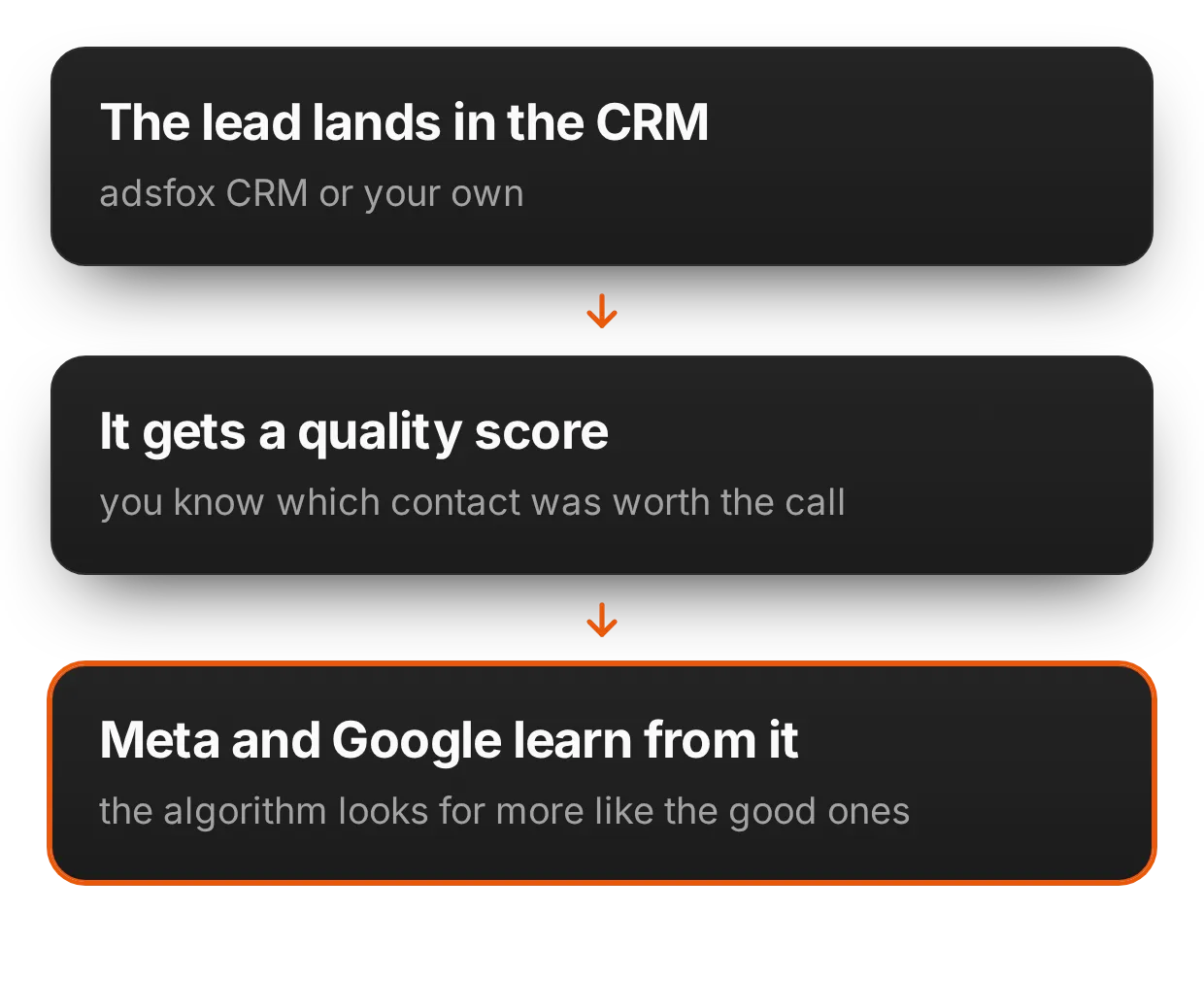
Track offline conversions where they happen
Offline conversions do not happen on web pages.
They happen in your CRM, in your sales pipeline and in your internal tools.
adsfox listens for status changes and key events in your CRM (or any webhook-enabled system), matches them to the original ad interaction using click IDs, GA4 client ID, cookies, IP and user agent, and turns them into optimization-ready signals.
You keep your sales process exactly as it is.
No rebuilds, no switching systems, no CSV exports every Friday.

Send optimization-ready signals server-side
adsfox sends offline conversions through the Conversions API of each platform: Meta, Google Ads, TikTok, LinkedIn, plus the GA4 Measurement Protocol.
Every event carries a conversion name, a conversion action and an optional monetary value, so it can be used directly as a campaign goal (Qualified Lead, Sale, Revenue), not just as a line in a report.
The same event goes to every connected platform at the same time, which means consistent optimization, shared learning and better budget allocation toward channels that drive offline revenue.
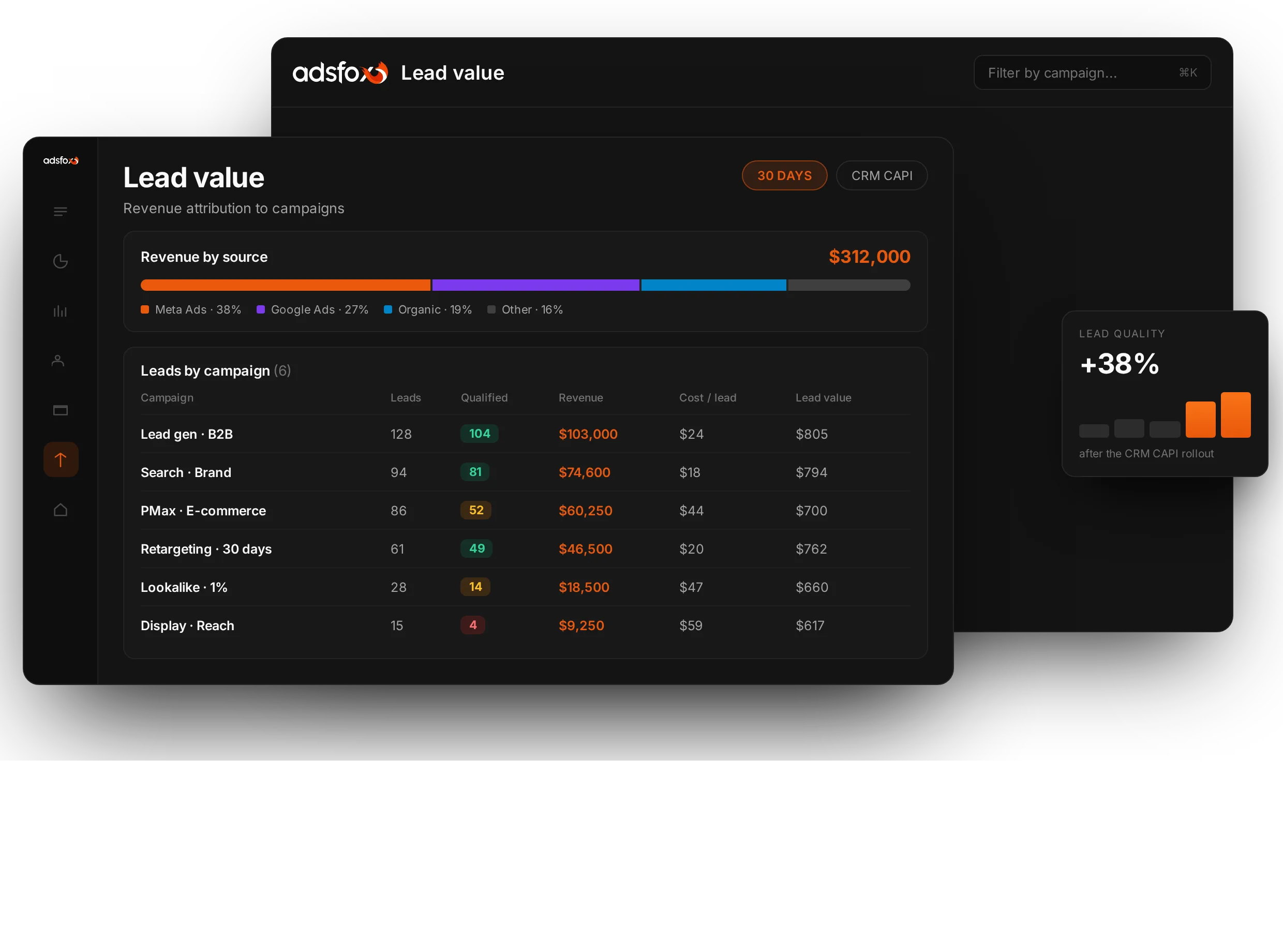
Optimize for what drives revenue
Advertising algorithms optimize only for the signals they receive.
When they get form submissions, they bring more form submissions.
When they get qualified leads, sales and revenue, they bring buyers.
Our clients see 17.6 to 40.4 percent more sales-qualified leads when they tag leads within 3 days, optimize campaigns for qualified leads and exclude unqualified leads from targeting.
Meta reports a 19 percent lower cost per high-quality lead when advertisers connect their CRM and switch the objective from lead volume to conversion leads.
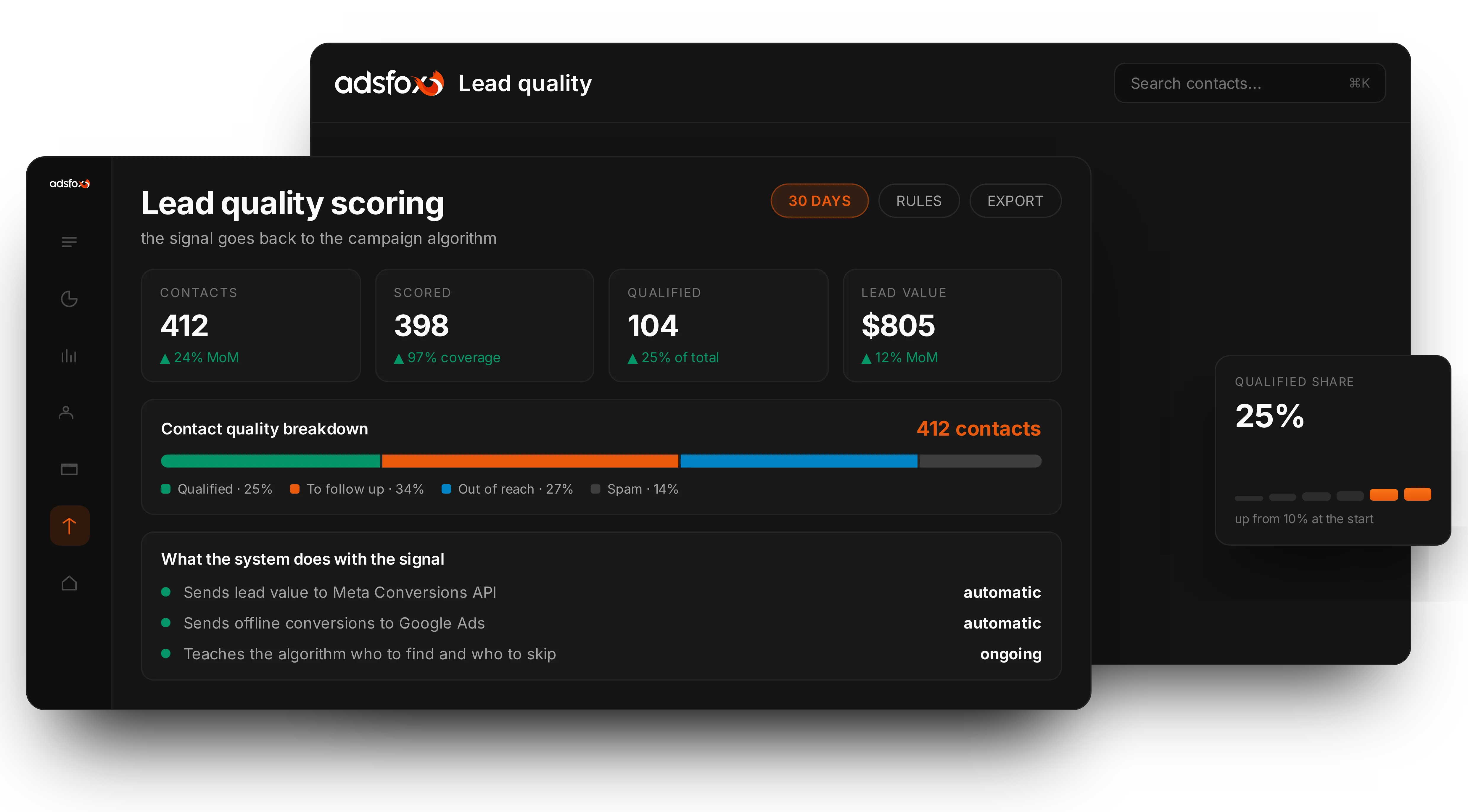
Measure true ROI and ROAS from offline sales
With offline conversion values flowing into Google Ads, Meta and GA4, you can finally calculate return on ad spend for lead generation the way e-commerce does: revenue from closed deals divided by ad spend, by campaign, ad group, keyword and audience.
You see which keywords bring phone calls that close, which audiences generate signed contracts, and which channels only generate contacts.
In GA4 the whole journey is visible: first click, lead, qualified lead, sale.
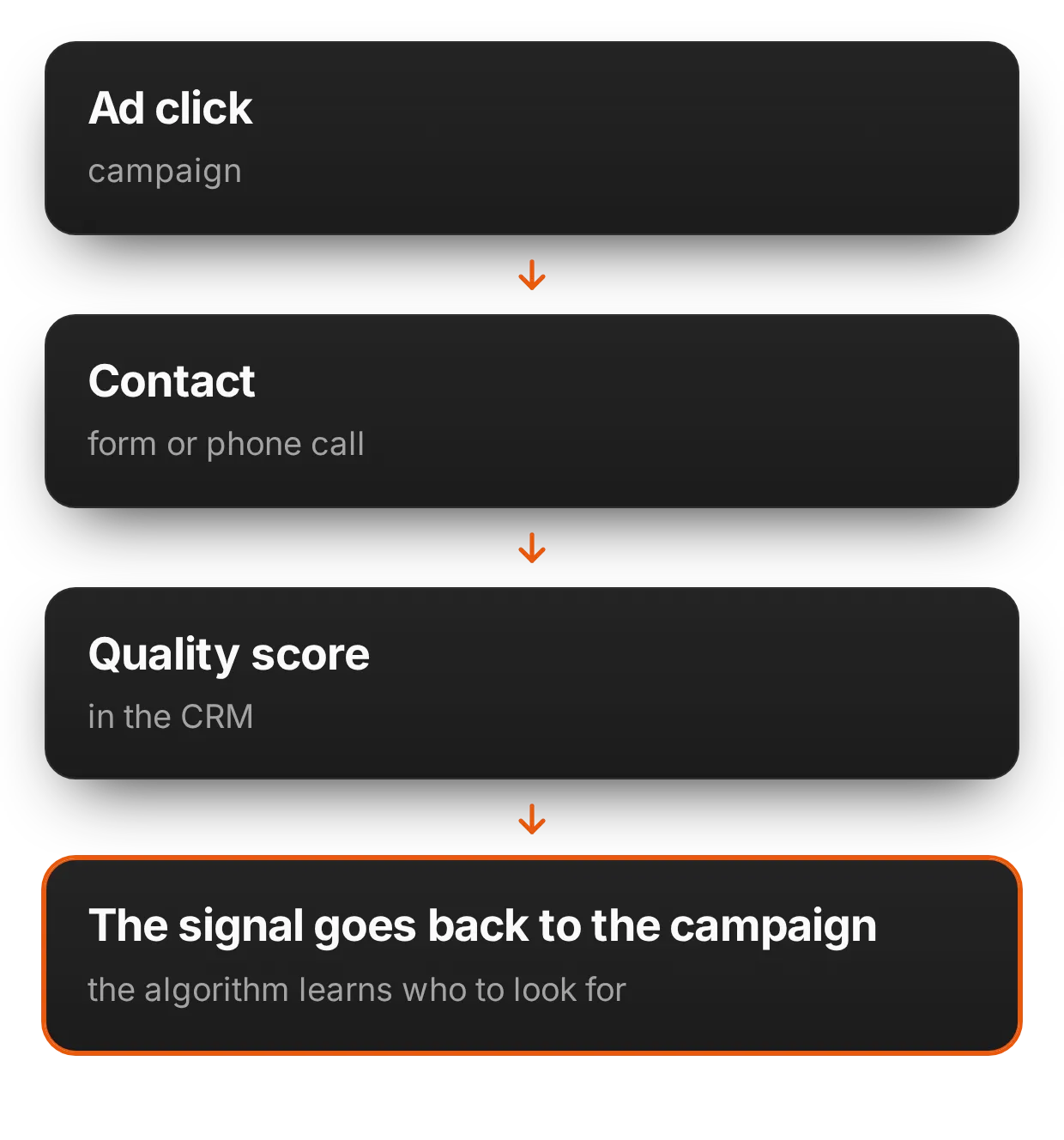
Built for lead-based businesses and agencies
adsfox is made for companies that sell through conversations: home services, healthcare and clinics, real estate, financial and legal services, B2B and SaaS.
It also works for marketing agencies that need to prove which campaigns brought revenue for each client from one login.
Setup takes minutes: connect your CRM, add one snippet to your website, map statuses, connect the ad platforms.
We are a Google Partner since 2018 and a Meta Business Partner, and we run these setups for our own clients every day.
What is offline conversion tracking?
An offline conversion is a customer action that happens outside your website but still comes from an online interaction: a phone call, an in-store visit, a signed contract, a demo that turns into a deal, or a lead that a sales rep marks as qualified in the CRM. Offline conversion tracking is the process of matching those actions back to the original ad click or form submission and sending them to the advertising platform as conversions.
Without it, Google Ads and Meta only see the form fill. They cannot tell a $10,000 contract from a spam submission, so they optimize for whatever produces the most forms. With offline conversion tracking, the platforms learn which clicks turn into revenue and shift bids, audiences and budget toward users who look like your real customers. That is the difference between paying for leads and paying for customers.
How offline conversion tracking works, step by step
- Capture the click. When a visitor lands on your site from an ad, adsfox stores the identifiers that platforms need to match a conversion later: GCLID (Google), FBCLID and the _fbp cookie (Meta), TTCLID (TikTok), LI_FAT_ID (LinkedIn), the GA4 client ID, plus IP address, user agent and landing page URL. One snippet on your site (or a tag in Google Tag Manager) is enough.
- Capture the lead. The form submission, lead ad, booked meeting or phone call creates a contact in adsfox and in your CRM, with the identifiers attached to the record.
- Record the outcome in your CRM. Your sales team does what it already does: moves the lead to Qualified, Non-qualified, Won or Lost and enters the deal value. No new fields, no extra admin.
- Send the conversion server-side. adsfox picks up the status change through your CRM integration or a webhook, deduplicates it, and sends it through the Conversions API of every connected platform, together with the value and the matching identifiers.
- Optimize and analyze. The events show up as conversion actions in Google Ads, as custom conversions in Meta Events Manager, as events in TikTok and LinkedIn, and as key events with value in GA4. You set them as campaign goals and read the reports by campaign, keyword and audience.
The full lifecycle adsfox supports: new lead, qualified lead, non-qualified lead, lost opportunity, sale with revenue. Each event includes an event ID for deduplication, so online and offline versions of the same conversion never double count.
Google Ads offline conversion tracking: GCLID, auto-tagging and the offline conversions API
For Google Ads, offline conversion tracking relies on the Google Click ID (GCLID). With auto-tagging enabled in your Google Ads account, every ad click receives a unique GCLID in the landing page URL. adsfox stores it with the lead, and when the lead becomes a sale, the conversion is uploaded with that GCLID, the conversion action name, the conversion time and the value. Google matches it to the exact campaign, keyword and search term that produced the click.
There are two ways to get Google Ads offline conversions into the account: a manual upload (Google Sheets or CSV in the Conversions section) or the Google Ads offline conversions API, which is what adsfox uses. The API upload is automatic, runs within minutes of the CRM change, and does not depend on anyone remembering to export a file. Google recommends uploading offline conversions within 24 hours (and no later than 90 days after the click) so Smart Bidding can use them. Step-by-step: how to connect adsfox with Google Ads and how to create a Google Ads campaign optimized for qualified leads.
Upload offline conversions to Google Ads: import vs API
- Manual import (CSV or Google Sheets): free and simple for a one-time upload, but delayed, error-prone (wrong timestamp format, missing GCLID, time zone mismatch) and useless for daily bidding. Fine as a fallback; adsfox supports it for historical data (importing a file with lead values).
- Offline conversions API: automatic, near real-time, deduplicated, and it can carry conversion values in your currency. This is what makes Target CPA and Target ROAS work for lead generation.
- Enhanced conversions for leads: when the GCLID is missing (for example the lead called from a directory listing or came back weeks later from a bookmark), Google can still match the conversion using hashed email address or phone number. adsfox sends both the click ID and the hashed user data, so match rates stay high even in privacy-first browsers.
Meta offline conversion tracking: offline conversions and the Conversions API
Meta used to have a separate Offline Conversions API; today offline events are sent through the same Conversions API used for website events, tagged as offline or CRM events. adsfox sends your CRM outcomes to Meta as server events with email, phone, the FBCLID, the _fbp browser cookie, IP address, user agent and the Facebook lead ID for leads that came from Instant Forms. More matching keys means Meta recognizes more of your customers, and better recognition means the algorithm learns faster who becomes a Sale.
Once the events are in Events Manager, you can run Meta lead campaigns with the conversion leads optimization goal, build lookalike audiences from qualified leads and buyers, and exclude non-qualified leads from targeting. Meta itself reports an average 19 percent lower cost per quality lead for advertisers who make this switch. Guides: how to integrate adsfox with Meta Ads, how to configure the pixel for CRM events in Meta and new CRM data and events in Meta Ads campaigns. Full details of the CRM integration are on the CRM Conversions API (CAPI) page.
Google Analytics offline conversion tracking (GA4)
GA4 does not know about your CRM unless you tell it. adsfox sends every stage change to GA4 through the Measurement Protocol with the same client ID that was captured on the first visit, so the qualified lead and the sale are attached to the original session and source. You get the full customer journey in GA4 from first click to signed contract: which landing pages, channels and campaigns produce revenue, not just which ones produce leads. Because adsfox sends lead value as the event value, GA4 treats lead generation like e-commerce: you can build funnels (lead, qualified lead, sale), compare channels by value, and export to Looker Studio. Guide: how to integrate adsfox with Google Analytics 4.
TikTok and LinkedIn offline conversions
The same events go to the TikTok Events API (with TTCLID, hashed email and phone) and to the LinkedIn Conversions API (with LI_FAT_ID and hashed email). Both platforms let you optimize lead campaigns for downstream events and exclude audiences built from non-qualified leads. This matters for B2B: LinkedIn leads are expensive, and sending Sales Qualified Lead events back is the only way to make the platform find more of them. Guides: TikTok Ads and LinkedIn Ads.
Offline conversion tracking for any CRM or webhook-based tool
adsfox works with the CRM your sales team already uses. Ready-made integrations cover HubSpot, Salesforce, Pipedrive, Zoho CRM, Bitrix24, Microsoft Dynamics 365, Livespace, Close, Freshsales, Zendesk Sell, monday.com CRM, Keap and many more; any other system that can send a webhook (or connect through Zapier or Make) works too. adsfox maps your statuses to standard events using defaults that fit most CRMs, and you can override the mapping at any time. If you do not have a CRM yet, the built-in adsfox CRM covers lead management, statuses, values and team roles.
- General procedure for connecting CRMs to adsfox
- Pipedrive integration (webhook)
- Zoho CRM integration (webhook)
- CRM integration via Make
- Webhooks in adsfox CRM
Other data sources that can trigger offline conversions: call tracking tools, booking tools such as Calendly, forms such as Typeform, Google Sheets, your own backend, and manual CSV uploads as a fallback.
Offline conversion tracking with Google Tag Manager and server-side tracking
adsfox works alongside Google Tag Manager, including server-side GTM containers. You can keep your existing GTM tags for page views and website events and let adsfox handle identifiers, lead capture and the CRM feedback loop. If you already run server-side tracking with adsfox, offline conversions use the same first-party data layer, so match quality and consent handling are consistent. Cookie banner and Consent Mode v2 stay under your control (cookie banner via GTM).
Conversion tracking software: adsfox vs. manual uploads, Zapier and LeadsBridge
You can build offline conversion tracking yourself with spreadsheets, Zapier zaps or a per-platform connector. In practice teams hit the same walls: a separate integration per platform, no deduplication between the pixel and the upload, no lead value, limited matching keys, and nobody owning the process after the person who set it up leaves. adsfox is one conversion tracking software layer for all platforms: one CRM connection, one event mapping, one identity per lead, values included, deduplication built in, plus GA4 and a client-facing panel. Pricing starts at $239 per month billed annually (see pricing), and setup is guided at no extra cost. Agencies can manage all clients from one account (adsfox for agencies).
What data adsfox collects for offline conversion tracking
adsfox collects first-party data from your website and CRM and processes it under a data processing agreement. Contact data: email address, phone number. Identifiers: click IDs (GCLID, FBCLID, TTCLID, LI_FAT_ID), Google Analytics client ID, browser cookie IDs. Context: IP address, user agent, landing page URL, UTM parameters. Conversion details: event ID, event name, timestamp, conversion action, value and currency. Personal data is hashed where the platform requires it, and consent is respected through your existing cookie banner. For GDPR, CCPA and similar regulations, add adsfox (legal entity and address in our privacy policy) to the processors in your privacy policy and include marketing and remarketing consent for the platforms you use.
Offline conversion tracking as part of lead generation optimization
Offline conversion tracking is one piece of a bigger system. adsfox combines it with lead generation tracking (source, campaign and behavior for every lead), lead qualification (a clear process for sales to mark quality) and the CRM Conversions API so that all platforms learn from the same truth. The whole package is described on the lead generation optimization page. If you would rather have somebody run it for you, our Google Ads agency and Facebook Ads agency teams set this up as part of campaign management. Book a demo or estimate your gains with the lead quality ROI calculator.
What our clients say
What I value most about working with you is having a dedicated specialist. The person matters, what they can do and how they communicate, and that is what I appreciate at adsfox. With other agencies and freelancers I could never get satisfying results. Now, after two years of working with you, it simply works.

Piotr
Owner, outdoor LED lighting manufacturer (luminous paving stones)
Given my own marketing background, I would definitely recommend working with adsfox. Highly recommended. These guys know what they are doing. I think adsfox is a great partner to work with.

Przemysław
Marketing director, event services company (crew and technical staffing)
What I value most about adsfox is that it is not a "pay and wait" arrangement. At any moment I can see where the money goes and what return it brings, and I have direct contact with specialists who advise me not only on ads but also on my offer and strategy. I delegate the complicated stuff and still keep full control over the outcome.

Dawid
Owner, e-commerce store (personalized wooden gifts)
Our revenue grew significantly and we won a lot of new clients, which is not easy in our business. That month was a record in terms of revenue, and a lot of women decided to book our services. Our schedule was packed, so we actually had to pause the ads for a while.

Justyna
Owner, women's body shaping and fitness studio
I am very happy with the cooperation. Many more customers started calling. We also see much higher traffic in our stats, both from Facebook and from Google, and it turns into phone calls and new bookings. I am very pleased with working with you.

Marcin
Owner, paintball park and outdoor events venue
With you I now pay almost 10 times less per conversion and get 200 new subscriptions a month, so for me this is a game changer.

Łukasz
Marketing manager, online courses and consulting (personal development)
Offline conversion tracking FAQ
An offline conversion is a customer action that happens outside a website, such as a phone call, an in-store purchase, a signed contract or a meeting, but is still attributed to an online interaction like an ad click or a form submission. Offline conversion tracking connects those actions to the campaign that started them.
You can import a CSV or Google Sheet in Google Ads (Goals, Conversions, Uploads) with the GCLID, conversion name, conversion time and value, or send them automatically through the Google Ads offline conversions API. adsfox uses the API: as soon as your CRM marks a lead as qualified or won, the conversion is uploaded with the stored GCLID and the deal value, and a hashed email or phone as a backup match key (enhanced conversions for leads).
For Google Ads: the Google Click ID (GCLID) or, with enhanced conversions for leads, a hashed email address or phone number. For Meta: email, phone, FBCLID, the _fbp cookie or the Facebook lead ID. For TikTok: TTCLID plus hashed contact data. For LinkedIn: LI_FAT_ID or hashed email. adsfox captures all of them on the first visit and stores them with the lead, so matching works even when one identifier is missing.
Yes. When cookies or click IDs are unavailable, offline conversions can still be matched using user-provided data (hashed email or phone) through enhanced conversions for leads in Google Ads and through customer information parameters in the Meta, TikTok and LinkedIn Conversions APIs. Server-side tracking based on first-party data is far more resilient to cookie restrictions than browser-only tracking.
Ideally within 24 hours of the CRM change, so bidding algorithms can use it while the click is still in the learning window. Google Ads accepts offline conversions up to 90 days after the click, and Meta does not use updates to leads older than 90 days for optimization. adsfox sends events within minutes of the status change, so timing is never the bottleneck.
Duplicates happen when the same event is uploaded twice, or when the pixel and the server both report the same conversion under one conversion action. adsfox assigns a unique event ID to every event, separates online and offline conversion actions, and checks each CRM change against what was already sent to each platform, so a sale is counted once per platform.
Yes. Every adsfox event can carry a value and currency: the real deal value for sales, an expected value for qualified leads (for example average deal value multiplied by your close rate) and zero for non-qualified leads. Values let Google Ads and Meta optimize for conversion value and let GA4 report lead generation like e-commerce revenue.
GA4 receives offline events through the Measurement Protocol. adsfox sends each stage change (qualified lead, sale, lost) with the GA4 client ID captured on the first visit and with the lead value as the event value. GA4 attaches the event to the original user and source, so you can see the full journey from first click to revenue and mark the events as key events.
Almost any. Ready integrations include HubSpot, Salesforce, Pipedrive, Zoho CRM, Bitrix24, Microsoft Dynamics 365, Livespace, Close, Freshsales, Zendesk Sell, monday.com, Keap and others; any system that supports webhooks, an API, Zapier or Make can be connected as well. If you have no CRM, adsfox includes one. See the general procedure for connecting CRMs.
Yes, keep the basic Meta pixel, TikTok pixel, LinkedIn Insight Tag, GA4 tag and Google Ads tag for page views and remarketing. You do not need extra browser-side conversion events such as generate_lead: all lead-related conversions are sent through the Conversions API from adsfox, deduplicated against the pixel with event IDs.
No. You can collect and analyze offline conversion data from SEO, email, referrals and other channels without running ads. When you launch campaigns later, the platforms already have your history of qualified leads and sales to learn from, and GA4 already shows which pages and channels bring revenue.
There is no minimum for reporting; every event is useful in GA4 and in your reports from day one. To switch a campaign's bidding goal to qualified leads or sales, platforms want a steady stream of events, roughly several per day. As a rule of thumb, around 200 leads per month lets you optimize directly for quality signals with stable results.
In long cycles the sale happens weeks after the click. Offline conversion tracking keeps the click identifiers with the lead in the CRM, so the conversion can still be attributed to the right campaign 30, 60 or 90 days later. Intermediate events (qualified lead, proposal sent) give the algorithms an earlier signal while the deal is still open.
Google Tag Manager captures identifiers on your pages and can pass data to server-side systems. adsfox works alongside GTM (web and server containers): keep your GTM setup for website events, and let adsfox handle lead capture, CRM matching and the server-side upload of offline conversions to every platform.
adsfox relies on first-party, consent-based data and server-side processing. Personal data is hashed where required, your cookie banner and Consent Mode keep working as before, and adsfox acts as a data processor under a written agreement. Add adsfox to your privacy policy and include marketing consent for the platforms you use.
Yes. Agencies manage multiple client accounts from one login, connect each client's CRM and send server-side conversion events to Meta, Google, TikTok and LinkedIn per client. It is a transparent way to prove which campaigns brought revenue, not just raw leads. Details on the adsfox for agencies page.