Meta AI Connectors: Managing Ads Beyond Ads Manager?
Meta AI Connectors are a development in performance marketing that shows campaign management may increasingly move outside the classic ad dashboard. If AI tools can analyze, create and modify Meta Ads campaigns, what changes is not only the technology of the work, but also the role of the agency and the way ads are controlled.
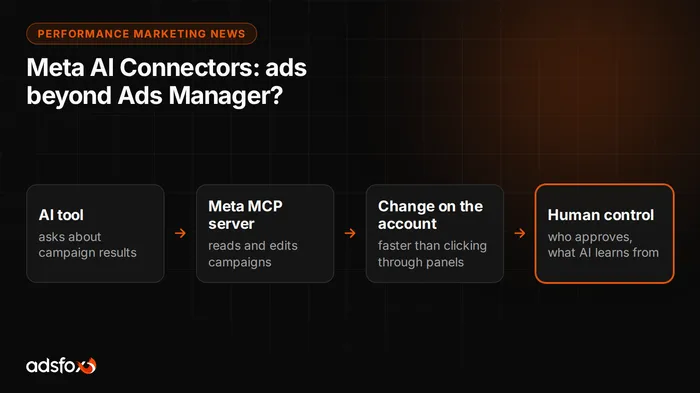
Meta AI Connectors are connections between AI tools and Meta ad campaigns, described by PPC Hero in the context of paid social work. According to the article, advertisers can create, manage and analyze campaigns from inside AI tools, with the integration running through Meta’s MCP server. That is an important signal: AI stops being just a suggestion tool and moves closer to the place where actions on the account are taken.
Why do Meta AI Connectors matter?
Until now, most work on Meta Ads campaigns happened in Ads Manager. That is where you checked results, changed budgets, analyzed ad sets and published new creatives. AI tools could help interpret data or write copy, but they usually worked alongside the process.
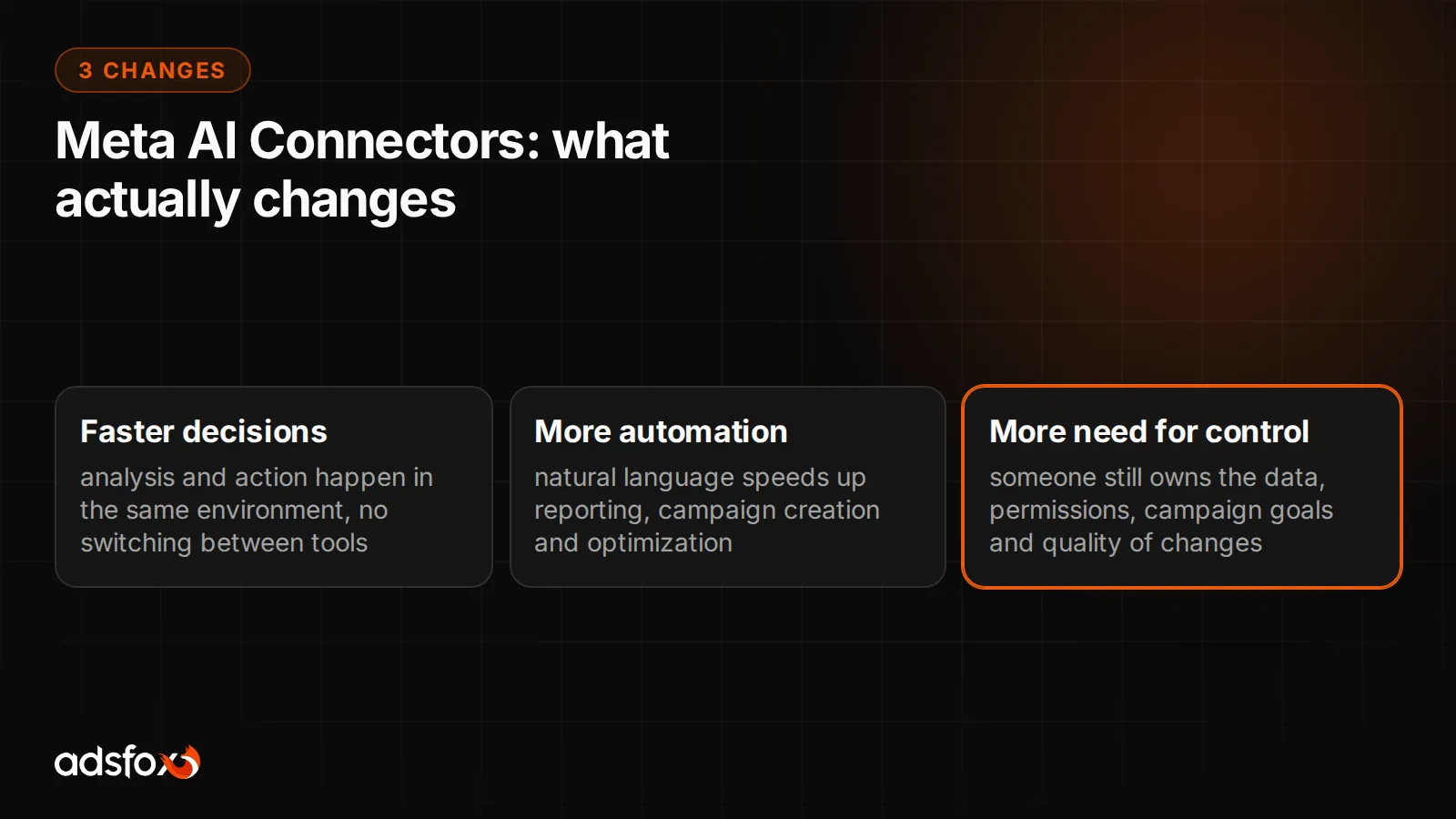
Meta AI Connectors change that pattern. If an AI tool has access to campaign data and can take actions, analysis and execution start happening in the same environment.
That can shorten the time from noticing a problem to reacting. At the same time, it raises the importance of control, permissions, data quality and accountability for decisions.
What can a business gain?
The biggest promise is speed. If a manager or an agency can ask an AI tool about campaign results and then immediately prepare a change, a report or a recommendation, the work can move faster.
The second benefit is convenience of analysis. Instead of clicking through dashboards and exports by hand, the team can ask questions in natural language: what hurt results, which ad sets are growing, where lead quality is dropping, which creatives are worth keeping.
The third benefit is automation of repetitive tasks. Reporting, initial analysis, data cleanup and creating campaign variants can be faster than in a classic manual process.
But each of those benefits only works when the company knows what result it wants and which data is reliable.
Where is the risk with AI-managed ads?
The risk is not that AI will “take over the campaigns.” The risk is that bad decisions can be made faster.
If the system only sees cost per lead, it may recommend actions that increase the number of cheap inquiries. If it does not see CRM data, it does not know which leads were valuable. If there are no clear brand safety rules, it may suggest changes that look good short-term but degrade the quality of communication long-term.
That is why AI in advertising needs a process. Who approves changes? Which decisions can it execute automatically? When is human approval required? How do we check whether an AI recommendation makes business sense?
How does the agency’s role change?
If AI makes campaign tasks easier to execute, the agency’s role should not be reduced to “clicking in the dashboard.” That will be an increasingly low-value part of the work.
The bigger value is in the agency understanding the business, the data and the sales process. Someone has to decide which goals are right, which leads are valuable, how to interpret the data and when automation should be stopped.
In practice, that means the agency’s role shifts from campaign operator toward a partner for the customer acquisition system. AI can speed up execution, but it does not replace strategy, analytics and accountability for the result.
Why is CRM data even more important?
Meta AI Connectors can speed up analysis and action, but they still need quality data. If the ad system and the AI tool only see surface metrics, they will optimize campaigns on an incomplete picture.
For a service business, what matters is what happens after the form. Did the lead pick up the phone? Did they pass qualification? Did they receive an offer? Did they become a customer? Without that data, AI may recommend raising the budget on a campaign that looks good in the dashboard but does not deliver sales value.
That is why campaign automation should go hand in hand with CRM integration, tracking and lead quality analysis.
How adsfox looks at Meta AI Connectors
At adsfox we treat developments like this as a signal that performance marketing is becoming more operational, more technical and more data-driven. It is no longer just about setting up a Meta Ads campaign. It is about whether the company has a system that can make a good decision based on data.
As a Meta Business Partner, we look at the development of Meta’s tools not only through the features in the dashboard, but through their impact on the client’s process. Automation makes sense when it supports the right goal: valuable leads, customers, sales and predictable growth.
If you run Facebook and Instagram Ads campaigns, ask yourself whether your account is ready for more automation. Does tracking work correctly? Does CRM feed back quality data? Does anyone control what AI is supposed to learn from?
Summary: AI speeds up campaigns, but does not replace control
Meta AI Connectors show where paid social is heading: less manual clicking, more work with AI, more automation and a faster move from analysis to action.
That is good news for companies with organized data and processes. It is a risk for companies with chaos in measurement, permissions and campaign goals.
Book a free consultation and we will check whether your marketing campaigns are ready for automation and whether the algorithms learn from the right signals.
Context source: PPC Hero, “What Meta’s AI Connectors Change About Running Paid Social”.