Server-Side Tracking: Better Data for Your Ad Campaigns
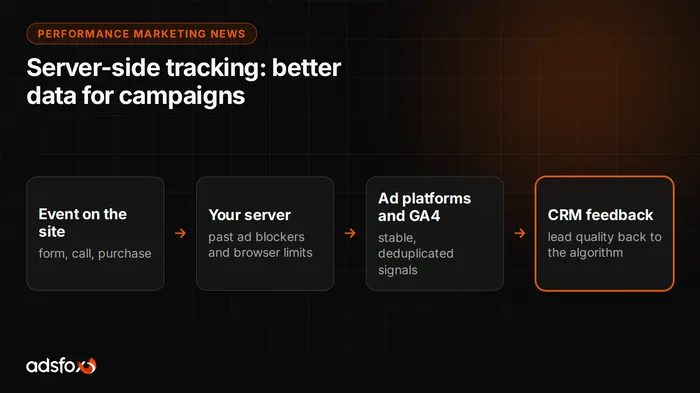
Server-side tracking is a way of collecting and sending event data on the server side, which helps a company reduce data loss from the browser and improve the quality of signals for ad campaigns. For the business, it is not a technical add-on. It is part of solid measurement that affects reporting, ad optimization, lead evaluation and budget decisions.
In practice, the website can register a click, a form submission or a purchase, but that information does not always reach GA4, Google Ads, Meta or TikTok. Stape, in its guide “Server-side tracking: what it is and how to implement it,” points out that browser limits, user consent and ad blockers can stop part of the data along the way. The effect is simple: ad platforms receive weaker signals, and the company reads reports that do not show the full customer path.
Why does server-side tracking matter for campaigns?
Server-side tracking matters for campaigns because ad platforms make decisions based on the signals they receive. If the system sees only part of the events, it may learn from an incomplete picture. That affects optimization, performance evaluation and decisions about where to move budget.
For a business, the risk is very practical. A campaign can look fine in the ad dashboard without showing which actions generated valuable leads. The problem gets worse when marketing is judged only by clicks or form count.
If you do not know which leads moved to a sales conversation, an offer or a sale, you are optimizing budget for activity, not for results. Server-side tracking helps put that foundation in order.
What exactly does server-side tracking improve?
Server-side tracking improves, above all, the stability and quality of data. That does not mean every system will suddenly report identical numbers. It means the company has more control over which events are sent, in what quality and to which tools.
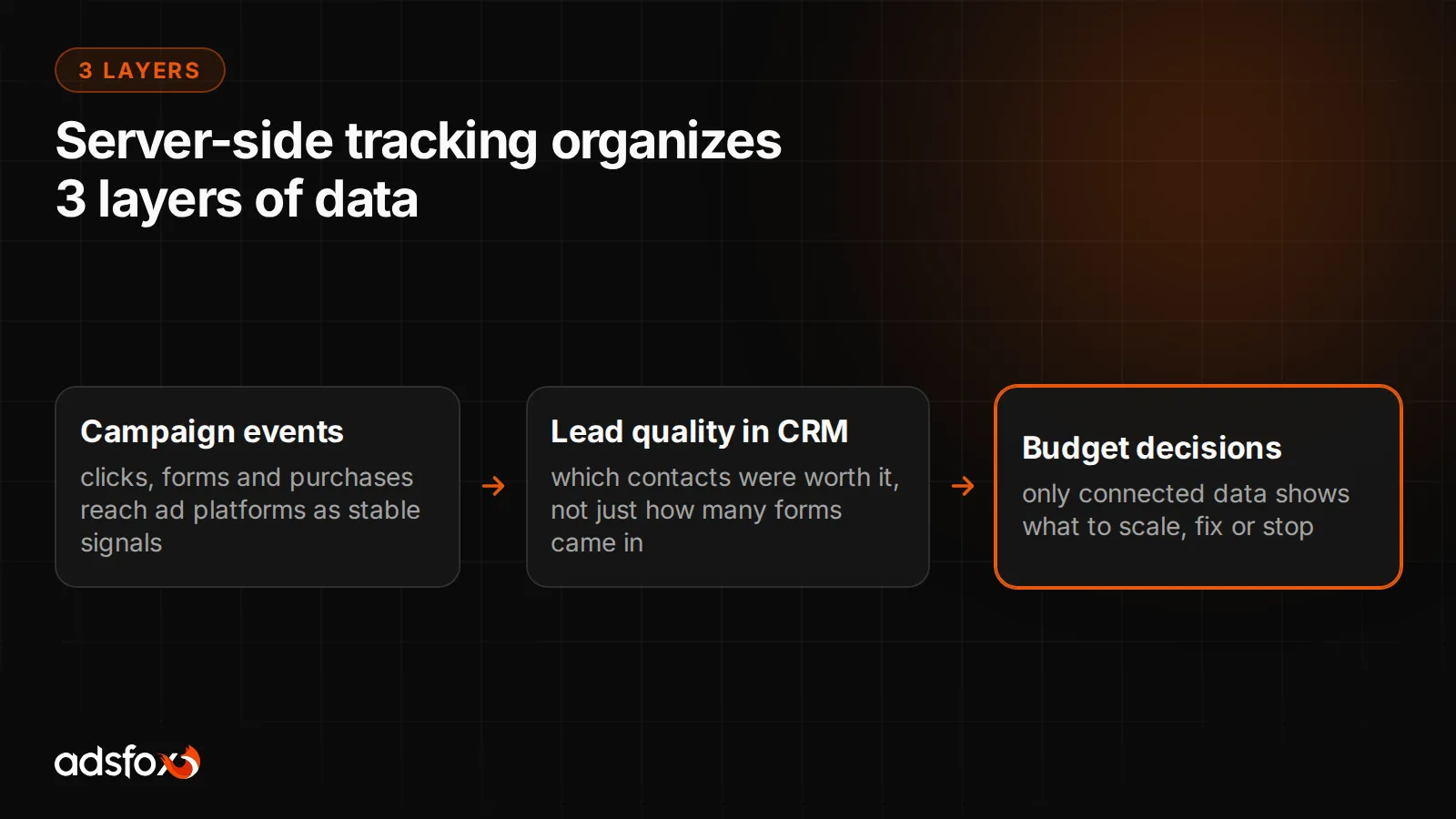
In practice, it helps take care of three areas:
- sending events to ad platforms,
- organizing lead and sales data,
- reducing discrepancies between analytics systems, CRM and ad dashboards.
That matters most in lead generation campaigns. A form submission alone does not say whether the lead was valuable. If the CRM does not send back information about contact quality, the ad platform learns from the signal “form,” not from the signal “potential customer worth something to the business.”
Is standard browser tracking no longer enough?
Standard browser tracking is still important, but in many companies it stops being enough as the only data source. The user’s browser is now a place where data can be restricted by consent, privacy settings, ad blockers, cookie blocking or other privacy protection mechanisms.
That does not mean a company should ignore consent and privacy. Quite the opposite. A good server-side tracking setup should comply with the privacy policy, user consent and the configuration of analytics tools, including GDPR in the EU and US state privacy laws such as CCPA. The point is to send data in a more controlled and consistent way, not a random one.
The most common mistake is treating tracking as a one-time setup. A company installs pixels, checks that the event “fires,” and then for months makes decisions based on reports nobody compares with CRM and sales.
How does server-side tracking connect with CRM and sales?
Server-side tracking delivers the most value when it does not end with sending an event. The best business effect shows up when campaign data is connected to CRM and lead quality information. Then the company can check not only how many contacts it acquired, but also how much those leads were worth.
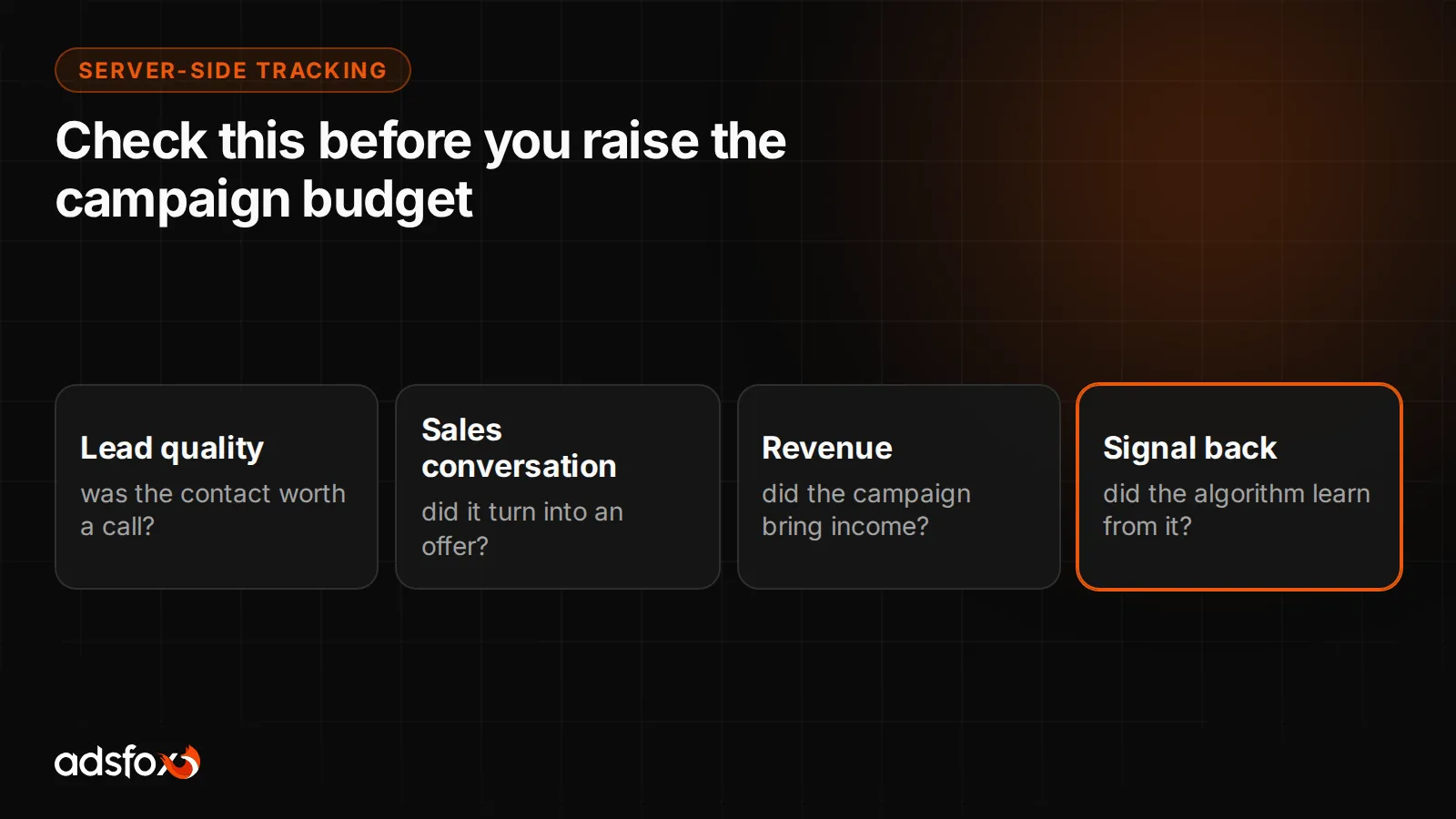
That changes how campaigns are judged. Instead of asking only “how much did the form cost?”, ask:
- was the lead valuable,
- did a sales conversation happen,
- did the customer receive an offer,
- did the campaign generate revenue,
- did the algorithm get a signal worth learning from.
At adsfox, this is exactly where we connect performance marketing with measurement, CRM and sales data. Tracking itself is not the goal. The goal is a better decision: which campaigns to scale, which to fix and which to stop.
When should you implement server-side tracking?
Server-side tracking is worth implementing when a company really invests in campaigns and wants to make decisions based on data, not just intuition. That applies especially to companies that generate leads, have a sales process and judge marketing not only by contact count but by quality and revenue.
Good signals that it is time:
- GA4, CRM and the ad dashboard show very different numbers,
- campaigns generate plenty of forms, but sales do not grow proportionally,
- the sales team reports poor lead quality,
- the ad budget grows, but decisions still rest on general metrics,
- the company wants to send platforms data about valuable events, not just clicks.
In that setup, server-side tracking becomes part of the decision system. It is not about a “prettier report.” It is about a better signal for the algorithms and for the people who decide on budget.
What does a good server-side tracking setup look like?
A good server-side tracking setup starts with an event map and business goals. The starting point should be the question: which events actually matter for sales? Only then decide what to send to GA4, Google Ads, Meta, TikTok or other systems.
In practice, the implementation should cover:
- an audit of current measurement,
- a list of key events and conversions,
- configuration of server-side data delivery,
- deduplication of events when the same signal travels multiple paths,
- testing and debugging,
- comparison of data with CRM and campaign reports.
The last one is critical. Without testing, a company can simply move chaos from the browser to the server. Well-implemented tracking should be checked regularly, especially after changes to the website, forms, CRM or campaigns.
What won’t server-side tracking solve on its own?
Server-side tracking will not fix a weak offer, a poorly built campaign or a sales process that does not handle leads. It is a measurement and signal tool. Very important, but still only part of a larger system.
If a company has poorly defined events, does not organize data in its CRM, or does not know which leads are valuable, implementing server-side tracking alone will not be enough. It can improve the quality of data delivery, but it will not replace strategy, analysis and work on the sales process.
That is why it pays to look at the topic more broadly. Server-side tracking should support campaigns, CRM, analytics and sales. Only then can marketing be judged by its real impact on the business, rather than by single metrics from the ad dashboard.
Summary: server-side tracking is the foundation of better decisions
Server-side tracking matters because it helps a company regain control over signal quality. If part of the data never reaches ad platforms, campaigns may be optimized on an incomplete picture. If ad data does not connect with CRM and sales, the company may scale actions that look good in a report but do not work toward results.
At adsfox we look at server-side tracking as part of the whole system: campaigns, data, CRM, lead quality and sales. That lets marketing be judged not only by form count, but by whether it actually supports the company’s growth.
Book a free consultation and we will check whether your measurement gives campaigns the right signals and whether your reports show marketing’s real impact on sales.