How Much Do Pinterest Ads Cost? Pricing and Billing
Pinterest has no price list. You set a daily or lifetime spending limit, and within that limit the platform bids in its auction and decides who sees your Pin and where. You usually pay per thousand impressions, per click, or per video view, depending on the campaign goal. The real price, though, shows up on the results side: cost per purchase, cost per lead, and return on ad spend. Pinterest adds one thing no other channel has: far more time passes between the first contact with an ad and the purchase, so a first-week report almost always shows a worse result than the campaign actually delivered.
Below we break that bill into parts: what the cost is made of, what exactly you pay for, why the conversion window is longer here, and how to avoid switching off a campaign that was just starting to make money.
What makes up the cost of a Pinterest campaign?
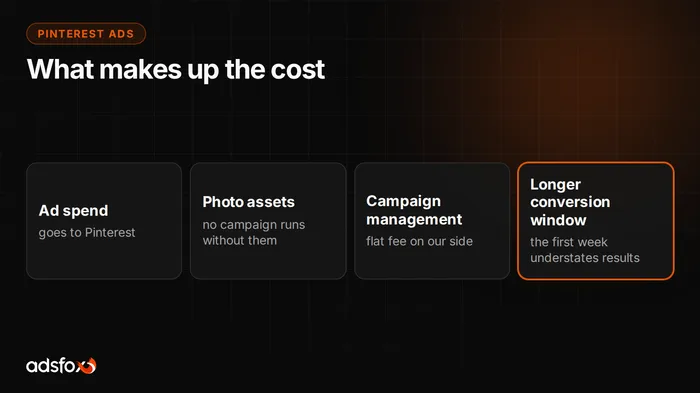
The bill has three layers, and most companies compare only the first one.
Media spend. The budget that goes through the auction. You set a daily or lifetime limit, and this is the only amount visible in the dashboard.
Creative production. On Pinterest this layer weighs more than anywhere else, because the whole platform is built on images. A product photo in context, vertical format, a clear description. With weak product photography no campaign setting will save the result, and the media budget simply burns.
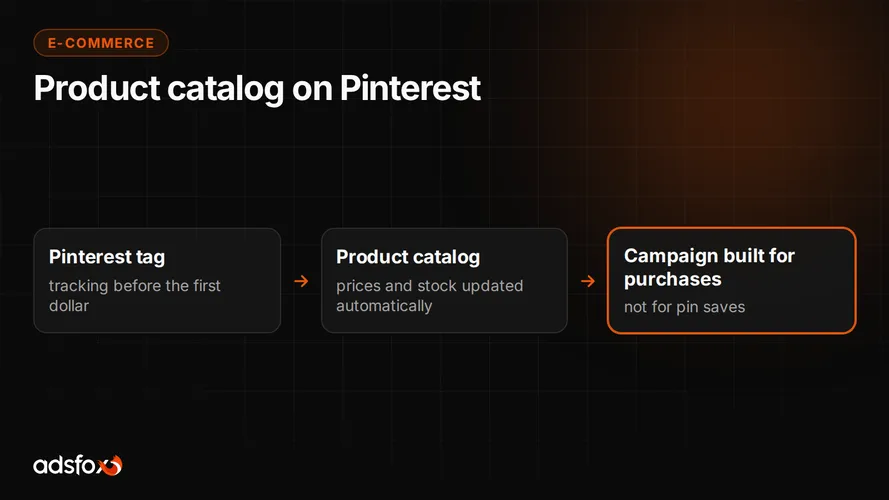
Management and measurement. The conversion tag, the product catalog, purchase events, passing data to analytics. Without this layer you cannot tell a campaign that made money from one that only generated Pin saves.
Two companies with an identical media budget get completely different results, and the difference usually comes from layers two and three, not from the bid.
What exactly do you pay for in Pinterest Ads?
Pinterest bills in several models, and the choice follows from the campaign goal:
- CPM, cost per thousand impressions. You pay for reach. The standard for awareness campaigns and for purchase-driven campaigns where the system looks for people most likely to convert.
- CPC, cost per click. You pay when someone goes to your website. Sensible when you drive traffic to a specific product category.
- Cost per video view. Billing for video formats, where the view itself matters rather than the click-through.
- Product catalog. Not a separate billing model, but it changes the cost of results a lot: your inventory goes into ads automatically with prices and availability, so you do not build a creative by hand for every product.
The final rate is set by the auction, not a price list. You set the spending limit and the goal, the platform picks the placement. The winner is not the advertiser who offers the most, but the one whose Pin best matches what a given user is looking for.
Why is the conversion window longer on Pinterest?
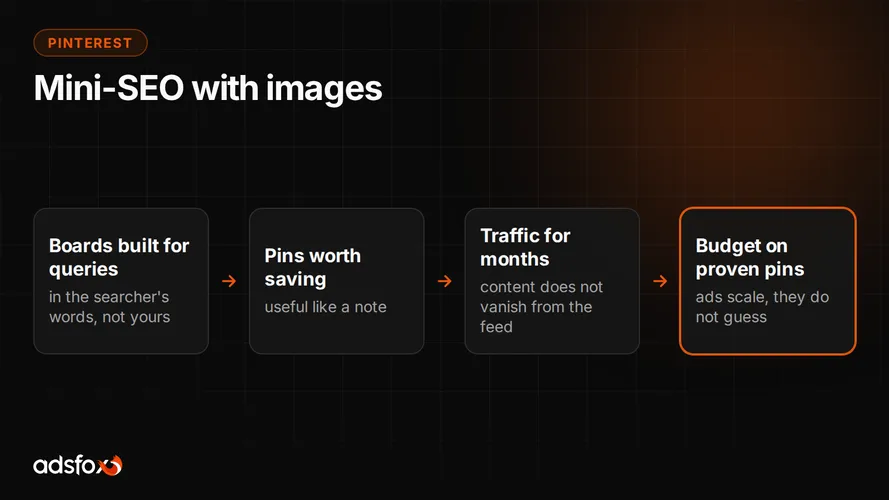
Because people go there to plan, not to buy right away. A remodel, a wedding, a wardrobe for the season, holiday gifts. The user browses ideas, saves the ones that fit to their own board, and comes back when the decision is ready. Weeks pass between the first contact and the transaction, not minutes.
There is a second feature of the platform: a Pin does not drop out of circulation after a few hours, the way a post in a classic feed does. It goes into Pinterest search and onto users’ boards, and it resurfaces in their later sessions. Traffic from well-matched Pins can keep going long after the campaign ends.
For cost this has a concrete consequence. The click is booked today, and the sale is attributed two or four weeks later. In a report viewed in real time, cost per purchase looks dramatically high, when in reality it drops with every week the window keeps closing.
Why does the first-week report understate the result?
Because it shows the full spend and only part of the effect. Spend is immediate, conversions arrive with a delay. This is the situation in which most good Pinterest campaigns get switched off too early.
The typical pattern looks like this: a company launches a campaign, after seven days compares it with Facebook results, sees a cost per purchase several times worse, and pauses the budget. Three weeks later, transactions from those same Pins show up in the stats, except the campaign is gone.
What to do about it:
- Decide up front when you will evaluate the campaign. The date has to cover the full conversion window, not the first weekend.
- Do not compare channels in the same window. A channel with a short decision cycle will always win a seven-day comparison.
- Take care of server-side measurement. Browser blocking loses a share of events, and with a longer window that loss hurts twice. We describe how it works in our server-side tracking service.
- Watch the trend in attributed purchases, not a single screenshot from the dashboard.
What starting budget makes sense?
The sensible minimum is set by the number of conversions, not a dollar amount. A campaign built for sales needs a certain number of events before it stops guessing who responds to your offer. With too small a budget that number is never reached, and the result is weak not because you spend little, but because the system has nothing to learn from.
On Pinterest there is a second factor: time. Even a well-planned budget needs a longer test period than in search, because you have to wait for the conversion window to close.
The practical order of the math:
- Calculate customer value. Average order value times the number of purchases over the customer lifetime.
- Set the ceiling for acquisition cost at which the sale still pays off.
- Check how many transactions a month you need to hit the plan.
- Multiply and add a test period longer than on other channels.
If the result comes out below the threshold at which the campaign can learn anything, it is better to start with a channel that has a faster feedback loop.
What does a sale from Pinterest cost compared with other channels?
The honest answer: we do not have our own confirmed data on cost per lead and return on ad spend from Pinterest, so we will not give you a number here that pretends to be a benchmark. What we do have are collected results from campaigns on other channels, and they show the scale of differences between industries well.
In our CPL and ROAS benchmark from 20 campaigns in 11 industries, cost per lead ranged from about $2 to $11, from $2 to $3.50 in beauty up to $7.50 to $11 for a law firm. On the e-commerce side, return on ad spend was 3.58 for medical footwear and 10 to 16 for raw dog food. The same mechanism works on Pinterest: the result is decided by industry, margin, and creative quality, not by the platform itself.
Hence the rule for comparing channels. Do not compare Pinterest cost per click with cost per click from Facebook; compare cost per purchase measured after the full conversion window. With a short window the comparison is always skewed against Pinterest.
When are Pinterest ads not worth it?
We will say it plainly, because it saves both sides money.
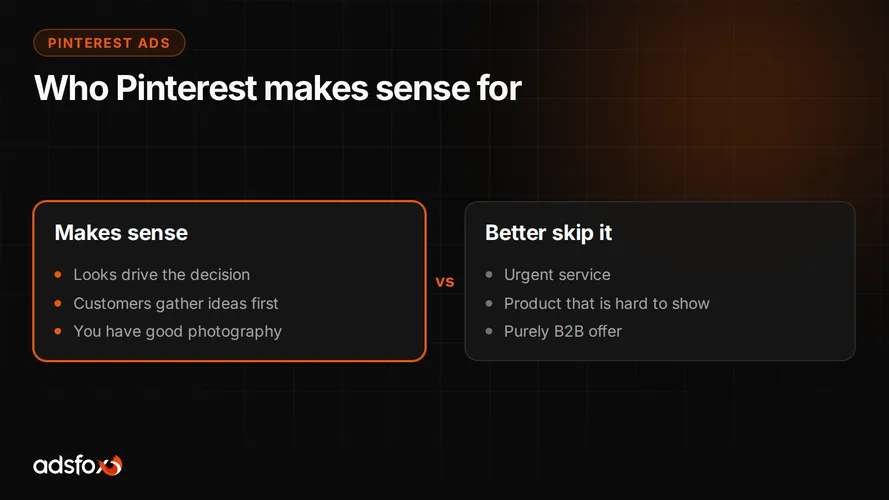
Pinterest usually works when the product can be shown in a photo, the decision is slow and based on looks: interiors, furniture, decor, lighting, fashion, jewelry, beauty, wedding supplies, remodeling, travel, gifts. The customer collects ideas first, then buys.
Pinterest usually does not work for urgent services where the customer needs a contractor now, for products with no visual value, for offers aimed only at businesses, and when you do not have decent product photography. It also will not work as a rescue channel when you need sales within two weeks, because the mechanics of the platform will not deliver that.
If your inventory falls into the first group but your photos are weak, we usually advise starting with the photos. It is a cheaper investment than a media budget burned on creatives nobody saves.
How to check whether you are overpaying for Pinterest ads
Four things to verify in your own account:
- Are you measuring purchases, not Pin saves. Saves and clicks to enlarge a photo look good in a report, but they do not pay invoices.
- Is the product catalog connected. Without it you build creatives by hand, which with a larger inventory raises management cost and limits the reach of your offer.
- Are you judging the campaign after the full conversion window. Conclusions from the first days lead to switching off campaigns that were only starting to work.
- Do you have more than one creative in rotation. A single photo burns out faster, and then the cost of reaching the same audience rises.
If you want to go through this point by point on your own account, that is what we do when managing Pinterest Ads campaigns. We have been doing this since 2018, have served more than 350 clients in more than 20 industries, and are a Google Partner and a Meta Business Partner (Badged).
What an agency charges for management: a concrete number
At adsfox, campaign management on a single channel starts from $490 a month. With more channels the unit price per channel is noticeably lower, because part of the work (measurement, analytics, learning your offer) is done once for the whole account. The price also depends on how much creative work we take on (whether we prepare the creatives or you supply them) and on the size of the ad budget, because we take responsibility for spending it, and the bigger the money, the bigger the risk on our side. The full rules are laid out in our campaign management pricing.
What to remember about Pinterest ad costs
There is no price list. You set a spending limit, the platform uses it in the auction, and you pay for impressions, clicks, or video views. The true cost shows up only in cost per purchase measured after the conversion window closes, and that window is clearly longer here than on other channels. The biggest mistake is not a bid that is too high, but judging the campaign after seven days and switching it off before the conversions arrive.
Get a free consultation: we will check whether your inventory and photos give this channel a chance, and tell you plainly if another platform is the better choice.