Who Should Advertise on Pinterest (and Who Shouldn't)
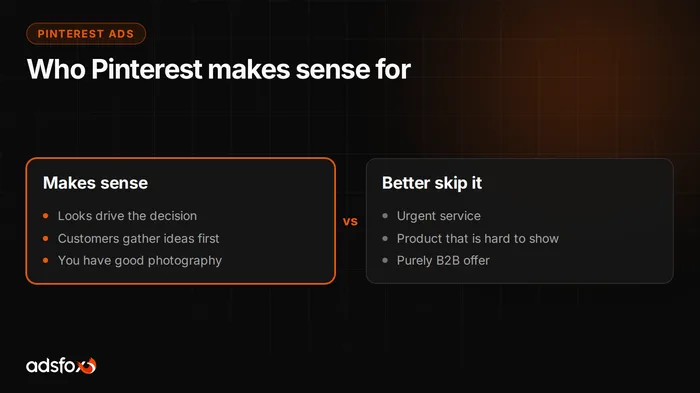
Pinterest advertising makes sense for businesses whose customer first looks, compares, and plans, and only then buys. Pinterest is an image search engine, not a place to kill time: the user types a query, browses results, and saves ideas for later. That is why interiors, furniture, decor, fashion, jewelry, beauty, wedding supplies, remodeling, travel, and gifts do well here. Services bought under time pressure, offers that are hard to show in a photo, and B2B sales do poorly.
Below we break it down: how this channel differs from other social media, what purchase-planning intent means, who the campaigns pay off for, and when it is better to skip it.
How is Pinterest different from Facebook, Instagram, and TikTok?
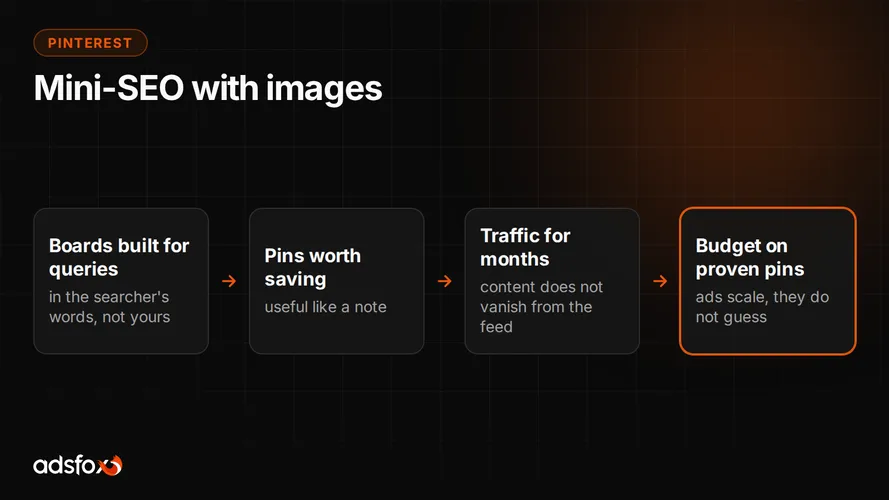
Pinterest is a visual search engine that picks content based on the query and interests, not on who you follow. That single difference changes almost everything about how campaigns are run.
The starting point is a query, not a feed. The user tells the platform what they are looking for: “gray kitchen with wood,” “outdoor wedding outfit,” “small living room with fireplace.” The ad lands in a moment of deliberate searching.
Content lives long. A post in a classic feed runs out of reach in a few hours. A Pin stays in search and on boards, so it keeps coming back to people for weeks.
The ad does not interrupt entertainment. It is one of the suggestions in the results, judged on equal terms with organic content. It does not need a first-second hook; it needs a clear photo of the product in a real setting.
In practice this means a creative from a Facebook and Instagram campaign rarely works here without rework. There you stop the thumb; here you help someone choose.
What is purchase-planning intent?
People come to Pinterest with a project in mind: a bathroom remodel, a wedding eight months away, a wardrobe for the season, an anniversary gift. They collect ideas, arrange them on boards, and come back when the decision is made. That is a completely different state of mind from scrolling reels after work.
For an advertiser, three things follow.
You catch the customer earlier than Google search does. At the moment someone saves a kitchen photo, they do not yet know the furniture brand or the contractor. There is room for your offer to become the reference point.
The path from save to purchase can be long. Sometimes a few days, sometimes a few months, especially for bigger-ticket projects.
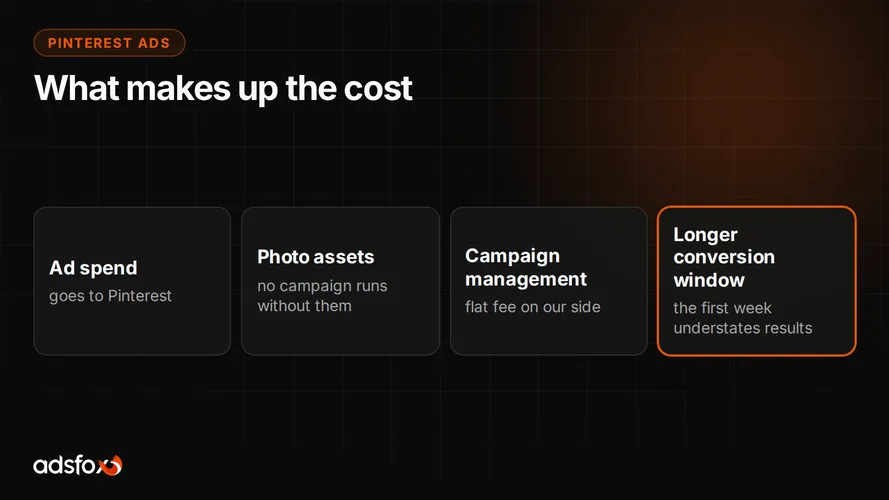
Campaign evaluation has to account for that. A first-week report shows a fraction of the effect, because a large share of saves turn into website visits much later. A Pinterest campaign is planned over a longer horizon than a campaign built for an immediate response.
Which industries does Pinterest advertising work for?
The common denominator is simple: the decision rests on looks and happens slowly, and the product can be shown in one good photo.
| Category | Why it works |
|---|---|
| Interiors, furniture, lighting, decor | The customer collects inspiration for months before buying |
| Fashion, jewelry, accessories | The purchase is driven by styling, not by an immediate need |
| Beauty and skincare | Before-and-after results and routines look good in photos |
| Wedding supplies and events | Planned far in advance, high order value |
| Remodeling, finishes, garden | The project grows out of ideas collected over weeks |
| Travel, gifts, recipes | Seasonality and clear planning intent |
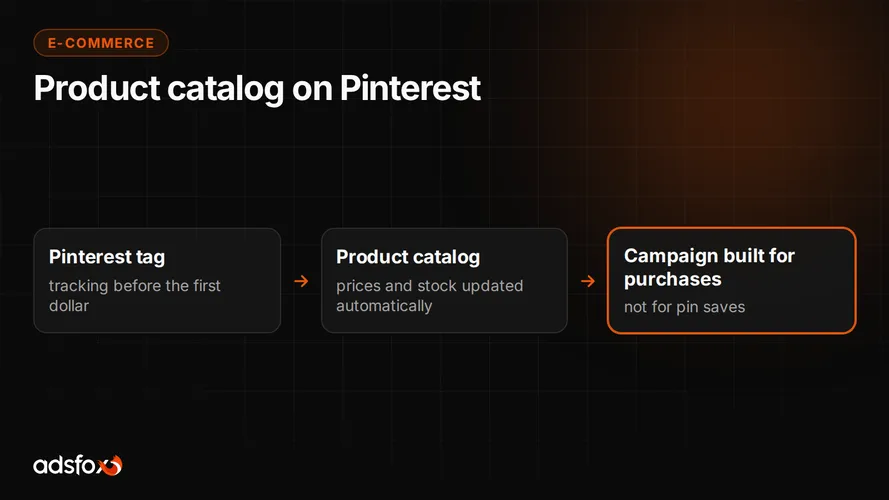
There is one technical condition on top of that. For a store with a wide range, the foundation is a connected product catalog, so the offer goes into ads with prices and availability. Without it, building a creative by hand for every product stops adding up at a few hundred items.
When are Pinterest ads not worth it?
Honestly: more often than the guides suggest. Skip this channel if you recognize your business in any of the points below.
- You sell a service bought under time pressure. A breakdown, towing, an urgent legal matter. Nobody plans that ahead on a board, so the right place is Google Ads and search.
- Your offer cannot be seen in a photo. Software, financial services, consulting. Without visual material the campaign has nothing to start with.
- You sell to businesses. Decision-makers do not look for suppliers on Pinterest.
- You do not have decent photography. Weak photos lose here faster than on other channels, because the image is the entire message.
- You need results this month. With a delayed purchase decision the effect spreads over time, and quick lead collection works better on other channels.
Spelling this out saves budget. A channel that does not fit your sales model will not start working with a higher bid.
Pinterest, Google, or Meta: when to use which channel
These three channels catch the customer at different moments and work best together, not instead of each other.
| Channel | The moment you catch the customer | When to choose it |
|---|---|---|
| The customer knows what they want and is looking for a provider or product | Demand already exists, the decision is urgent | |
| Meta | The customer is not looking for anything, they are browsing content | You need to spark interest and collect leads quickly |
| The customer is planning a project and collecting ideas | The decision is visual and deferred |
The practical takeaway: Pinterest is rarely the first channel for a business just starting with paid ads. It usually makes more sense to capture the demand that already exists in search first, then add a reach-building channel, and connect Pinterest once you have visual material and the patience for a longer sales window. The exception is interior, wedding, and fashion brands, where Pinterest is often the most natural place to start, because the customer spends the choosing phase there anyway.
How much do Pinterest ads cost and how to judge results
There is no price list. You set a daily or lifetime budget, that is, a spending limit, and within it the platform decides who sees the ad and where. The real cost depends on industry, season, photo quality, and how tightly you narrow the audience.
We do not have our own confirmed data on cost per lead or return on ad spend on Pinterest, so we will not give you a number here that pretends to be a benchmark. What we do have are collected results from other channels, and they show how much everything depends on the industry. In our CPL and ROAS benchmark from 20 campaigns in 11 industries, cost per lead ranged from about $2 to $11, and return on ad spend in e-commerce ran from 3.58 for medical footwear to a range of 10 to 16 for raw dog food.
The practical evaluation rule is simple. Saves, impressions, and clicks to enlarge a photo look good in a report, but they do not pay invoices. A campaign is set up and judged on purchases, add-to-carts, or quote requests, and the results are compared with the other channels in one place.
How to check whether Pinterest makes sense for your business
Five questions worth answering before the first dollar goes out.
- Does the customer plan the purchase in advance? If the decision is made within an hour, this is not the channel.
- Do you have photos you would not be embarrassed to show next to the best in the category? That is the main criterion.
- Do you have a product catalog or a sensible landing page? Traffic with nowhere to convert is spend without effect.
- Are you tracking conversions correctly? Without the tag and connected data you will judge the campaign by saves, not by sales.
- Will you give the campaign a few months? A shorter test usually ends with a conclusion based on incomplete data.
If you would rather go through this with someone who has done it before, that is what we do in our Pinterest advertising service. We have been doing this since 2018, have served more than 350 clients in more than 20 industries, and are a Meta Business Partner (Badged) and a Google Partner. That is why we can tell you not only how to set up the campaign, but also whether, in your case, the budget would earn more elsewhere.
What to remember about Pinterest advertising
Pinterest works like a search engine where people plan, not like a feed where they get distracted. That sets everything: the creative has to help people choose, the effect spreads over time, and the content keeps working long after the campaign starts. The channel pays off in visual industries with a deferred purchase decision, and falls apart for urgent services, offers without photos, and B2B sales. Before you spend the budget, check one thing: is your customer looking for an idea for something, or for a rescue right now?
Get a free consultation and we will go through your offer, materials, and data, then tell you plainly whether Pinterest is the right channel in your case.