Ecommerce SEO: How to Rank an Online Store in Google

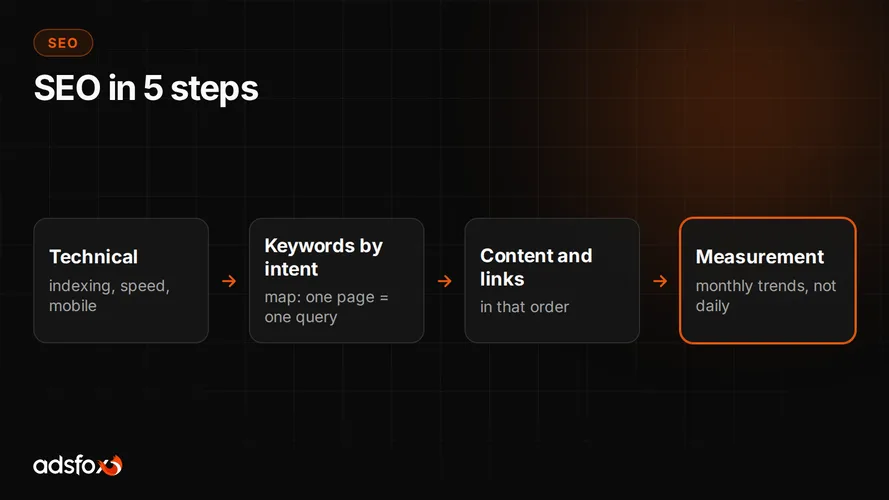
Ecommerce SEO is the process that gets your store’s product and category pages to rank high in Google’s free results for the phrases shoppers search for. Four things matter most: optimizing category and product pages, valuable content, a clean technical setup, and links that build domain authority. It is a longer game than paid advertising, but once rankings are earned, organic traffic drives sales without a fee per click.
At adsfox we have run data-driven performance marketing since 2018, and we bring the same approach to ecommerce SEO: we look not at rankings alone, but at which phrases actually generate revenue.
How is ranking a store different from a regular website?
An online store is a specific SEO challenge, because it has hundreds or thousands of pages: products, categories, filters, variants. That creates problems a simple business website does not have: duplicate content, thin product descriptions, faceted navigation generating unnecessary URLs, and harder indexing. That is why ecommerce SEO starts with cleaning up the structure, not with writing individual articles.
Optimizing category and product pages
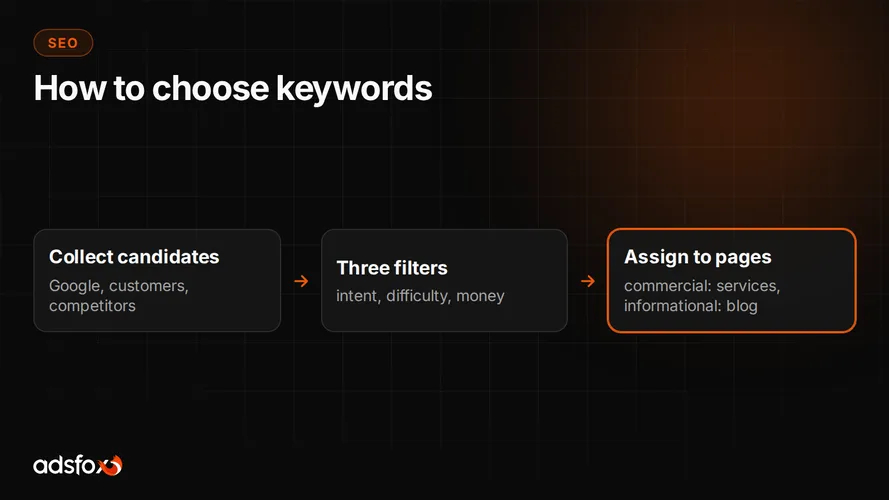
This is the foundation of ecommerce SEO. Category pages usually drive the most buying traffic, because they attract shoppers ready to purchase (someone searching for “women’s hiking boots,” for example). So we optimize category titles, headings, and descriptions for buying phrases, and we make sure the most important products have unique, specific descriptions. A product page with a real description, specifications, and answers to customer questions sells better and ranks higher than an empty template.
Content that attracts shoppers
The catalog alone is not enough. Guides, articles, and supporting content bring traffic at an earlier stage of the decision and build the store’s topical authority. A customer who first lands on your guide to choosing hiking boots is more likely to come back to buy. Regularly publishing useful content is one of the strongest, and still underrated, parts of ecommerce SEO.
Technical SEO for online stores
In ecommerce, the technical side can decide everything. What matters most: load speed (especially on mobile), correct indexing of the right pages, handling filters and pagination so they do not create thousands of junk URLs, and removing duplicate content between similar products. A technically clean store lets Google focus its attention on the pages that actually sell.
Links and authority in ecommerce
Links from other sites are still one of the strongest authority signals for Google. In competitive ecommerce categories it is hard to rank high for buying phrases without a solid link profile. Quality is what counts, though: a few strong, relevant links work better than dozens of random ones. The number and quality of links is also one of the main factors driving the cost of SEO.
How to measure ecommerce SEO results
In a store, the goal is not rankings, it is revenue from organic traffic. That is why we combine data from Google Search Console and Google Analytics 4 with actual sales and look at which phrases and categories really make money. That kind of measurement lets us direct the SEO budget where it pays back fastest, instead of optimizing everything evenly.
If you want your store ranking for the phrases that actually drive sales, take a look at our SEO agency services or go straight to booking a free consultation. We will assess your store’s potential and propose a plan that fits your catalog and budget.