How to Choose Keywords That Bring Customers, Not Traffic
Keywords are the queries people type into a search engine, and choosing them is a decision about which of those queries your website will answer. Good keyword selection starts with intent and the commercial value of the keyword and ends with search volume. Most businesses do it in the opposite order: they take the keywords with the most searches and lose, because volume without intent is traffic that buys nothing.
This article shows the method we have used in SEO strategies since 2018, for more than 350 clients in over 20 industries. No academic theory: three steps, three filters, and the most common mistakes.
What keywords are and why “choosing” them is a business decision
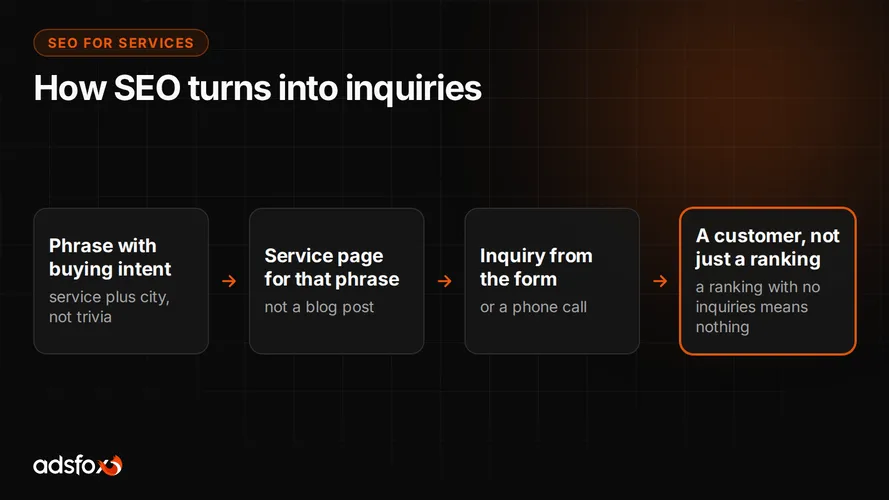
Behind every keyword is a person with a need. “How to clean an espresso machine” is typed by someone who wants a how-to. “Espresso machine repair Chicago” is typed by someone with a broken machine and a credit card in hand. Both keywords are about espresso machines, but only one leads to the repair shop’s revenue.
That is why keyword selection is not a technical task but a decision about whose attention you are competing for. A website has a limited number of pages and you have limited energy, and each main keyword is a commitment: a separate page, content, work on visibility. Choosing keywords is choosing where those resources go to work.
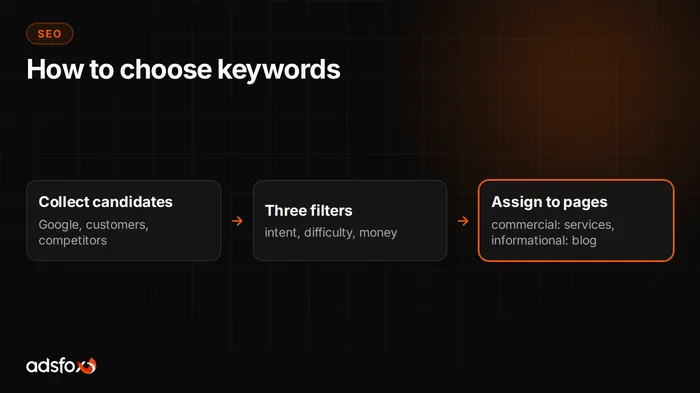
Step one: collect candidates
There are three sources, and it is worth using all of them, because each misses something different.
- What you know about your customers. Write down the questions customers ask before they buy. These are long-tail keywords that tools often do not see and that convert best.
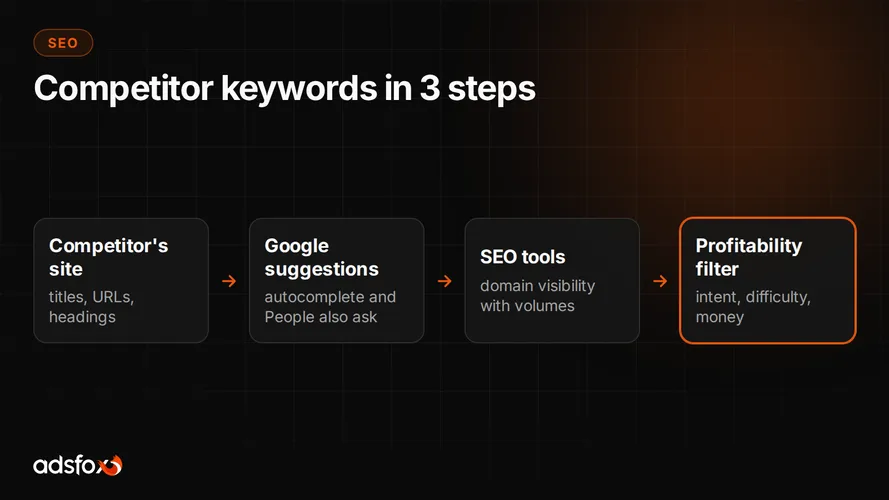
- Google’s suggestions. Autocomplete, the People also ask section, and related searches show how people actually phrase queries around a topic.
- Competitor visibility. The keywords your competitors rank for are a map of proven demand. How to get it, we described in our post on how to find competitor keywords.
At this stage do not evaluate, just collect. Evaluation is the next step.
Step two: three filters for every keyword
The intent filter. Ask: what does the person typing this keyword want? Knowledge, a comparison, or a vendor? The fastest test is to type the keyword into Google and look at what it shows: how-to guides mean informational intent, service pages and the map pack mean commercial intent. Google has already researched that intent for you, you just have to read the result.
The difficulty filter. Keyword difficulty shows who you are competing with for visibility. A fresh domain will not win a keyword that sites with thousands of links have been fighting over for years, and no content quality will change that in a reasonable time. Instead, you take a longer variant of the same keyword: not “air conditioning” but “air conditioning for a 500 sq ft apartment cost.” Less traffic, higher intent, a real chance.
The money filter. Does the keyword lead to a transaction? A practical signal is ad bids: if companies pay per click on this keyword, there is value behind it. A high-volume keyword that nobody advertises on is often traffic from the curious. In our practice, keywords with a few dozen searches a month have been worth more than keywords in the thousands, because every searcher was a potential customer.
Step three: assign keywords to pages
This is where the effectiveness of the whole effort is decided. The rule is simple: commercial keywords are served by service pages, informational keywords by blog posts. A service page targeting an informational keyword will lose to how-to guides; a blog post targeting a commercial keyword will lose to offer pages. That is not a matter of text quality but of matching the page type to the intent.
Second rule: one page, one main keyword plus its natural variants. “AC installation” and “AC installation cost” can live on one page, because that is the same intent. “AC installation” and “AC repair” are two intents and two pages. Stuffing everything onto one page ends with the page winning nothing.
Third rule, which few people remember: check for cannibalization. Two of your own pages targeting the same keyword take visibility away from each other. Before you add a new page, check whether the topic is already taken by an existing one.
The most common keyword selection mistakes
- Volume as the only criterion. Lots of traffic with no intent is a server cost, not sales.
- Keywords “from your head” instead of from data. A company’s industry jargon often does not match the customers’ language. Check how people really search.
- Ignoring the long tail. Keywords with a few dozen searches each add up to most of the traffic, and there is less competition for them.
- Choosing once and for all. Demand changes, competition changes. A keyword review is recurring work, not a one-time job.
What about AI? Keywords are no longer just Google
A growing share of buying questions is asked not in a search engine but in a conversation with an AI model, and there is no list of ten results there, just an answer with a few names. Choosing topics for citability in models follows a similar logic of intent but a different mechanism of visibility. We write about it on our AI SEO agency page and in our post on Google AI Overviews.
Where to start on your own site
With an audit of what you have: which keywords already bring you visibility, which pages cannibalize each other, and where the gaps are that competitors serve and you do not. We run that review at the start of our SEO agency service, on data, not on gut feeling.
Want to see what a well-built keyword map looks like for your industry? Book a free consultation. We will show you live where the demand is that you are not serving yet.