How to Find Competitor Keywords (and Which Are Worth Taking)
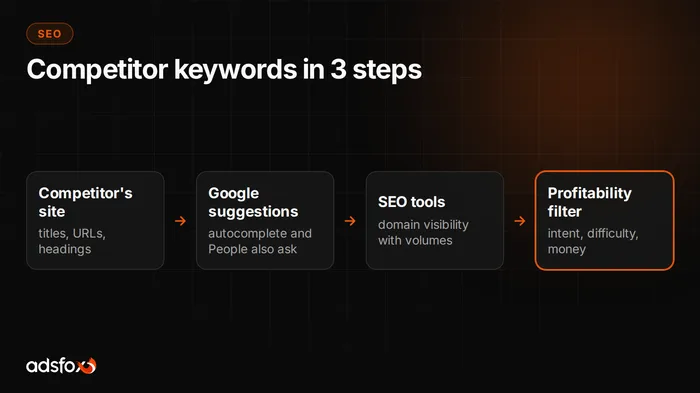
You can find competitor keywords in three ways: manually on their website, through Google’s suggestions, and with paid SEO tools that show the visibility of any domain. The list itself is only the beginning, though. The more important question, which most guides skip, is which of those phrases are worth going after at all, and which are traffic without money behind it.
At adsfox we run this kind of intelligence before every SEO strategy, because competitor visibility is the cheapest map of demand on the market: someone already spent budget to find out what works. Below is the method we use, from free to paid, plus the filter that separates phrases worth the work from filler.
Method one: read the competitor’s site like an SEO
Zero tools, maximum information about strategy. The phrases a competitor deliberately targets leave traces in three places:
- Page titles. The browser tab or the Google result shows the title, and the title is a declaration of the main phrase.
- URLs. A structure like /services/local-seo/ tells you directly which topics got their own pages. A separate page means a separate phrase.
- Headings and FAQs. The H1 and H2 headings on service pages, and the questions in FAQ sections, are the long-tail phrases the competitor is hunting.
This method will not give you search volumes, but it shows something more valuable: the architecture. You see which topics the competitor decided deserve their own pages, and that is a decision usually backed by data.
Method two: Google suggests for free
The search engine itself reveals what people search for around a topic. Type a phrase the competitor ranks for and collect:
- the suggestions in the search bar, that is, autocomplete,
- the People also ask section, which is a ready-made list of questions for FAQs and headings,
- related searches at the bottom of the results page.
It is a free source of long-tail phrases and intent. Its limitation: it does not tell you how hard it will be to break in or how many searches are behind a phrase.
Method three: tools that show domain visibility
Paid SEO tools (Ahrefs, Semrush, Moz, SpyFu) do one key thing: you enter a competitor’s domain and get a list of the phrases it ranks for, with positions and volumes. On top of that, a domain comparison shows phrases the competitor ranks for and you do not, in other words, a ready-made list of gaps.
We additionally use DataForSEO data, because it lets us automate this research and repeat it regularly instead of doing it once a year. Whatever the tool, the mechanics are the same, and the differences come down to database freshness and price.
The most important part: the filter that separates phrases worth the work
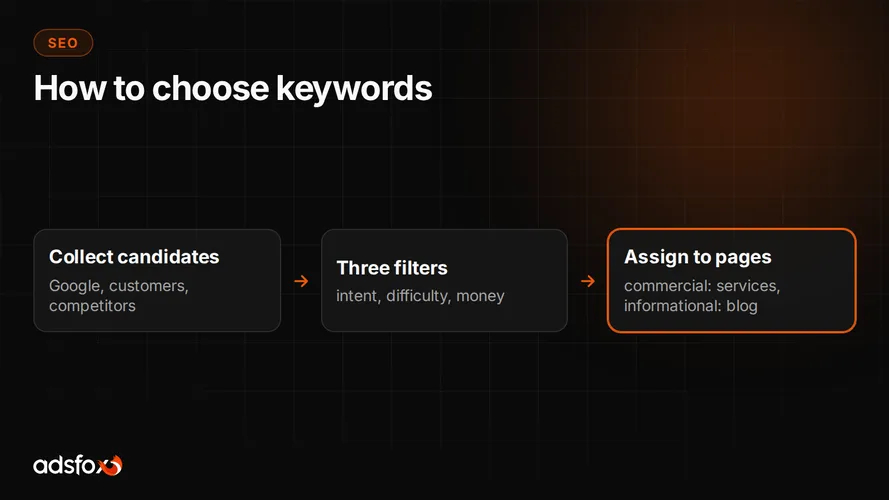
A list of competitor phrases without a filter leads to a classic mistake: writing for everything that has volume. Before a phrase makes it into the plan, we run it through three questions.
Does the intent fit the offer? An informational phrase (“how does X work”) is material for a blog post; a commercial phrase (“X company,” “X pricing”) is material for a service page. Mixing up those roles ends in a page that has no chance of winning, because Google shows a completely different type of result for that phrase.
Is the difficulty within reach? A high-difficulty phrase requires a link profile that a younger domain does not have. Instead of banging your head against the wall, you take a longer-tail version of the same phrase and win where you can. We explain how to size that up in our post on choosing keywords.
Does the phrase lead to money? The simplest signal is the CPC in ads: if businesses pay for clicks on that phrase, there is commercial value behind it. A phrase with huge volume and zero CPC is often traffic that never buys anything.
What not to do with a list of competitor keywords
We see two traps constantly. First: copying topics one to one, including the competitor’s mistakes. The fact that someone wrote ten weak posts does not mean the market needs them. Second: going after competitors’ branded phrases. Traffic from “competitor-name reviews” rarely converts for you, and content built around someone else’s brand hurts your credibility.
Competitive intelligence is supposed to answer one question: where is the demand you are not serving yet but have a realistic chance of serving? The rest of the list is noise.
What to do with this knowledge
A filtered list of phrases turns into a plan: which service pages to strengthen, which posts to write, and in what order. For us, that plan is built as part of our SEO agency service, and we increasingly extend it to visibility in AI answers, because models cite pages by their own rules, which we cover on our AI SEO agency page.
Want to see which phrases your competitors rank for and where the gaps are that you could fill? Book a free consultation. We will do that review live, on real data from your industry.