SEO Step by Step: A Plan That Actually Gets Results
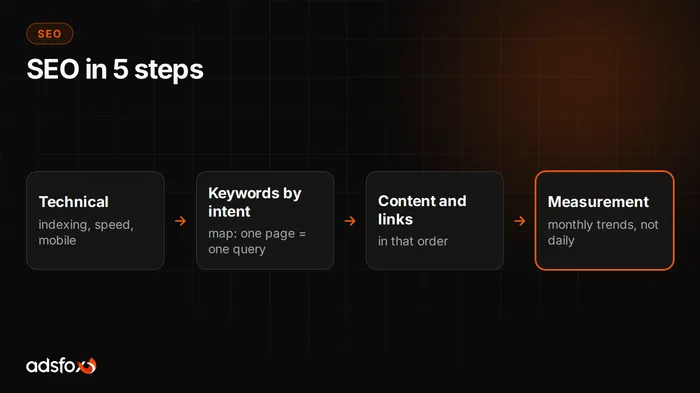
SEO step by step is five stages in a set order: technical cleanup, keyword selection, content for intent, links, and measurement. Order matters more than speed, because each stage builds on the foundation of the previous one: the best article on a page Google does not index simply does not exist. This guide walks through the whole process the way we do it on real engagements.
One caveat up front, because honesty is cheaper than disappointment: SEO is work measured in months. The first movement shows up on long-tail keywords after weeks, hard keywords take quarters. Anyone promising page one in a month is talking about keywords with no searches, or about something they do not control.
Step 1: technical, or whether Google can see you at all
Before you write anything, check the foundation in Google Search Console:
- Indexing. Are the important pages in the index and the junk (filters, duplicates, test pages) out of it? Too much indexed junk blurs Google’s picture of the site.
- Speed and mobile. A slow site or one that falls apart on a phone loses regardless of content, because users leave, and Google sees that.
- URL structure and internal linking. Can every important page be reached in a few clicks? Orphan pages, which nothing links to, are second-class to Google.
If the site has serious technical gaps, it is sometimes cheaper to rebuild it than to patch it, which we cover on our web design agency page.
Step 2: keywords, or what you are actually playing for
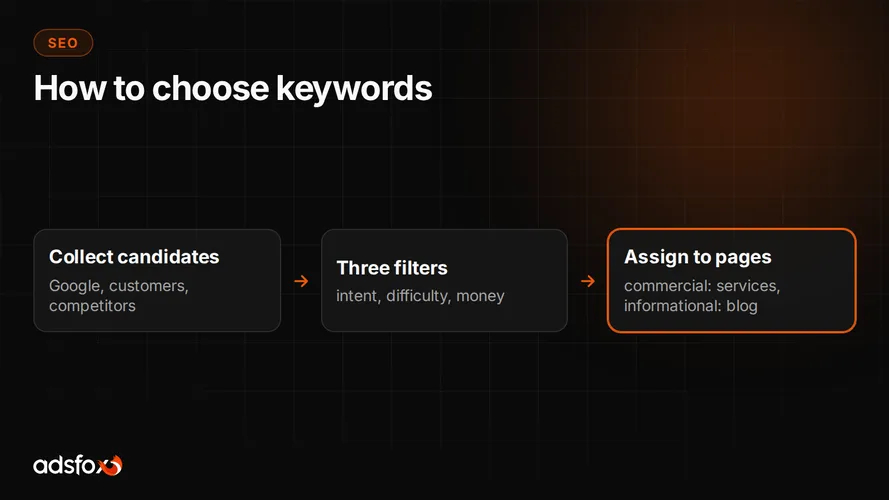
Keyword selection is a business decision: which queries you answer and with which page. A short version of the method we laid out in a separate post on how to choose keywords:
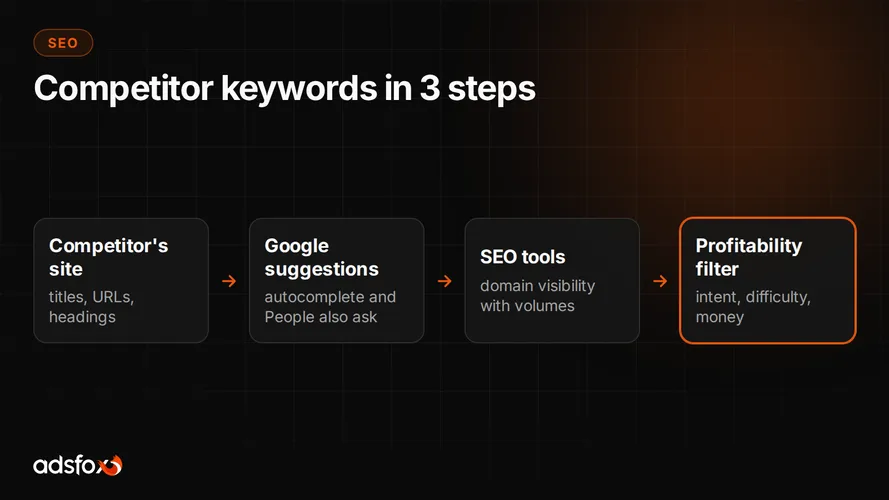
- Collect candidates from Google’s suggestions, customer questions, and competitor visibility.
- Filter by intent: commercial keywords go to service pages, informational ones to the blog.
- Filter by difficulty: a younger domain takes the long tail, not the brick-wall keywords.
- Assign each keyword to one page and make sure two pages are not fighting for the same one.
The result is a map: a list of pages to strengthen and a list of content to write, in an order driven by commercial value, not search volume.
Step 3: content that answers before the reader finishes
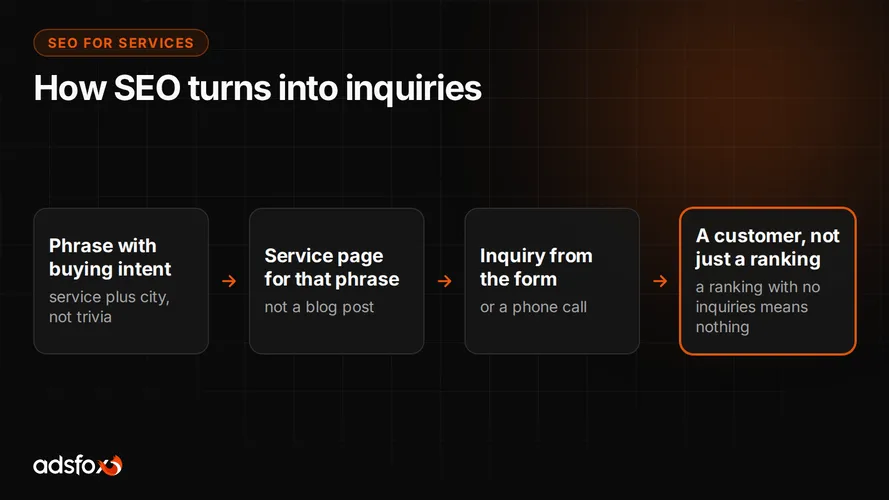
Service pages answer commercial keywords: what you do, for whom, how the engagement works, what it costs, and why you. Blog posts answer the questions a customer asks earlier: how something works, what to choose, how long it takes.
The craft that works both in Google and in AI answers:
- Answer first. The first paragraph answers the question in the title directly, the elaboration comes later.
- Headings as questions. That is how people search and how models match content.
- Self-contained sections. Each part complete on its own, with no “as mentioned above.”
- Specifics instead of filler. Numbers with a source, examples, steps. Zero “in today’s world.”
The same structure that wins featured snippets in Google increases the chance of being cited in AI Overviews and in ChatGPT, which we describe in our post on Google AI Overviews.
Step 4: links, or votes of trust
Links from other sites work like recommendations: they tell Google your page is a point of reference. For easy keywords, technical fixes and content are enough; for competitive ones you cannot do without links, because your competitors have them.
The quality-over-quantity rule is literal here: one link from a topical, widely read site does more than dozens of entries in directories that exist only for links. How to tell one from the other, and where to get the valuable ones, we laid out in our post on link building.
Step 5: measurement, or how you know it works
SEO without measurement is guessing. The minimum is Google Search Console: which keywords bring impressions and clicks, how positions change, which pages are growing. On top of that, on-site analytics to see whether organic traffic does what you brought it in for: inquiries, calls, purchases.
Look at monthly trends, not daily ones. And measure what has value: traffic growth on a keyword that does not lead to revenue is a vanity metric.
Timeline: what it looks like over time
A realistic starting plan usually looks like this: technical cleanup and a keyword map at the beginning, then a regular content rhythm (steady and modest beats a burst followed by silence), in parallel work on links to the pages that should grow first. Monthly reviews: what grew, what stalled, what needs fixing.
That is exactly the setup we use in our SEO agency service, and increasingly we combine it with visibility in AI models through our AI SEO agency service, because buying questions are moving to AI assistants.
Do it yourself or with an agency?
You can do the basics yourself: this plan is enough to clean up the technical side, choose sensible keywords, and write content that answers customer questions. The line runs at competitive keywords and scale: data-driven competitor analysis, systematic link building, keeping up a content rhythm while running a business. There, the owner’s time costs more than the service.
If you want to check where your site stands today and what will deliver the fastest result, book a free consultation. We will walk through your visibility live and show you a plan in the order that pays off.