What Is Snapchat Used For and What It Means for Business
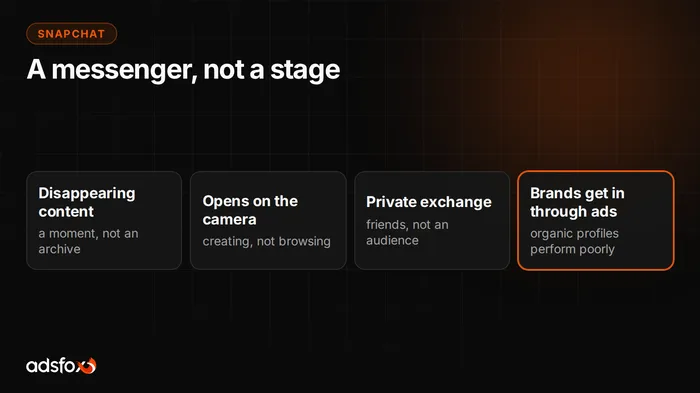
Snapchat is used for everyday contact with friends through photos and short videos that disappear by default after being viewed. It is a messaging app with the camera at its center, not a platform for publishing to an audience. That one trait separates it from Instagram and TikTok more strongly than it seems, and everything a business should know before asking “should we be there” follows from it.
We wrote this article in two parts: first how the app works, because without that you cannot understand user behavior, then what that mechanic means for a business presence.
How Snapchat works: the mechanics in five points
Disappearing messages. The foundation of the app: a photo or video sent to a friend disappears by default after being viewed. That lowers the bar for sharing everyday life: you are not building an archive or an image, you are sending a moment.
Opens on the camera. The app opens on the camera, not on a feed. The default action is creating, not browsing. Hence the enormous popularity of Lenses and Filters, which are the language of communication here.
Stories. Content visible to friends for a limited time: a less committal form of publishing than a post on a public profile.
Snap Map and Streaks. The social layer: where your friends are, who is active, streaks of daily exchanges. These are mechanisms that sustain very frequent, short returns to the app.
The Discover section with publisher and creator content. It exists, but it is an add-on to the messenger, not its core, unlike TikTok, where the feed is everything.
Who uses Snapchat?
We are not going to make up demographic statistics, so we will say what follows from the mechanics and market practice: Snapchat concentrates a clearly younger audience than the other big platforms, with strong reach among teens and young adults, and the usage pattern is frequent, short contact throughout the day, centered on conversations with friends. Before you build a plan on that, check the age structure of your own customers in your own data, because that is what decides, not general opinions about the platform.
For a business, more important than the age metric is the attention context: the user is here in private exchange mode, not content discovery mode. That sets expectations for any form of brand presence.
What this means for a business
An organic business profile performs poorly. People do not come here to follow brands, so building reach with a profile, the way you would on Instagram or TikTok, usually disappoints. The exception is brands with a very young, loyal community, but that is an exception, not a plan.
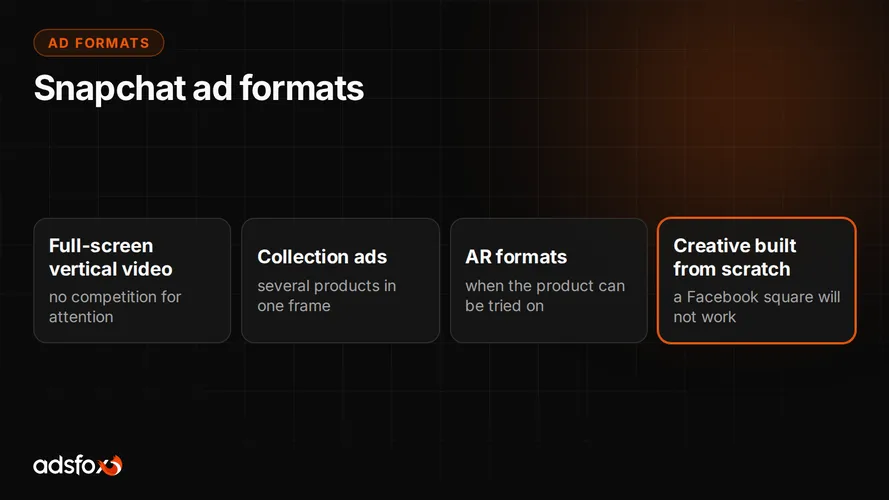
The path to the user runs through ads. Full-screen vertical video between content, Collection Ads for products, and sponsored Lenses that users apply to their own photos. We described the formats in detail in our post on Snapchat ad formats.
The creative has to speak the app’s language. Ad material competes with content from friends, not with other ads. A polished TV spot looks foreign here; what works is naturalness, pace, and sound from the first second.
Measurement takes care. Younger users mean a mobile environment with tracking restrictions, so without server-side measurement some conversions vanish from reports. We cover this on our server-side tracking page.
Should your business be there?
Three questions instead of fortune-telling:
- Are your customers young? Check your sales data and analytics, not your assumptions.
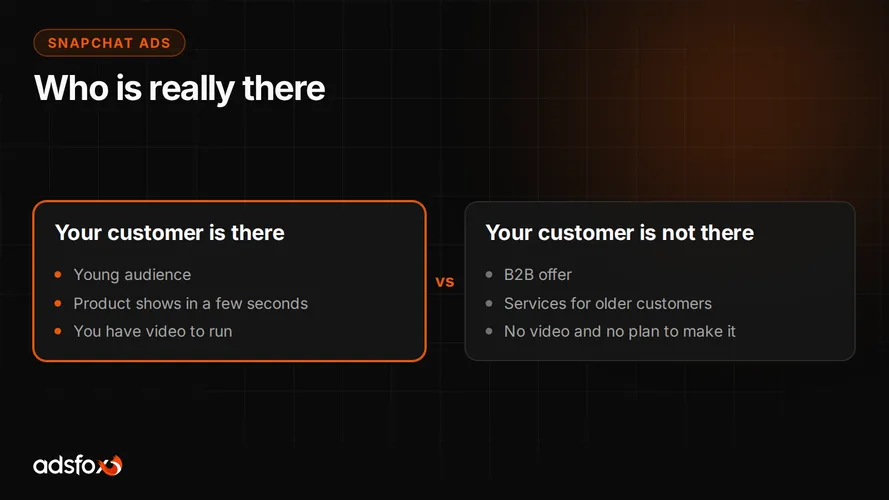
- Can the product be shown in a few seconds of video? Fashion, cosmetics, restaurants, entertainment, apps: yes. Complex B2B services: no.
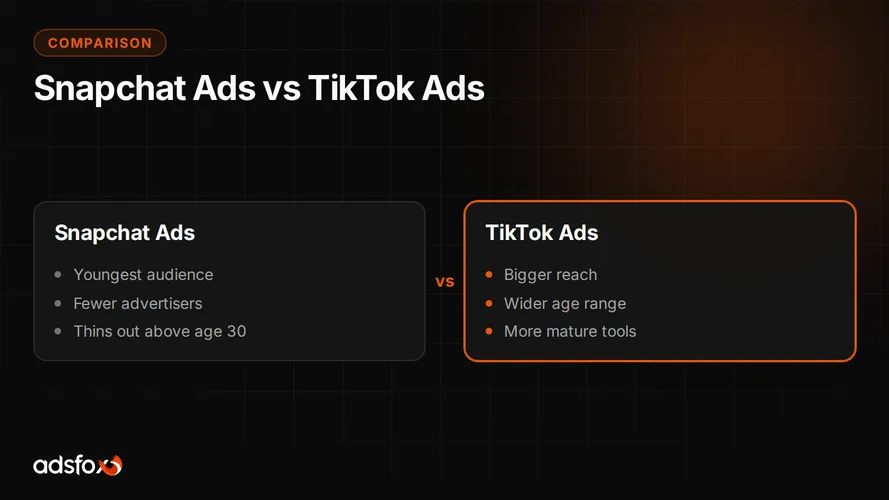
- Are your first-choice channels already saturated? Snapchat works best as a supplement when Meta and TikTok keep getting more expensive in the young demographic. We compared both vertical video channels in our post Snapchat Ads vs TikTok Ads.
Three yeses: it is worth budgeting a test. Any no: start elsewhere and leave Snapchat for the stage when it has something to supplement. The full breakdown of “who it is for and who it is not for” is in our post on who should advertise on Snapchat.
What a sensible start looks like
Not with a profile, but with a measured ad test: vertical video in several variants, a clear goal (store traffic, installs, sign-ups), events tracked from day one, and evaluation by cost per result, not by reach, which in a full-screen format always looks impressive.
We run such tests and campaigns as part of our Snapchat Ads agency service, with the same measurement rigor as in the other channels since 2018. Book a free consultation: we will check against your data whether your customers are even there, and tell you plainly if they are not.