Snapchat Ads: Who Should Advertise on Snapchat?
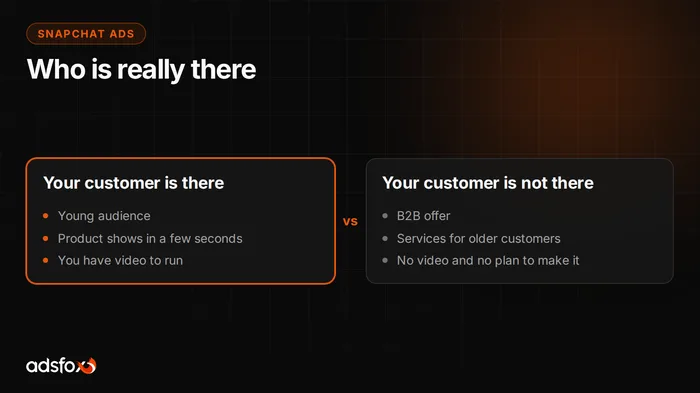
Snapchat advertising makes sense for businesses whose customer is under thirty and whose product can be shown in a few seconds of vertical video: fashion, footwear, cosmetics, restaurants, events, entertainment, mobile apps, courses and schools. In other cases we usually advise against this channel, because the audience thins out quickly above thirty and the creative has to be built from scratch. Most often Snapchat Ads works as a supplementary channel when Meta and TikTok campaigns stop growing in the younger demographic without a rise in customer acquisition cost.
Below we break that decision into its parts: who is really here, which businesses it works for, and in which situations we say no.
Who really uses Snapchat?
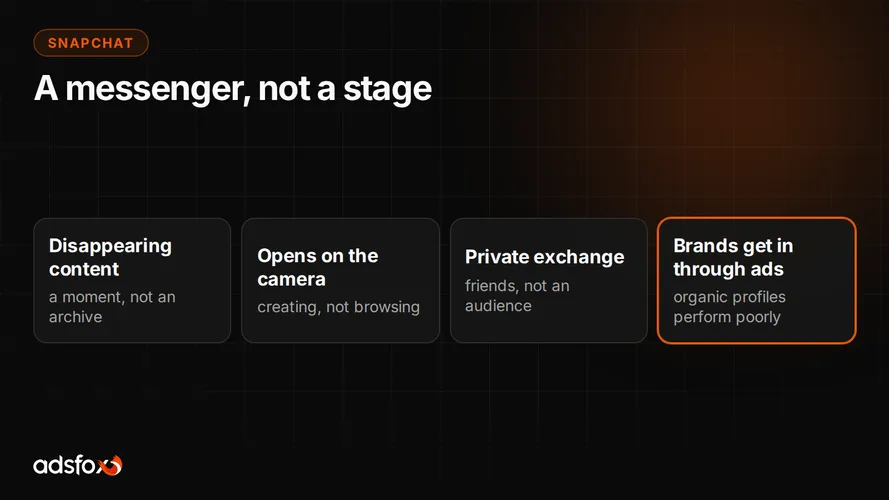
Snapchat is a visual messenger in which the basic content is a photo or a short video that disappears after being viewed. That changes the character of the whole platform. People come here to talk with friends, not to browse brand content, so contact with the app is frequent but very short.
The audience is the youngest among the big channels: teenagers, students, and people under thirty. In the US, Snapchat reaches a large share of 13 to 24 year olds, but the audience drops off sharply above thirty. We will not give you an exact number, because the figures circulating publicly are inconsistent and copied from outdated sources. That matters less than the consequence that follows from it.
The consequence is that the message has to work in the first second. There is no room for an introduction, for building context, or for text to read. If your offer needs explaining, Snapchat will be a bad place for that explanation, and it is better used at most as a first touch, with the close happening elsewhere.
Which businesses does Snapchat advertising make sense for?
We choose this channel when two things line up at once: the customer is young and the product is visual. One without the other is not enough.
| Industry | Why it works | Condition |
|---|---|---|
| Fashion and footwear | the decision is visual, made in seconds | a regular supply of new video |
| Cosmetics | the effect shows on camera, AR try-on works | show the effect, not the ingredient list |
| Restaurants and venues | young audience in a specific city | an offer they can come for today |
| Events and entertainment | short ticket sales window | date and place in the first frame |
| Mobile apps | the user is already on their phone | tracking of installs and in-app events |
| Courses and schools | the decision is made by a young person | a simple sign-up form |
A separate, good reason is a ceiling in other channels. If raising the budget in the young demographic on Meta Ads and TikTok raises cost instead of order count, Snapchat gives you access to the same people with fewer advertisers bidding. That is what the case for starting most often looks like with our clients, and how we approach it in our Snapchat Ads agency service.
When do we advise against Snapchat Ads?
It is more honest to hear this before spending the money than after. We advise against it in four situations.
B2B offers. Purchasing decision-makers are not on Snapchat, and even if they have an account, they are not in the mode in which one considers buying a service for a company. LinkedIn and search serve that purpose better.
Local services for older customers. Window replacement, senior care, financial advice, a law firm. Here the customer searches actively, so the money works better in search campaigns.
No video and no plan for video. Snapchat without a regular supply of creative burns out on its own, regardless of campaign settings. A one-time production of a single spot is not enough.
Meta is still scaling. If adding budget on Facebook and Instagram does not raise your customer acquisition cost, add it there. A new channel opens when the old one stops growing, not when it looks interesting.
How much does Snapchat advertising cost?
The bill has two line items: the ad budget that goes to Snapchat and the fee for managing the campaign. On top of that comes video production, which some businesses handle in-house.
We will not give you our own cost per lead or ROAS for this channel. We do not yet have a sample that would let us calculate it honestly, and a number pulled out of thin air would simply mislead you when planning a budget.
Take your reference point from your industry. In our cost per lead and ROAS benchmark we collected results from 20 campaigns in 11 industries: cost per lead there ranges from about $2 to $11 depending on the market, for example $2 to $4 in beauty and $8 to $11 for a law firm. That is data from other channels and from our European campaigns, so do not treat it as a promise for Snapchat. Treat it as a ceiling the new channel should not exceed if it is to make sense.
Which ad formats work on Snapchat?
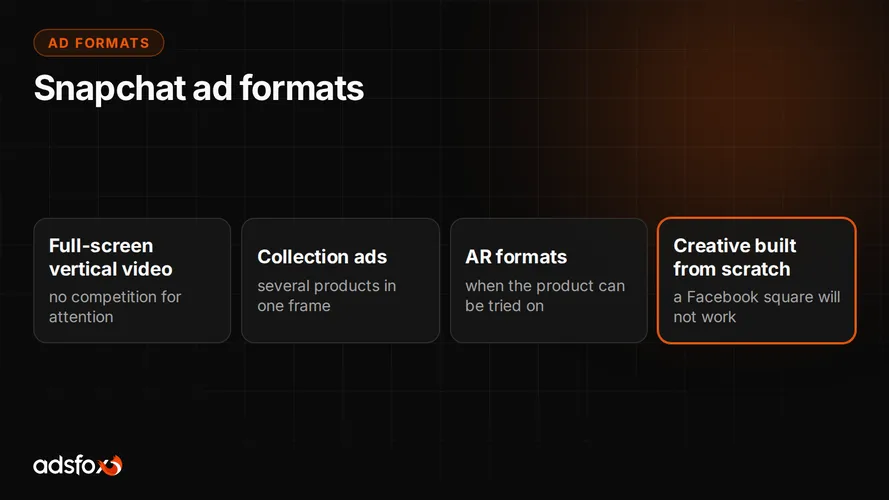
The foundation is full-screen vertical video, shown between friends’ content and in the section with publisher content. It is viewed with sound on, with no competition for attention on the same screen, so composition and the first second matter more than in channels scrolled on mute.
Alongside that, Collection Ads work, showing several products in one frame with a path to the store, as do augmented reality formats in which the user tries the product on through the phone camera. The latter only makes sense where trying on genuinely affects the decision: eyewear, color cosmetics, jewelry, headwear. In other cases it is an expensive novelty, and we advise against doing it just to have it.
One shortcut we do not recommend: a square Facebook creative cropped to vertical loses its composition and usually performs worse. Design the frame from scratch, even if the script stays the same.
Snapchat Ads or TikTok Ads: where to start?
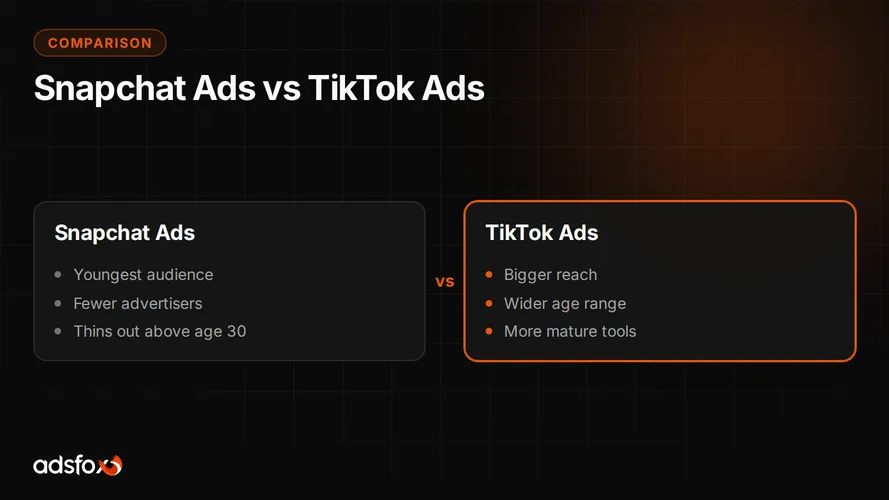
In most cases with TikTok. It has a wider age range and bigger reach, so for the same budget it will usually deliver more leads and gather the data needed for optimization faster. That is why by default we propose TikTok advertising first and add Snapchat as a second step.
We choose Snapchat earlier in one case: when you are clearly targeting the youngest group and want to avoid bidding for them against every other advertiser. Less competition in the auction can lower the cost of reaching the same person.
The good news is that creative carries over. Vertical video with sound works in both channels, so material shot for TikTok can be tested on Snapchat without a separate production. What changes is mainly the first second and how the offer is presented.
How to measure sales from Snapchat?
We start with measurement, not with ads. We implement the Snap Pixel, define the events that matter to the business, and connect them to Google Analytics 4 so results can be compared with the other channels in one place and with one yardstick.
With an audience this young, we especially recommend server-side tracking. These are phone users with tracking restrictions turned on, so some conversions never reach the ad platform. A campaign optimized on incomplete data shifts budget in the wrong direction, and you see a worse result than the real one.
A separate trap is the reports. Reach and video views look exceptionally impressive here, because the creative takes up the whole screen. Look at the events that mean something to your business: an inquiry, a sign-up, an order. Our tools and AI agents monitor results, compare periods, flag deviations, and prepare notes for review. Decisions about budget and campaign direction are made by a specialist who knows your offer.
How to check whether Snapchat makes sense for you
- Describe your customer by age. If the median is above thirty, you stop at this step.
- Check whether you have video. Not one, but several variants and an idea for more every month.
- Calculate your ceiling per lead. Derive it from margin and customer value, not from wishful thinking.
- Set up measurement before launch. Snap Pixel, events, GA4, ideally server-side.
- Give the channel a full test period. The first weeks are for gathering data and swapping creative, not for judging the result.
If any of the first three points comes out as a no, you have saved yourself the budget. That is a result too.
So who is Snapchat Ads for?
For brands whose customer is young and whose product shows in a few seconds. For businesses that have enough to feed a video channel. And for advertisers who have hit a ceiling in the younger demographic on Meta and TikTok. To everyone else we say so plainly, instead of pushing the service.
We have been running campaigns since 2018, have worked with more than 350 clients in over 20 industries, and are a Google Partner and a Badged Meta Business Partner. In the first conversation we check one thing: whether your target audience is really in this app.
Book a free consultation: we will walk through your numbers and tell you honestly whether Snapchat is for you, or whether it is better to add budget where it already works.