TikTok Ad Specs: Formats, Sizes and Safe Zones
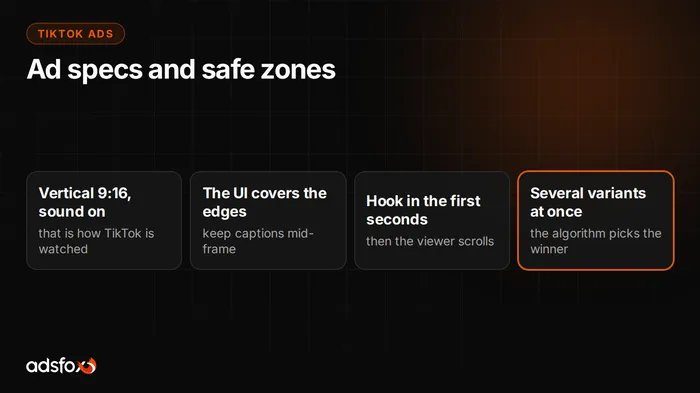
A TikTok ad is a full-screen vertical 9:16 video, produced with sound, with captions, and with the key content placed outside the areas covered by the app’s interface. The recommended resolution is 1080 x 1920 px, the minimum accepted for vertical video is 540 x 960 px, and the standard length is between 5 and 60 seconds. The ad also has to fit the text limits: brand name up to 40 characters, ad text up to 100 characters.
Below you will find the full set of parameters in one place, a description of the safe zones, and an explanation of why a square creative carried over from Facebook usually does not work on TikTok. TikTok updates its interface and guidelines, so before producing a large batch of videos, check the current values in TikTok Ads Manager and Creative Center.
What ad formats does TikTok Ads offer?
An ad format in TikTok Ads is the way your video appears in the app and how the user can interact with it. The format name translates into where the ad is shown, what the viewer sees, and which interface elements cover the frame.
Campaigns built for results use mainly two of them:
- In-Feed Ads: video in the main For You feed, looking like a regular post, with an action button at the bottom.
- Spark Ads: promotion of an existing post from a business profile or a creator’s account, keeping the account name, comments and likes.
The other formats show up less often and serve different purposes. Video Shopping Ads pull material and data from a product catalog, and reserved formats such as TopView or Top Feed are bought exclusively for large reach campaigns.
The technical video specification is shared across most of them. The differences are about how much of the frame the interface takes up, because Spark Ads additionally shows the full caption and the profile name.
What is the technical spec for TikTok ad video?
The table below collects the parameters the system checks when you upload a video. A creative that does not meet them simply will not go through.
| Parameter | Value |
|---|---|
| Aspect ratio | 9:16 (recommended), 1:1, 16:9 |
| Resolution for 9:16 | 1080 x 1920 px recommended, minimum 540 x 960 px |
| Video length | 5 to 60 seconds, some placements accept longer |
| File formats | mp4, mov, mpeg, 3gp, avi |
| Maximum file size | 500 MB |
| Brand name | up to 40 characters |
| Ad text | up to 100 characters |
| Orientation | vertical, full-screen video |
1:1 and 16:9 are allowed, but treat them as exceptions. A square on a vertical screen leaves empty bars above and below the frame, so from the first frame the ad looks like material carried over from another platform. Horizontal video does even worse, because it takes up a small part of the screen.
The text limits have practical consequences too. One hundred characters of ad text is one short sentence plus a call to action, not a place for a description of your offer.
What are safe zones in TikTok ads?
A safe zone is the area of the frame that is not covered by the app’s interface elements: the ad caption, the profile name, the CTA button, the like and share icons, and the system navigation bar. Anything you place outside that area, the viewer will see only partially or not at all.
Approximate margins for a 1080 x 1920 px video look like this:
| Edge | Covered by the interface |
|---|---|
| Top | about 130 px |
| Bottom | about 480 px |
| Left | about 45 px |
| Right | about 140 px |
The bottom of the screen loses the most space, because that is where the caption, account name and action button sit. This explains the most common production mistake: captions pasted along the bottom edge, the way they are done for other platforms, disappear under the interface on TikTok.
A practical editing rule: keep the logo, prices, addresses and all captions in the central part of the frame. Leave the sides and the bottom as background.
Why does a cropped Facebook square fail on TikTok?
Because cropping 1:1 to 9:16 is not a change of aspect ratio, it is cutting half of the information out of the frame. Facebook material is designed so that the important elements fit inside a square. After cropping to vertical, the system keeps the center of the frame, and the product, the presenter’s face or a caption ends up outside the picture.
On top of that come three differences no crop can fix:
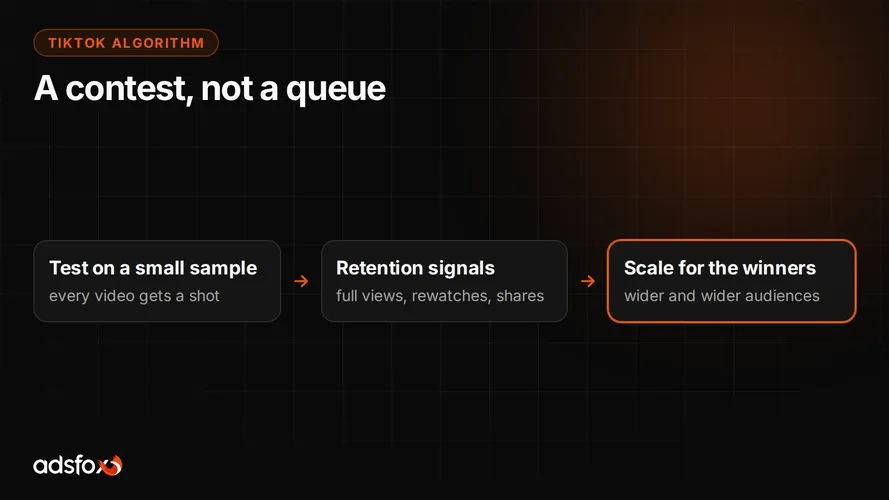
- The rhythm of the first seconds. On TikTok the user decides to scroll almost instantly, so the creative has to open with a scene, not with a logo card.
- Captions in the wrong place. Captions burned in along the bottom edge slide under the ad text and the CTA button.
- The language of the message. A video produced to look like an ad looks like a foreign object on TikTok, even at the correct aspect ratio.
Meta Ads creatives can be a starting point and a source of proven sales arguments. If you already run Facebook campaigns, you know them from your Meta Ads work and you know which messages convert. On TikTok, though, they have to be recorded again, vertically and in a different tone. You will find more on the content itself in our post on how to create effective TikTok content.
What role does sound play in a TikTok ad?
TikTok plays video with sound on, so the audio is part of the creative from the first second. A video uploaded without a soundtrack feels like a technical error and falls out of the rhythm of an app where the user scrolls through video after video with music or a voice.
Three things work in practice:
- A voiceover or a person on camera carries the sales argument that will not fit into one hundred characters of ad text.
- Music matched in tempo to the editing holds attention, but it cannot drown out the voice.
- Ambient sound creates the impression of a video recorded for real, not assembled in a studio.
Watch the licensing. Tracks available in the TikTok app for personal accounts cannot always be used by a company in an ad. Business accounts use a separate Commercial Music Library, and that is the one to stick to so the creative is not rejected or taken down.
At the same time the message has to be clear on a muted phone, because part of the audience watches without sound.
How should captions be prepared for TikTok ads?
Captions in a TikTok ad are not a transcript of everything that is said. They are an extract of the most important sentences, burned into the video and placed in the safe zone. The automatic captions generated by the app are helpful, but you have no control over their placement or style.
Rules that cut down on revisions:
- Keep captions in the middle of the frame, with a margin above the bottom interface.
- One thought per card, two lines of text at most.
- High contrast: light text on a dark backing or the reverse.
- The key information in the first seconds, before the viewer scrolls.
- Do not repeat in the captions exactly the same text you put in the ad copy.
Captions also help structure the edit. If a scene cannot be summed up in one line, it is usually a sign the scene is too long or says two things at once.
What does it cost to start, and when does TikTok Ads not pay off?
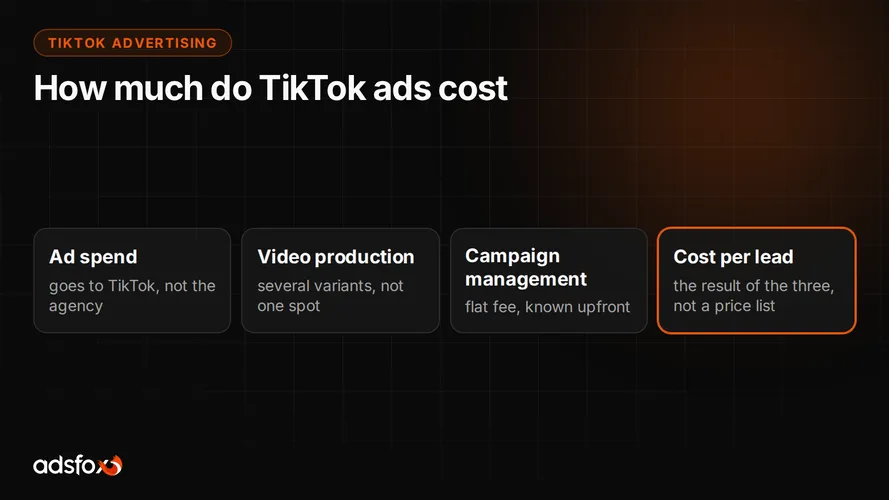
TikTok Ads Manager enforces a minimum daily budget: $50 a day at the campaign level and $20 a day per ad group. That is a technical threshold, not a recommendation. The real test budget depends on how many creatives you want to check and how long the campaign has to collect data before the conclusions mean anything.
There are situations where TikTok is not the right choice, and it is better to say so before launch:
- The offer requires a long explanation and a buying decision spread over weeks, and the company has no process for closing leads.
- There is no way to record video and no one willing to appear on camera.
- The budget is enough for one campaign, and it is better invested in a channel that already delivers sales.
- The audience is a narrow professional group that is easier to find through search.
We collected reference points for cost per lead in different industries in a separate post: how much a lead costs in different industries. The data comes from Meta Ads and Google Ads campaigns, so treat it as background for a budget conversation, not as a forecast of TikTok results.
How do you check a creative before uploading it to TikTok Ads?
A short checklist that catches most problems before publication:
- The video is vertical 9:16, at a resolution of at least 1080 x 1920 px.
- The file size does not exceed 500 MB, and the format is mp4 or mov.
- The length falls between 5 and 60 seconds.
- The logo, captions and prices sit in the middle of the frame, with a margin from the bottom.
- There is a soundtrack, and the music comes from the Commercial Music Library.
- The message is clear on a muted phone.
- The ad text fits in one hundred characters and does not repeat the captions from the video.
- The first two seconds show a scene, not a logo card.
- Several variants go into one ad group, not a single video.
The last point is often skipped, and it decides how fast the campaign learns. One video only shows whether it worked. Several variants show what specifically works: the opening hook, the argument or the ending.
Where do you start with TikTok creative?
Start with framing and captions, because those are the cheapest fixes. Only then change the script, the cast and the editing pace. A correct spec will not make an ad sell, but getting it wrong can block even a good idea, because half of the message hides under the interface.
adsfox has been running campaigns since 2018 and has served more than 350 clients across more than 20 industries. We are a Meta Business Partner (Badged) and a Google Partner. With new channels we first look at whether the company can deliver video material regularly, and only then at the budget. If you are considering TikTok advertising, we will check together whether your offer is a fit for this channel and how to prepare the first set of creatives.
Book a free consultation: we will review your current material, assess it against TikTok’s specs, and show you what to fix before the campaign launches.