TikTok Ads Cost per Lead: How to Lower It Without Cutting Bids
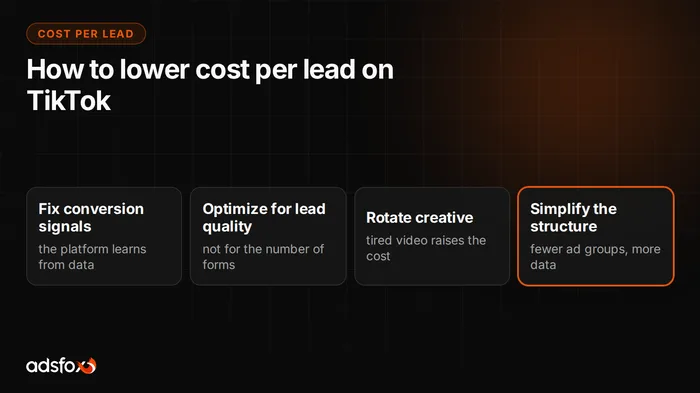
You will lower your TikTok Ads cost per lead faster by fixing tracking and lead quality than by cutting bids. Four levers deliver the biggest effect: passing conversions to the platform correctly, scoring lead quality instead of counting forms, rotating video creative regularly, and a simple campaign structure that does not scatter the budget across a dozen ad groups. Manually cutting the budget and turning off “expensive” ads after two days usually does the opposite, because it resets the algorithm’s learning.
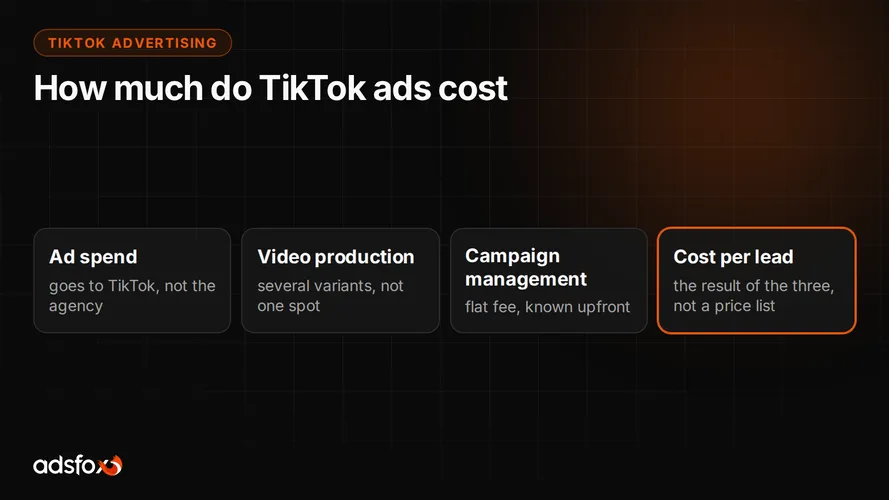
Cost per lead (CPL) is a cost metric that shows how much ad spend goes into one acquired contact. On its own it says nothing about profit. It becomes meaningful only when set against how many of those contacts turn into a conversation and a customer. Searches like “tiktok ads cost per lead” come up constantly, and the answer almost always depends on what happens after the click, not on the bid in the auction.
Why is a cheap TikTok lead often the most expensive one?
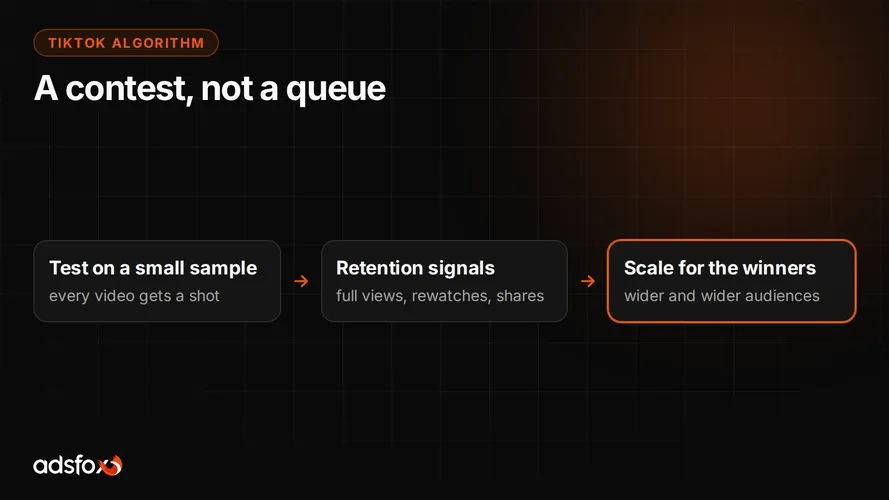
TikTok optimizes a campaign toward the goal you point it at. If the goal is “as many forms as cheaply as possible,” the algorithm will deliver cheap forms. The problem is that on a video platform the bar for filling out a form is low: someone watches a video while waiting in line, taps out of curiosity, leaves a phone number, and an hour later does not remember who they gave it to. CPL looks great, and the sales rep’s calendar stays empty.
The opposite mistake costs money too. An advertiser sees “expensive” leads, so they cut the budget in half and turn off half of the ads. The campaign goes back into the learning phase, the data falls apart, and the cost rises instead of falling.
Sensible optimization is about something else: giving the platform a better signal about which contact is valuable to you, and raising the effectiveness of every stage of the funnel. Then cost per customer falls even when CPL itself temporarily rises.
How do you set up conversion tracking so the campaign learns from good data?
Start with what TikTok can actually see. If the platform only receives a “form submitted” event, it will look for people who like submitting forms. That is not the same group as people who buy.
The minimum worth putting in order before raising the budget:
- The TikTok Pixel installed correctly, without events duplicated by several plugins at once.
- One main conversion event, aligned with the business goal, not five equal ones.
- Server-side event delivery, to limit losses from browsers and ad blockers.
- Marking in the CRM which lead was valuable and which was rejected right away.
- Sending that score back to the platform, so the algorithm learns from quality.
The order matters. We wrote more about why tracking should come before budget on TikTok in our post on tracking and budget in TikTok Ads.
How do you score lead quality instead of counting submissions?
Lead quality is a score that separates contacts that fit the offer from random ones, before you start comparing costs. Without it, you are optimizing the campaign for a metric that has no connection to revenue.
In practice a simple split in the CRM is enough: qualified lead, rejected lead, reason for rejection. After two weeks you can see which creatives and which audiences bring real customers, and which only generate traffic.
How much that changes the picture of a campaign is visible in our aesthetic medicine case study (Meta campaigns): the share of qualified leads rose from 21.1% to 45.7%, and CPL fell from about $8.50 to about $7.10. The client paid less and got twice as many conversations that made sense. At a gym chain, cleaning up campaigns and offers cut cost per lead from about $9 to $3 across 404 leads.
We do not publish our own CPL figures for TikTok, because those reference points come from other channels. The mechanism, though, is identical.
How often should you rotate video creative in TikTok Ads?
TikTok wears out creative faster than any other ad platform. The same video that collected cheap conversions for three days can cost twice as much in week four, even though you changed nothing in the settings. That is not an account failure; it is creative fatigue.
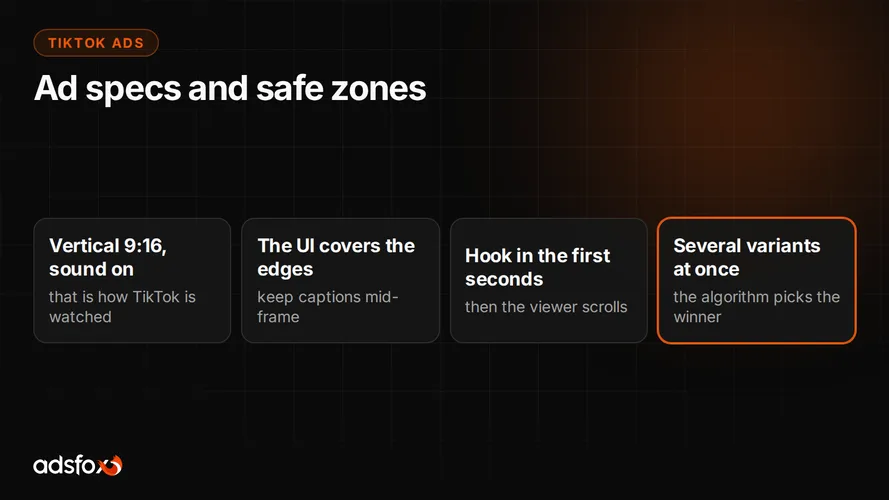
That is why we plan creative in batches, not one at a time. Instead of one polished spot, several variants are produced: a different hook in the first two seconds, a different opening shot, a different voice, a different closing call to action. Burned-out ads get replaced instead of getting more budget.
A simple working rhythm holds up well: several active variants at once, the weakest one replaced every week, the winning hook carried into new videos. We collected concrete rules for filming material that works on this platform in our post on effective TikTok content.
Which campaign structure lowers cost per lead?
The most common reason for a high cost per lead on a TikTok Ads account is fragmentation. Five campaigns, four ad groups in each, one video in each. The budget is split into so many pieces that no ad group collects enough conversions to exit the learning phase. The result: everything is expensive and nothing is reliable.
A simpler structure usually wins:
| Instead of | Better |
|---|---|
| a dozen ad groups with small budgets | a few groups with budgets that allow conversions to accumulate |
| one creative per ad group | several video variants in one group |
| narrow, overlapping targeting | a broader audience and selection through the creative |
| changes every day | changes after data has been collected |
An ad group needs a regular stream of conversions for optimization to have something to work with. If the budget does not allow that, it is better to have one well-fed campaign than four starving ones.
What should you compare your cost per lead against?
The reference point is not an internet average but your own economics. Calculate what a customer is worth, what percentage of leads you convert into sales, and what your margin is. Those three numbers give you the maximum cost per lead you can accept.
Ranges from other industries are useful only as a sanity check. Our benchmark of 20 campaigns across 11 industries (channels other than TikTok, run in Europe) shows very different levels:
| Industry | Cost per lead range |
|---|---|
| beauty salons | $2 to $3.50 |
| aesthetic medicine | $5 to $7 |
| law firms | $7.50 to $11 |
The difference between a beauty salon and a law firm is not a matter of a better or worse campaign; it is a matter of customer value. You will find the full list, together with ROAS results in ecommerce, in our CPL and ROAS benchmark.
Not sure what you actually pay for a valuable lead from TikTok? Book a free consultation, we will go through your numbers and show you where the budget is leaking.
When do TikTok ads not pay off?
We will say this plainly, because it saves disappointment. TikTok advertising makes no sense when the daily budget cannot clear the $20-a-day ad group minimum in a conversion campaign, because below that you cannot use advanced targeting and the data accumulates too slowly.
The second case is a company that cannot deliver new video material. TikTok without fresh creative stops working after a few weeks, no matter how well you set up the campaign.
The third signal is more technical: if your Facebook campaigns are still scaling without a sharp rise in cost per acquisition, adding budget there usually gives a better return than opening a new channel. TikTok is worth considering when raising the Meta budget clearly pushes CPA up. If those conditions are met, see how we run TikTok advertising from the creative and tracking side.
Where do you start in the first 30 days?
Do not do everything at once. The order that usually delivers the fastest effect:
- Clean up tracking: one main conversion event, no duplicates, events sent from the server.
- Introduce lead quality scoring and a rejection reason in the CRM, so you know what you are really paying for.
- Simplify the structure: fewer ad groups, more budget per group, several video variants inside.
- Set a creative rotation rhythm: new variants every week, replace the weakest, build on the winning hook.
- Judge the campaign by the cost of a qualified lead, not the cost of a form.
We have worked this way since 2018, with more than 350 clients across more than 20 industries, as a Meta Business Partner (Badged) and a Google Partner. Every time we come back to the same order: data first, then creative, budget last.
Book a free consultation: we will check your campaigns, conversion tracking and lead handling process, and then tell you plainly whether TikTok Ads will lower your cost per customer.