TikTok Ads vs Facebook Ads: Which Channel to Start With
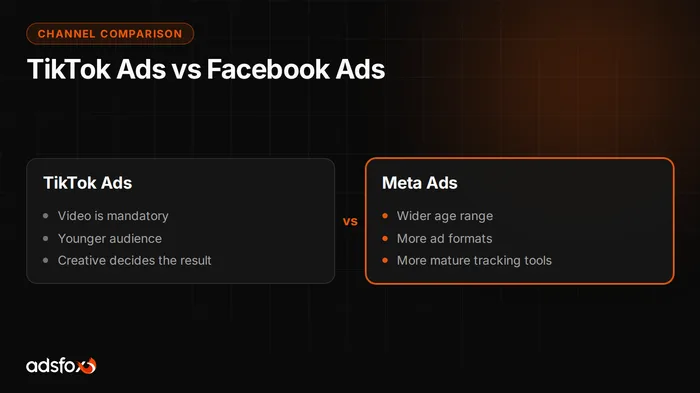
If you have to pick one channel to start with, for most small and mid-sized businesses the better choice is Meta Ads, and TikTok Ads is worth adding as a second step. The reason is simple: Facebook and Instagram have a broader audience across every age group, a more mature lead generation system and effective remarketing, so the first meaningful result shows up sooner and cheaper. TikTok can deliver reach and attention, but it demands a different kind of creative and more frequent replacement of material. Our recommendation is therefore: saturate Meta first, then test TikTok.
How do TikTok Ads and Meta Ads differ?
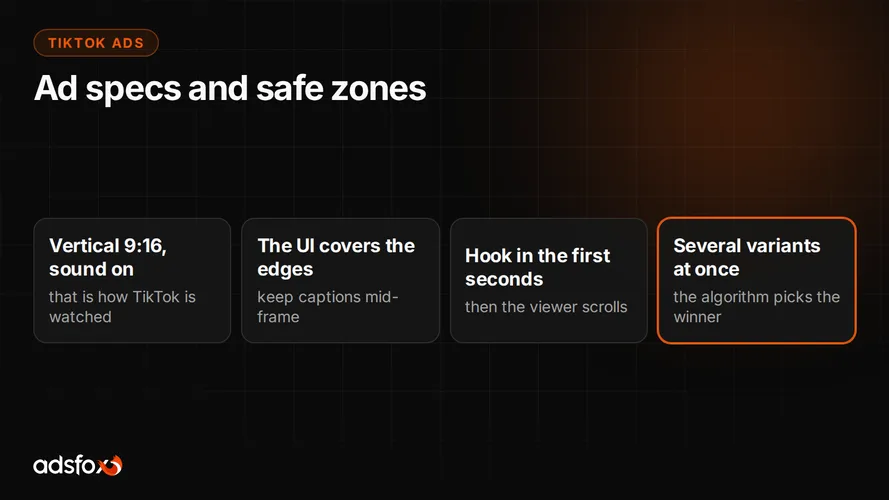
Meta Ads is the ad system for Facebook and Instagram. It relies on a large user base in every age group and on extensive lead generation formats, including forms filled out without leaving the app. TikTok Ads is TikTok’s ad system. It works exclusively in vertical video format and relies more on what the user watches than on who they are.
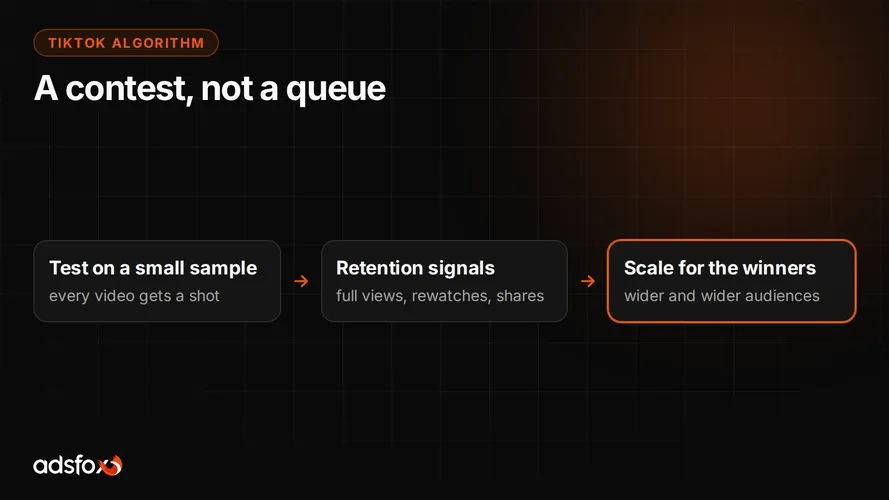
That difference shows up in daily work. In Meta Ads you can build a campaign on photos, graphics and simple videos, and users enter the funnel at different stages of the decision. In TikTok Ads the ad has to look like native content, otherwise the user scrolls past it in a fraction of a second.
The second major difference is the rate at which creative wears out. Material for Meta can keep working for weeks; on TikTok it burns out faster, so the company needs the capacity to produce video.
TikTok Ads vs Meta Ads: how do the channels compare?
The table below sets the two channels side by side from the perspective of a company that has a budget and wants customers, not views.
| Criterion | Meta Ads | TikTok Ads |
|---|---|---|
| Audience | Broad, all age groups, including older decision makers | Narrower demographically, strong among younger users |
| Creative format | Photos, carousels, video, Reels | Vertical video in the platform’s style only |
| Creative wear rate | Slower, material keeps working longer | Faster, needs a steady supply of new videos |
| Lead generation | Mature lead forms and website traffic | Forms and traffic, but less proven for service businesses |
| Remarketing | Extensive, closes the funnel well | Limited, works mainly at large reach |
| Our cost data | Benchmark from 20 campaigns across 11 industries | No proprietary cost-per-lead data |
| Natural role | Base channel, delivers leads and sales | Complementary channel, builds reach and recognition |
If you want to see what a lead actually costs in specific industries, we collected it in our CPL and ROAS benchmark from our campaigns.
Why saturate Meta Ads first?
Meta Ads usually pays back faster, because the company reaches people who are already looking for a solution and can convert them with a lead form or website traffic. Add remarketing, which closes people after the first touch. The effect is that you have your first conclusions about the market and the offer within a couple of weeks, not after a quarter.
We see it in our campaigns. At a gym chain, cost per lead fell from about $9 to $3 across 404 leads. At a beauty salon the campaign brought 1,626 leads at about $2.10 each, and the following year more than 700 leads a month. Those are results from a channel that was run consistently, not tested for two weeks.
As long as Meta is growing and holding a sensible cost per lead, moving budget away from it into a new channel usually lowers the overall result. You will find more about costs on the Meta side in our post on how much Facebook ads cost.
How do you know Meta Ads is saturated?
Channel saturation is the point where adding budget stops bringing proportionally more results. It is not one weak week; it is a repeatable trend visible for at least a month.
The signals we check most often:
- cost per lead rises despite correct creative and a stable offer,
- frequency rises while the number of new people reached stands still,
- a clear budget increase brings disproportionately few new leads,
- new creative stops moving the result, even though it used to,
- lead quality drops even though CPL looks similar.
Before you declare a channel exhausted, check lead quality too. In an aesthetic medicine campaign, the share of qualified leads rose from 21.1% to 45.7%, and cost per lead fell from about $8.50 to about $7.10. Sometimes what looks like saturation is simply messy tracking. We described the practical steps in our post on how to lower CPL in Facebook Ads.
When is it worth launching TikTok Ads earlier?
There are situations where the order can be reversed. TikTok makes sense right away when the product or service is visually convincing and can be shown in fifteen seconds: a before-and-after, a demonstration, behind the scenes, a quick tip.
We consider an earlier start when:
- the target audience is mostly younger,
- the company has a team member or a creator who films video regularly,
- the offer is impulse-driven, with a low barrier to the first purchase,
- the brand sells physical products and wants to test in-app sales, which we described in our post on TikTok Shop in performance marketing,
- Meta has been running for a long time and has genuinely stopped growing.
Even then we do not start by moving the whole budget. TikTok comes in as a separate line of spend with its own goal and its own assessment. If you are still putting material together, our guide on how to create effective TikTok content will help.
When does TikTok Ads not pay off?
The honest answer: fairly often. TikTok Ads does not pay off for a company that cannot deliver new video material every week, because creative burns out there faster than on Meta and the campaign stalls on its own.
We also advise against launching when:
- the budget barely covers one channel and splitting it would weaken Meta,
- the offer is very expensive and the decision process takes months,
- the target audience is narrow B2B, for example industrial purchasing managers,
- the company does not measure lead quality and cannot tell a good contact from a random one,
- the only motivation is that the competition is there.
In those cases the same money usually works better in PPC campaigns or in refining Meta. Telling a client “not yet” is cheaper than burning the budget on a channel the company has no capacity for.
How much budget does an honest TikTok Ads test need?
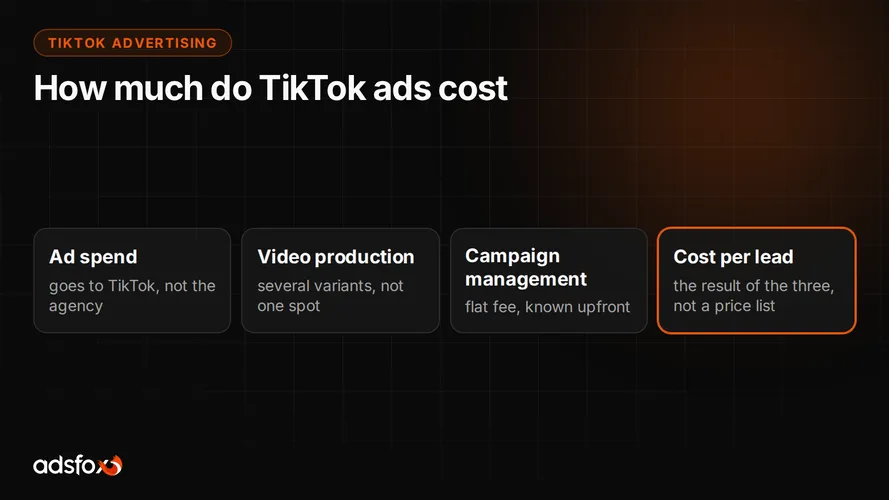
TikTok Ads Manager requires $50 a day at the campaign level and $20 a day per ad group. Below that, the campaign collects too little data to conclude anything beyond the fact that the ad was shown.
More important than the amount is where the money comes from. The test budget should be an addition, not a transfer from a campaign that already delivers leads. If you have to choose, that is a sign it is too early for TikTok.
Plan the test for a full cycle: several video variants, a clear goal, a fixed definition of a valuable lead, and a date when you make the decision. Without that, the campaign ends with the conclusion “TikTok does not work,” which really says nothing. We described how to approach tracking and budget with automation in AI in TikTok Ads: tracking first, then budget.
How do you compare results from both channels so the decision is fair?
The most common mistake is comparing channels by the cost per lead shown in the ad platform. A cheap lead who does not answer the phone is more expensive than an expensive lead who buys.
The comparison makes sense when you look at:
- the cost of a qualified lead, not every submission,
- the share of leads that moved on to a conversation and a proposal,
- sales attributed to the channel in the CRM, not only in the ad platform,
- the campaign’s effect on direct inquiries and branded searches,
- the time it takes for a lead from a given channel to become a customer.
TikTok more often works at the top of the funnel, so its impact tends to show up in places other than a form clicked right after watching a video. That is why, when assessing a test, we look at the whole process from impression to sale, not at one table in the ad platform.
Where do you start at your company?
The practical order looks like this: clean up tracking, squeeze Meta until it stops growing, and only then add TikTok as a separate channel with its own budget and its own assessment. This order protects the result you already have and gives you an honest reference point for the new channel.
adsfox has been running campaigns since 2018, has served more than 350 clients across more than 20 industries, and is a Meta Business Partner (Badged) and a Google Partner. We run both Facebook Ads campaigns and TikTok advertising, so our recommended order is based on results, not on a preference for either platform.
Book a free consultation: we will check your current campaigns, assess whether Meta is already saturated, and tell you plainly whether TikTok Ads makes sense in your case.