TikTok for Business: Who It Makes Sense For (and Who Not)
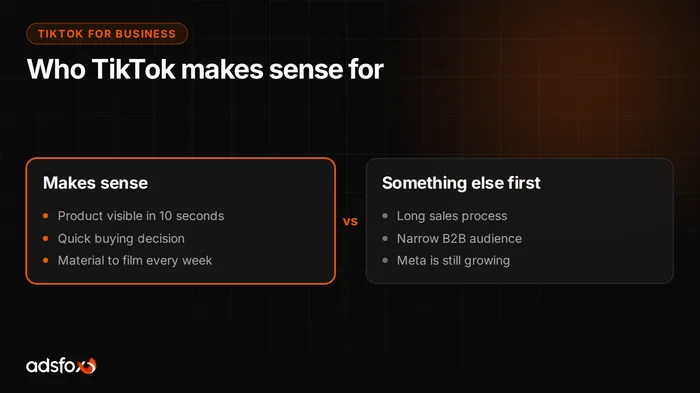
TikTok for business makes sense when the effect of a service or product can be shown in a video of ten or fifteen seconds, the audience is broad, and someone in the company will record content regularly. It makes no sense where you have a few hundred customers in the whole country, the buying decision is made in a bidding process or after a series of meetings, and your only assets are product photos on a white background. The channel is neither a fad nor a cure-all: it is one more place where you pay for attention and have to be able to count what came out of that attention.
Below you will find the criteria we apply to that decision, and the moment when it is more honest to tell a client: Meta Ads first, TikTok later.
What exactly is TikTok for business?
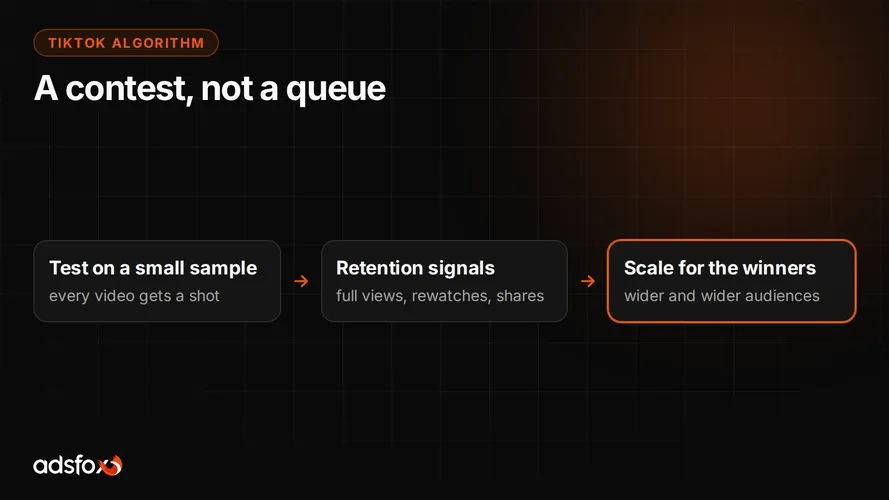
TikTok for business is a marketing channel where reach depends on the quality of a single video, not on the size of a follower base built up earlier. That sets it apart from classic social media, where organic reach was long built on the number of page fans.
In practice a business has two paths here, and they are worth keeping separate. The first is an organic profile: a business account, regular posts, comments, building recognition. The second is TikTok advertising, meaning paid campaigns in TikTok Ads Manager where you buy reach for a specific goal: traffic, a form, a purchase in your store.
These paths complement each other, but do not replace each other. An account without ads grows unpredictably and is hard to build a sales plan on. Ads without decent video burn through the budget fast, because in this format the creative decides the result, not the campaign settings.
Which businesses does TikTok make sense for?
In short: the ones where a change, an effect or a way of using the product shows on screen in a few seconds. From our experience, these have good odds:
- Services with a visible effect: beauty, medical aesthetics, dentistry, fitness, hair. A transformation, a treatment, a workout: that is natural video material.
- E-commerce with a product you can show in use: apparel, footwear, accessories, pet food, home gear.
- Courses, training and education: an expert explaining one specific thing in 30 seconds works better than a graphic with a list of modules.
- Restaurants and venues: restaurants, cafes, hotels, attractions. The interior and the plate sell better on video than in text.
- Businesses with a recognizable face: an owner, a trainer, a specialist who can talk to the camera.
The common denominator is a broad audience and a short path from seeing to acting. If your customer can buy or leave their details the same day, TikTok is worth a test. If six months and three meetings pass between first contact and a contract, this channel will rarely be the first choice.
Which businesses does TikTok make no sense for?
We ask clients this question as often as the previous one, because talking someone out of a channel is often cheaper than testing it. TikTok is usually not a good first choice when:
- The market is narrow and industrial: you sell machines for one specific technology and you have a few hundred customers nationwide. Reaching them precisely will cost more here than in Google Ads or LinkedIn.
- Sales go through bids and long negotiations: the decision is made by a committee, not by a person scrolling their phone in the evening.
- There is nobody to make the content: without a steady supply of new creative the campaign burns out fast, and outsourcing every video raises the real cost of the channel.
- The budget covers one channel: splitting it across two platforms usually means neither collects enough data to prove anything.
- The business does not measure lead quality: if you do not know which inquiries turn into sales, testing a new channel will not answer any business question.
The last point is the most important. A channel can only be judged when you know what success is. Without that, you are left with a debate about view counts.
What criteria decide whether to go on TikTok?
Instead of intuition, walk through a few questions and count the answers. The table below organizes what we ask on a consultation.
| Criterion | TikTok makes sense | TikTok can wait |
|---|---|---|
| Audience | broad, consumer | narrow, industrial, decision-makers |
| Product or service | visible effect, easy to show | abstract, needs explaining |
| Buying decision time | minutes to a few days | weeks or months |
| Video resources | someone in the company records regularly | no person and no material |
| Budget | enough for a second channel next to the main one | barely covers one channel |
| Measurement | leads land in a CRM and have a status | only the number of inquiries counts |
If you tick four or more items in the right-hand column, the decision is effectively made, and it is not a “yes.” If the left column dominates, a test with a budget and a deadline set in advance makes sense, rather than an open-ended “let’s try and see.”
When should you launch Meta Ads first?
Launch Meta Ads before TikTok when the business has one budget and needs inquiries in the current quarter. The reason is mundane: on Meta you find out faster which message, which offer and which audience actually buys. Those lessons carry over to TikTok later and shorten the groping-in-the-dark phase.
We have data on this from our own European campaigns. At a gym chain, the cost per contact fell from about $9 to $3 across 404 contacts collected. At a beauty salon, the campaign brought in 1,626 contacts at $2.10 each, and the following year more than 700 leads a month. At a medical aesthetics clinic, the share of qualified leads rose from 21.1% to 45.7%, and the cost per contact fell from about $8.50 to about $7.10. That last one is the most interesting: the CPL itself changed moderately, but inquiry quality more than doubled.
Once a foundation like that is working, adding TikTok is an extension, not a gamble. More about our work on that channel on our Facebook Ads agency page, and reference points for cost per lead by industry are in our CPL and ROAS benchmark.
How much does a meaningful TikTok Ads test cost?
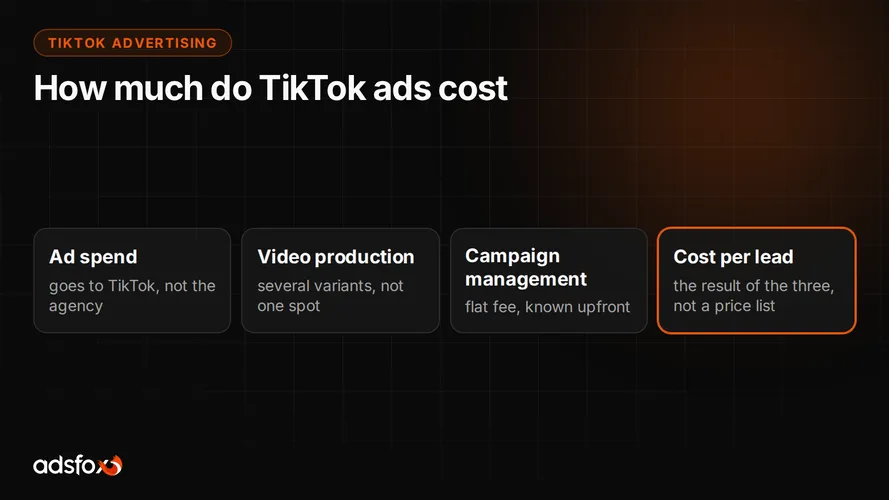
TikTok Ads Manager sets a minimum of $50 a day at the campaign level and $20 a day per ad group. But that is only one of three line items you have to count before launch.
- Media budget: the amount you buy reach with. Too low, and the campaign never leaves the learning phase and gives no answer.
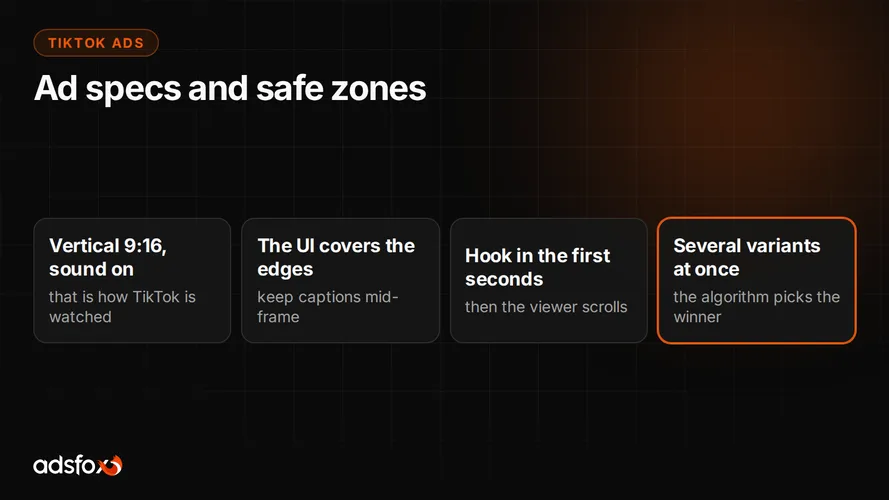
- Content production: several video versions at the start and regular top-ups, because creative wears out faster here than in other channels. Tips on preparing them are in our post on effective TikTok content.
- Time: a test measured in weeks, not days, plus your team’s time to handle the inquiries.
We deliberately do not quote a cost per lead range for TikTok here. We do not have a comparable sample for this platform like we have for campaigns in other channels, and making up a number so the post looks more concrete would be the worst possible favor when you are planning a budget.
How do you judge whether a TikTok test succeeded?
Judge the test by the same measures you use for any other channel. View and comment counts are not a business result, just a signal that the video landed with the audience.
Check above all:
- the cost of a valuable lead, not a contact in general,
- the share of inquiries qualified by your sales team,
- the comparison with your main channel over the same period,
- whether inquiries from TikTok fit the offer or are random,
- lessons about creative: which format and which message attracted the right people.
If after the test the cost of a valuable contact is clearly higher than in your main channel and there is no downward trend, the honest conclusion is to close the test or postpone it. That is a result too, and it is better to accept it after a few weeks than after a year.
How do you approach this decision in your business?
Start by answering three questions: can your product be seen on video, do you have someone to record it, and do you know which leads turn into sales. If the answer to all three is “yes,” a TikTok test is justified. If any of them is “no,” deal with that gap first, because a new channel will not fix it, only expose it.
At adsfox we have been in business since 2018, have served more than 350 clients across more than 20 industries, and are a Badged Meta Business Partner and Google Partner. That gives us a basis for comparison in this conversation: we know how similar businesses do in each channel, and when a new channel actually adds sales versus just scattering the budget.
Book a free marketing consultation: we will walk through your sales model, current campaigns and measurement, then tell you straight whether TikTok is a channel for you now or for later.