Website speed optimization: how to test your site, what really makes it faster, and when a rebuild costs less than more fixes. With our test of seven sites.

A business website has one job: turn someone searching for a service into an inquiry. This section collects everything that decides whether it does that: choosing the technology, deciding between a template and a custom build, what a website really costs, and what happens after launch. We write from our own projects, including a page-weight test of seven websites that settled the question of whether templates slow a site down. If you want us to build yours, see our web design agency page.
Website speed optimization: how to test your site, what really makes it faster, and when a rebuild costs less than more fixes. With our test of seven sites.
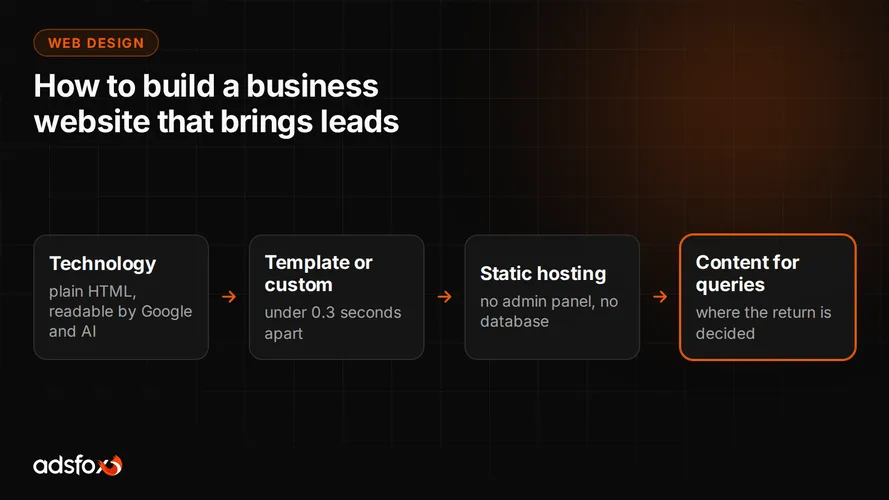
Web design projects usually start with a question about looks and should start with a question about inquiries. A service company's website is a sales tool: it needs to show up in Google for the phrases customers use, answer their question faster than the competition, and make contacting you effortless. Design serves that goal, not the other way around. In practice, four decisions made at the start determine the outcome: the technology, the build approach, the hosting, and who writes the content and how. Each has its own guide in this section, based on sites we have shipped rather than a rehash of what is already online.
The starting point is a four-step process: define the pages by the searches you want to win, write the content before the design, choose a technology that renders content as plain HTML, and set up measurement (GA4, call and form tracking) before launch. We explain why we build on Astro, a static site generator, rather than a heavy JavaScript framework for most service businesses; how "islands architecture" lets you add interactive elements (booking widgets, calculators) without slowing everything else down; and whether you need a CMS at all. A well-planned business site takes anywhere from 20 to several hundred hours of work depending on page count and scope, and most of that time goes into content, tracking, and SEO preparation rather than visual design.
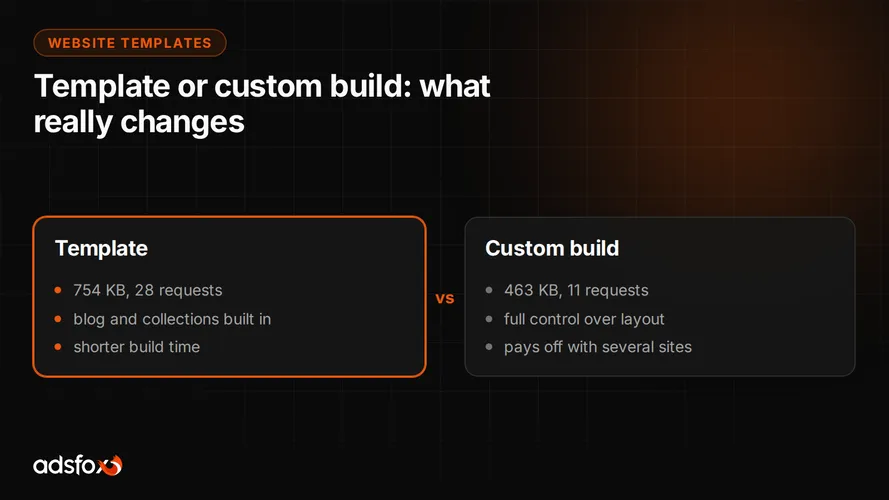
This question usually gets settled by gut feeling, so we measured it with Playwright. The result runs against intuition: five of our template-based sites averaged 754 KB per page, while a site built from scratch came in at 463 KB. On a typical mobile connection that difference is under three tenths of a second. In exchange, a good template gives you a working blog, content collections, image optimization, and a design system you do not have to invent. Custom design wins on control over layout, not on speed. Our practical conclusion: for most businesses the money saved on custom design is better spent on content and photography. There are exceptions (unusual layouts, complex web apps, strict brand systems), and we list the situations where we advise against a template.
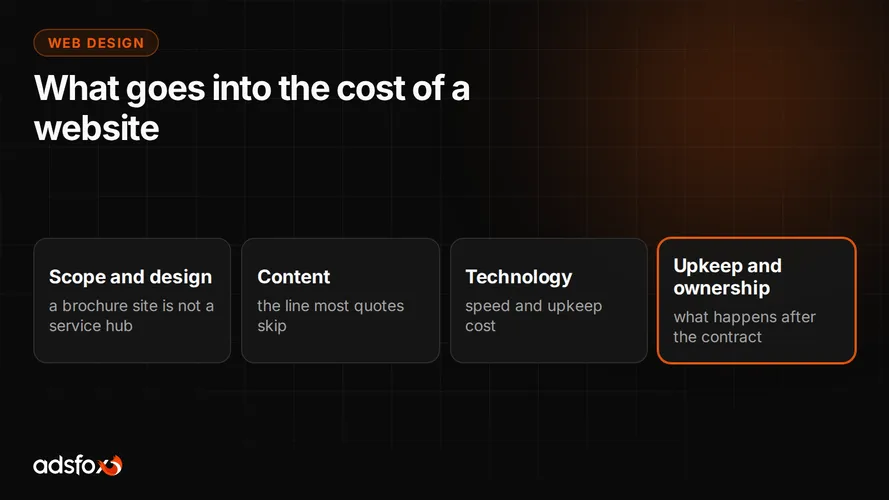
Quotes in the US range from a few hundred dollars for a DIY builder to $50,000 or more from a large agency, because "a website" describes a dozen different products. Instead of one number, break the invoice into parts: scope and design (how many pages, how many unique layouts), content (who writes it, whether photos are included), technology (template license, custom development, integrations), and maintenance after launch (hosting, updates, support). A typical five-to-ten-page service business website from a small agency lands between $3,000 and $10,000; a site with a blog, booking, and custom design runs higher. Two quotes with the same price can differ on all four components, so compare scope, not totals. The most important question before signing is what happens to the site if you stop working together. A website you cannot take with you is not yours.
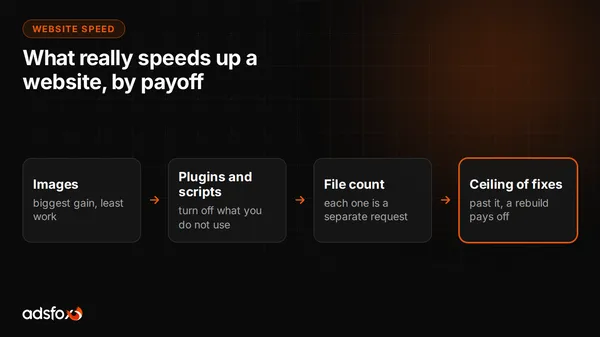
Website optimization pays off in this order: properly sized and compressed images, removing unnecessary plugins and third-party scripts, reducing the number of separate files the browser has to download, and only then server-side tweaks. Those steps have a ceiling, though. They will not change the fact that a site which builds its content in the browser with JavaScript will always show a blank screen first. We explain how to recognize that point and when a rebuild is cheaper than another caching plugin. There is also a simpler test than PageSpeed Insights: open your site on a phone on a weak signal and count how many seconds pass before you see text instead of a loading spinner.
Astro is a static site generator that sends finished HTML to the browser instead of assembling the page with JavaScript on the visitor's device. The consequences are practical: the browser shows content immediately, search engines and AI models see the text on the first request, and the absence of a database and admin login removes the most common way sites get hacked, along with the weekly plugin patching. In our measurement, a from-scratch Astro site weighed 463 KB with 11 server requests, compared with 39.3 MB and 300 requests for an award-winning animation-heavy site. We build all client sites, and the site you are reading, on Astro, so you can check the result yourself in PageSpeed Insights.
Security is usually considered after an incident, but it is decided when the technology is chosen. A large CMS with an admin panel and dozens of plugins is an attack surface someone has to actively guard: update, check theme compatibility, and fix what broke in the process. A small business rarely has that person on staff, so the work either costs a monthly retainer or does not happen at all. A static site has no login page and no database to overwrite, so the most common attack vector disappears with them, and maintenance shrinks to publishing content. We list the questions to ask a vendor about maintenance before you sign anything.
The way people look for services is changing. A growing share of buyers ask ChatGPT, Perplexity, or Google's AI Overview for recommendations before they ever click a result. Those models read text, not visuals, so a site that loads its content after JavaScript runs, or keeps its offer inside images, is largely invisible to them. This is the practical reason why website technology is no longer only a technical decision. How to take advantage of that is covered in our SEO and generative engine optimization guides.
These guides describe how to build a website well. If you would rather have someone do it for you, that is what we do every day: see our web design agency page. We build on Astro, business and service websites only (no online stores), and we treat the site as part of your marketing system rather than a project that ends at launch. Want to discuss a specific case? Book a free consultation and we will tell you plainly whether a template will do or you need a custom build.
Most five-to-ten-page service business websites from a small agency cost $3,000 to $10,000. The price depends on four components: scope (number of pages), content (who writes it), technology, and maintenance after launch. Compare scope, not totals, and ask what happens to the site if you part ways.
For service businesses, a static site generator such as Astro works best: it serves finished HTML, so search engines and AI models see the content without running JavaScript, and there are no weekly plugin updates. WordPress is fine when you need a large editorial team, and React-style frameworks make sense when the site is really an application.
For most projects a template is enough. In our measurement, the weight difference between a template site and a from-scratch build was under three tenths of a second of load time, and the template came with a blog, content collections, and image optimization. Custom design buys control over layout, not speed.
A well-planned business site takes from about 20 to several hundred hours depending on page count and scope. Time goes into content, conversion tracking, structured data, and SEO and GEO preparation, not into the visual design. Follow-up sites built on a documented process take a fraction of that.
Yes on both counts. Google uses Core Web Vitals as a ranking factor, and visitors on mobile abandon slow pages before they see the offer. Images, third-party scripts, and JavaScript-rendered content are the usual causes; a static build fixes the last one permanently.