How Much Does a Business Website Cost?
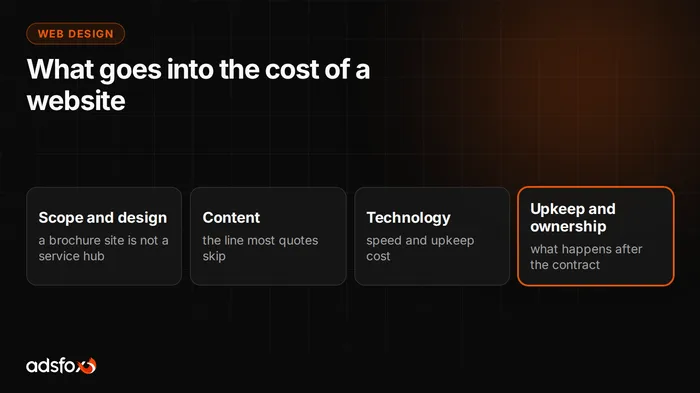
The cost of a business website depends on four components: scope (how many pages and what for), content (who writes it), technology (what it runs on and how fast) and upkeep after launch. We will not give you a single number, because any number without scope is misleading. The wide spread of quotes on the market comes from the fact that “a website” means ten different products. Instead, we break the bill into parts so you know what you are paying for and which savings come back to bite you.
What makes up the price of a website?
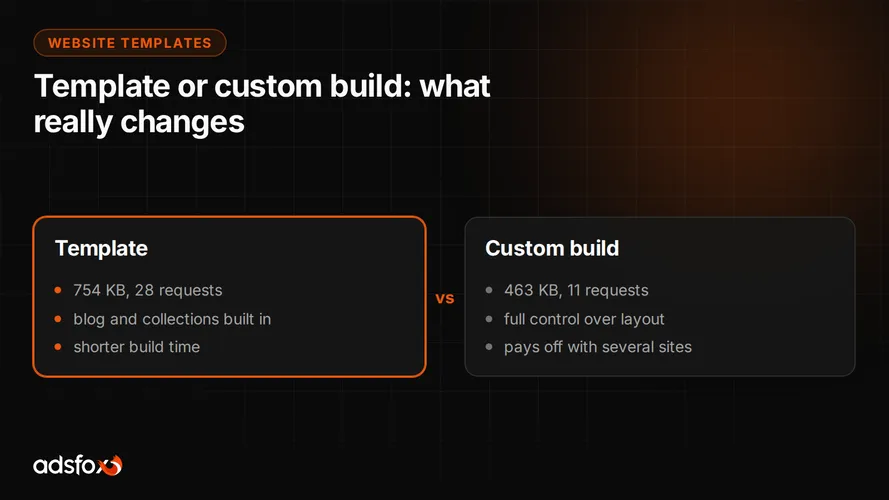
Scope and design. A brochure site with a few pages is different work from a site with twenty service pages, a blog and online quotes. Visual design is a separate line: a template adapted to your brand costs less than a design from scratch, and it is often perfectly sufficient.
Content. The most commonly skipped line in quotes and the most common cause of delays. Someone has to write the copy: about the company, about each service, for the home page. If the vendor assumes “the client supplies the content,” the site stalls for months or launches with copy that does not sell. Good content is research and writing work: for the customer, for search queries, for conversion.
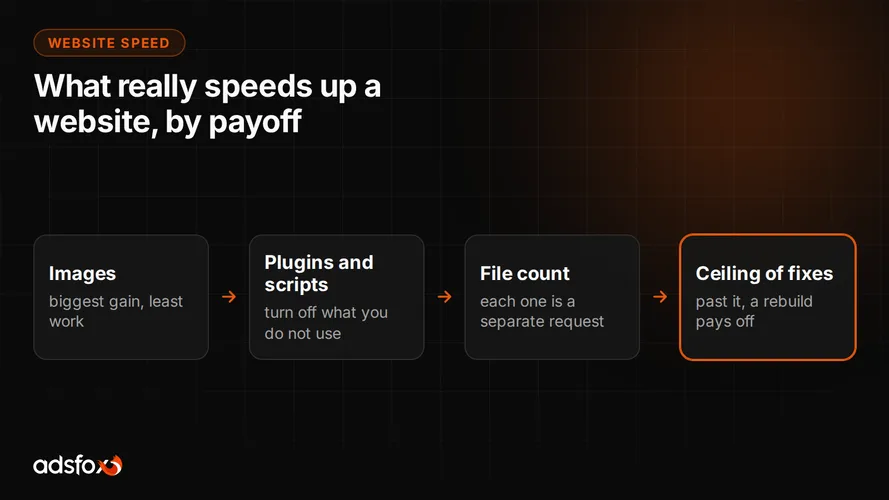
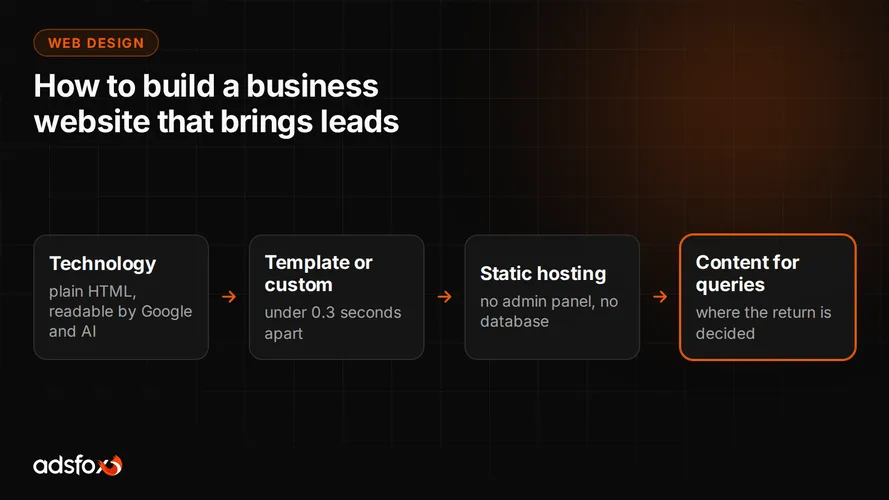
Technology. What the site is built on decides its speed, security and upkeep costs. A site on a heavy system with dozens of plugins needs constant updates and can slow down just by existing. Static sites (we build in Astro) are fast by nature and have nothing to patch every week. Speed is not a luxury: a slow site loses visitors before they read anything and converts paid ad traffic worse, traffic you are paying for.
Upkeep and growth. Hosting, domain, backups, fixes, content changes. Ask about this before the contract: what is included, what costs extra, what an hour of changes costs and, most important, what happens to the site when the engagement ends. A site you cannot take with you is not yours.
Why do quotes differ several times over?
Because you are comparing products that share only a name. On one side: a template, copy from the client, no tracking, hosting bundled in a package you do not control. On the other: a design built for the brand, content written for search queries and conversion, event tracking from day one, technology without maintenance debt, and everything owned by you.
Both proposals are called “a business website.” The difference shows up after launch: the first site exists, the second one works. Before you compare numbers, make both vendors list exactly what is in scope, especially who writes the content, what the tracking looks like and who owns what.
Where not to save: three items that come back to bite you
Content. A site whose “About us” says “we are a young, dynamic team” sells nothing. Content is the reason the site exists at all: it should answer the customer’s questions and lead them to contact you. It is also the foundation of visibility in Google and in AI answers, which we cover in SEO and AI search optimization.
Speed. Users do not wait. A slow site loses twice: once when a person leaves before the page loads, and again when you pay for campaign traffic that bounces off the loading screen. The PageSpeed score is one of the first things to ask a vendor about, along with examples of live sites they have built.
Tracking. A site with no defined events (form, call, purchase) is a site you know nothing about. You cannot tell whether it works, and you cannot feed ad campaigns with conversion signals. Tracking is set up during the build, because bolting it on later tends to leave holes.
Website and marketing: a bill that does not end at launch
A website does not live in a vacuum. Its real cost and real value depend on what happens after launch: does it attract search traffic, does it convert campaign traffic, does the content keep growing. That is why we increasingly bundle the build with SEO in one package: the site is built for search queries and tracking from the start, and then developed systematically. We describe that model on our web design agency page.
If you plan the site mainly as the backbone of ad campaigns, count the other side of the bill too: a better-converting site lowers your customer acquisition cost in every channel. We collected reference points for those costs in our benchmark of 20 campaigns across 11 industries.
How to compare proposals: a checklist
Before deciding, ask every vendor these questions:
- What exactly is in scope: how many pages, custom design or template?
- Who writes the content and based on what?
- What will the speed score be, and can I see live sites you have built?
- What about tracking: which events will be measured from launch?
- What does upkeep cost and what does it cover?
- Who owns the site, domain and hosting after the engagement ends?
A vendor who answers all six specifically will save you more than the cheapest proposal.
Want a quote with those answers written in up front? Book a free consultation. We will walk through your needs and tell you plainly what scope makes sense for your company and what is not worth paying for.